Eric O’Connor (CF-L4), Katie Hayes (CF-L4), Katie Hogan (CF-L3), and Jocelyn Rylee (CF-L4) sat down for a live conversation about the realities of coaching — what’s working, what’s not, and what separates good coaches from truly great ones. Here’s what they had to say.
If you’d rather watch a recording of the livestream, you can do that here.
What’s one piece of advice you wish you’d gotten earlier in your coaching career?
Katie Hayes: Trust the process and don’t skip steps — and with that comes being OK making mistakes. When I started, I thought I had to be able to do what more experienced coaches could do, or what good was I to people? But it doesn’t work that way. You’re going to mess it up a lot. And that’s OK. If you build rapport, if people have a good time in your class, they’ll keep coming back — and that allows you to keep pushing the needle forward.
Jocelyn Rylee: I started my affiliate in 2008, when I was young and overconfident — which is honestly an asset in the beginning. But what I’ve learned over the years is the importance of being willing to acknowledge when something isn’t working and pivoting. There’s a delicate balance between holding the line as a leader and actually listening to people. I learned those lessons through a million mistakes.
Katie Hogan: It’s OK to not always have the answer. Be curious, be willing to try things. Sometimes you look at an athlete and honestly say, “I don’t know why I can’t fix this, but let’s stay curious and revisit it.” Let it be a journey instead of performing certainty you don’t have.
Joe Alexander: Get good at the fundamentals. My security blanket when I was starting was knowledge. I wanted to nuke topics, use advanced terminology, and demonstrate how much I knew. But watching great coaches later, I realized how far you can take things that seem pedestrian. The best ones aren’t doing fancy things. They’re crushing the basics. And the novice’s curse is real: you want to rush past fundamentals and do fancy things. Most of us have to fall on our faces and figure that out the hard way.
Do you write lesson plans?
Jocelyn: I’ve been coaching my affiliates for years, still on the floor three to five days a week, and it’s easy to roll up with a class plan in my head. And I can run a good class that way. But I was inspired by seeing another coach’s notebook full of pen-to-paper lesson plans — and I went back to it. I can run a good class with a plan in my head. I can run a great class with preparation.
Katie Hogan: Yes. Even in my small garage affiliate with five athletes, if I hadn’t organized with timestamps — when the workout needs to start, when I need to transition people — it would’ve been complete madness. And any time I’m in a less familiar setting — a seminar or a different gym — I’m absolutely writing a lesson plan. There are just too many variables.
Eric: I do. I type mine because my handwriting is devastating. And I think coaches should do both: Use what’s in CAP (CrossFit Affiliate Programming) and other programs for ideas, but also develop their own warm-ups, progressions, and timelines. That is coach development. If you’re an affiliate owner looking for a low-barrier way to develop your coaches, let them write the warm-ups. That’s a starting point right there.
Jocelyn: And if you’re trying to build a team of coaches, give them some free rein. Let them bring their personality and expertise. You want members coming to a coach’s class not just because of the time slot, but because of what they get from that specific person.
What’s your approach to scaling, especially for tricky situations?
Jocelyn: I had an athlete recovering from pec surgery who still wanted to be in the gym. So, we got creative — rigging things up and figuring out how to keep him working out with as much variety as possible without overtraining his other shoulder. You just look around the room and problem-solve. And sometimes people come in feeling like they need to apologize for needing to scale. I tell them, “This is my favorite part of my day. If everyone just knew what they were doing, there’d be nothing for me to do here.”
Katie Hogan: Zero in on what you want to preserve. We talk about preserving the stimulus for the whole workout, but do it for each movement, too. If we’re working a rope-climb progression and someone has arthritic hands, ask: What is it about this skill that I want to preserve today? Is it grip? Is it the footwork? Is it just the challenge of being off the ground? Once you know what you want to preserve, you can get creative about how to get there using different equipment and setups.
Eric: And the coach needs to be the coach. I’ve seen coaches present scaling options and then just let athletes pick for themselves. That’s not coaching — that’s a buffet. Especially with beginners, you need to tell them, “This is what we’re doing today.” Would you give a one-on-one client five options and let them choose? No. Just because there are other people in the room doesn’t change the standard of service. We’re coaching individuals in a group, not a group of individuals.
Katie Hayes: Scale for progress, not participation. And if you notice athletes plateauing, it might not be their fault. It might be yours. Are you providing enough variance? Enough challenge? Beginners will make progress just from showing up and doing functional movements. The harder group to coach is the intermediate and advanced athletes. That’s where scaling has to be more specific and more intentional.
How do you assess an athlete’s status on any given day before you coach them?
Katie Hogan: It’s a deliberate check-in, not just a casual, “How are you?” Eye contact. Genuine questions. “How’s your body doing? How are you feeling from yesterday’s workout?” I do the same workouts my athletes do, usually a day or two ahead, so I can give them a preview of what they’ll be feeling. And as we move into scaling decisions, you can pull people aside: “Today is not the day for heavy back squats. I know you haven’t been sleeping. Let’s just move today and check in after set three.”
Jocelyn: Watch the nonverbals as people walk in. Eyes down, body language off — that’s a signal right there. And watch their reaction to the whiteboard. That can tell you a lot before you even say a word.
Katie Hayes: I learned this the hard way. I saw an athlete warming up with just a bar and the 10s, and I invented a story in my head: she’s sandbagging. So, I got in there to motivate her, tried to get her to add weight, and she looked at me with tears in her eyes and said, “I can’t try harder at one more thing in my life right now.” That one stayed with me. I was coaching the workout, not the person. Ask more questions before you decide what’s right for someone else. As a mentor of mine always says: Ask one more question.
Does having prewritten Rx’d, intermediate, and beginner options — like what’s in CAP — help or hinder coach development?
Eric: Fine as a guideline, as a set point — but coaches have to know there’s a lot of in between, and it has to be more specific for most people. Think of those options as potential variance in your scaling, not a box to put people in. They can help you avoid redundancy, too. Maybe the last two times you scaled pull-ups the same way, and now you can do something different.
Katie Hayes: It can hinder if we’re not applying critical thinking on top of it. Don’t let it be the only guide. Let it start your thinking process rather than cement you into it. It’s a guide, not a rule.
Do you have a system for building warm-ups and progressions?
Joe: Yes, start with the common movement themes we teach in the course: midline stabilization, core-to-extremity, balance across the frontal plane, posterior chain engagement, sound hip function, active shoulder, full range of motion, and effective stance and grip. You can group and sequence those themes to build a progression for almost any movement. The goal is to be able to distill it down to three steps that capture the essence of what the movement actually is, and then make sure those three steps contain the critical ingredients that give you the majority of the motor pattern.
Jocelyn: When I’m feeling stagnant or need to freshen things up, I learn from a different coach. Drop into another affiliate, take a class from a subject-matter expert, and get off my island. I’ve taken adult gymnastics classes. I’ve done a learn-to-row course. Inspiration from others is huge for me. You can’t understate it: sometimes getting better at coaching just means ripping off other coaches. And that’s okay.
Time caps: useful tool or coaching crutch?
Katie Hayes: I’m not a fan. In general, a time cap is lazy — it lets coaches off the hook from doing the real work of scaling appropriately and preserving the stimulus. The coach gets to say, “Well, when the clock hits 20 minutes, we’re all done.” That takes too much of the actual coaching out of the equation. There are outliers — something like Murph, yeah, I might cut someone off at an hour and a half — but we don’t use them as a rule.
Jocelyn: Same. I think it can become a get-out-of-jail-free card. If you’re relying on time caps all the time, you’re not developing the skill of understanding the workout well enough to scale it so people can actually hit the stimulus. If you use them regularly, start by cutting that in half. Then work it down from there.
Katie Hogan: I’ll go devil’s advocate. I view them as tools, and like any tool, you can use them well or poorly. A time cap can create useful urgency — if someone might have coasted through the last few rounds, the clock closing in can bring out more effort and intensity. It can also be a learning moment: we either win or we learn. If someone hits the cap, there’s information in that. What goes in their logbook today about their capacity?
Joe: The question is always: What’s the intention? Is there a thoughtful reason behind the cap, or are you using it as a stopgap for not having communicated the stimulus and scaling clearly enough? Those are two very different things. The best coaches — and the best gyms — are the ones who get the stimulus communication right in the first place and use every tool with that intention in mind.
This conversation was recorded live as part of a CrossFit Education panel featuring coaches from the upcoming Owners and Coaches Conference in San Jose, California, July 22-23, 2026. Want to join us? You can still get tickets here.
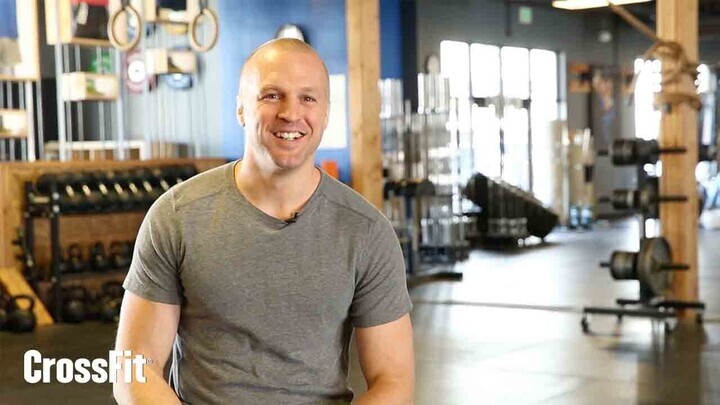 Eric O’Connor is a Content Developer and Seminar Staff Flowmaster for CrossFit’s Education Department and the co-creator of the former CrossFit Competitor’s Course. He has led over 400 seminars and has over a decade of experience coaching at a CrossFit affiliate. He is a