The Frontal Plane: CrossFit’s Hidden Efficiency Standard
People love to throw around complex terms in fitness. Frontal plane, sagittal plane, transverse plane; it can sound like unnecessary jargon. But here’s the truth: understanding the frontal plane will make you more efficient in virtually every movement you do in CrossFit.
And efficiency isn’t just about going faster. It’s about being able to complete lifts you couldn’t before, conserving energy during workouts, and avoiding the compensations that lead to missed lifts and injury.
If you’d rather watch and listen to this conversation, you can do that here.
You can also find our other information on common movement themes here:
- Midline Stabilization
- Core to Extremity
- Posterior Chain Engagement
- Active Shoulders
- Full Range of Motion
- Effective Stance and Grip (Coming soon)
- Sound Hip Function (Coming soon)
What Is the Frontal Plane?
Think of an imaginary line running through your body from your ear, straight down through the middle of your body, to your midfoot. This line divides your body into two halves: front and back. That’s your frontal plane.
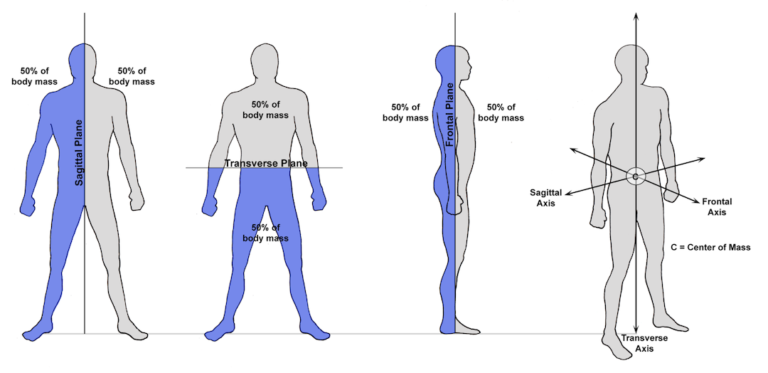
Simple enough, right? But here’s why it matters: when you’re moving objects — barbells, dumbbells, your own bodyweight — those objects should travel as close to this line as possible.
The Grocery Bag Test
Here’s the simplest way to understand why the frontal plane matters.
Hold a bag of groceries tight to your chest. Pretty light, right? Now hold that same bag of groceries at arm’s length away from your body. Suddenly, it feels much heavier.
The weight didn’t change. What changed is how far the load deviated from your frontal plane. The farther an object moves away from that centerline, the harder your body has to work to control it.
Or think about pulling a bag of dog food off the ground. Is it easier when the bag is between your feet or when you’re reaching into the trunk of your car? The trunk scenario is harder because the load is far from your frontal plane.
This same principle applies to every lift you do.
Overhead Movements: The Straight Line Rule
When you press a barbell overhead, whether it’s a strict press, push press, or jerk, you want that bar traveling in a perfectly vertical line.
To accomplish this, you need to move your body out of the way. Pull your chin back. Navigate around your face. Watch the bar travel straight up, not forward in an arc.
The same applies to any overhead movement:
Every time the bar drifts forward away from your frontal plane, you’re making the lift exponentially harder. You’re also setting yourself up to miss the lift as the weight increases.
Pulling Movements: Keep It Close
When you’re doing a hang power clean, the bar should travel up your body, staying tight to your torso. You accomplish this by fully extending your hips while keeping your elbows high and outside.
If the bar drifts away from your body, you lose efficiency. You also lose the ability to receive it properly in the front rack position.
This applies to dumbbell variations, too. Ever see someone do what we jokingly call a “dumbbell hang power curl?” The dumbbells swing away from the body in an arc, and the athlete ends up curling them rather than pulling them efficiently. The fix? Bring your elbows up and back. Keep those dumbbells traveling close to your body, right up the frontal plane.
Lifting From the Floor
Whether you’re deadlifting, snatching, or cleaning from the floor, the frontal plane is your guide for bar path.
A key checkpoint: Are you clearing your knees to allow the bar to travel straight up? If your knees are in the way, the bar has to travel forward around them, deviating from the frontal plane and making the lift less efficient.
When you execute these lifts properly, the bar travels in a straight vertical line from the floor to wherever it needs to finish.
The Connection to Foot Pressure
Here’s where frontal-plane control connects to another movement theme you’ve probably heard about: posterior-chain engagement and foot pressure.
The way you control movement around the frontal plane for most lifts is through proper foot engagement — ideally with your weight shifted slightly toward your heels to counteract the forward pull of the load.
This is especially critical in dynamic movements like Olympic lifts. If you shift forward onto the balls of your feet too early in a clean, snatch, push press, or jerk, the bar will drift forward out of the frontal plane.
We’re talking about inches, even fractions of inches, in foot position, but these small changes have massive effects on bar path. When you stay rooted in your heels as long as possible, you’ll experience those lifts where it feels like the bar “came back to you” instead of you having to chase it.
The bar lands in a solid position overhead or in the rack, and you think, “That felt perfect.” That’s proper frontal plane management.
Why Every Inch Matters
At 50% of your max weight, you might be able to complete a lift even with poor bar path. You’re strong enough to muscle through the inefficiency. The bar loops forward, but you make it work.
But as you approach 80% or 90% of your max, that same inefficient pattern will cause you to miss the lift. At heavier loads, you need exact precision. The bar path has to be tight.
This is why you should practice proper frontal plane control even at light weights. The patterns you groove at 50% are the patterns you’ll default to at 90%. If you’re inefficient when it’s light, you’ll miss lifts when it’s heavy.
Finding the Root Cause
When you see bar path problems, don’t just focus on the bar; look for the root cause in the movement.
Bar loops forward on a snatch or clean?
Maybe you’re shifting onto your toes too early. The fix isn’t just “keep the bar close,” it’s “stay in your heels longer.”
Bar drifts forward on a push press?
Maybe you’re pushing your hips too far back, causing excessive torso inclination. The fix isn’t “chin back,” it’s “hips straight down in the dip.”
Bar rolls forward in a front squat?
Maybe you have what we call an “immature squat pattern,” excessive forward torso lean. Cueing “chest up” won’t work if you physically can’t get your chest up. Instead, try bringing your hips closer to your ankles to help your torso get more vertical.
The frontal plane is the reference point, but the solution often lies in fixing the underlying movement fault.
Frontal Plane in Gymnastics
The frontal plane isn’t just for barbell movements; it applies to gymnastics work too.
When you’re hanging from a pull-up bar, imagine the frontal plane as a line running from the bar straight down through your body to your feet. Efficient kipping or butterfly pull-ups minimize horizontal swing. You’re managing your body’s movement to stay close to that vertical line.
Yes, you’ll deviate from the frontal plane during the movement as that’s part of the mechanics of creating momentum. But your points of balance should always start and finish in the frontal plane.
Take a bar muscle-up. You start hanging in the frontal plane. As you kip and pull, you deviate from that plane to generate momentum. But you want to finish back in the frontal plane, in a stable support position above the bar.
If you over-rotate past the frontal plane, you lose balance and have to fight to stabilize. The most efficient muscle-ups return to the frontal plane at the top.
The same principle applies to Olympic lifts: where do you want that bar to finish overhead? In the frontal plane. Athletes who are stumbling around the platform after a lift haven’t found the frontal plane yet. When they do, when the bar locks out directly over their center of mass, they’re balanced and stable.
The Efficiency Standard
At its core, the frontal plane is about efficiency. It’s about making every movement as mechanically advantageous as possible.
When you deviate from the frontal plane, whether by a small or large degree, you make the lift harder. You waste energy. You reduce your capacity to handle heavier loads. In some cases, you make the movement impossible to complete.
Think of the frontal plane as an invisible standard running through every movement you do.
Small deviations: The lift feels harder than it should, you burn more energy, and you might miss at higher percentages.
Large deviations: The lift becomes mechanically impossible, or you have to use compensation patterns that increase injury risk.
What To Focus On
Next time you’re training:
Overhead movements:
- Watch the bar travel straight up.
- Pull your chin back and navigate around your face.
- Don’t let the bar drift forward in an arc.
Pulling movements (cleans, snatches):
- Keep the bar close to your body.
- Elbows high and outside.
- Stay in your heels to prevent forward drift.
- Clear your knees to allow vertical bar travel.
Gymnastics movements:
- Minimize horizontal swing.
- Start balanced in the frontal plane.
- Finish balanced in the frontal plane.
Root cause analysis:
- If the bar is drifting, what’s causing it?
- Check foot pressure first.
- Look at hip and torso position.
- Fix the source, not just the symptom.
The frontal plane might sound like technical jargon, but it’s really just a simple concept: keep loads close to the center of your body, and you’ll be more efficient.
A bag of groceries is light when it’s close to your chest. A barbell is easier to move when it travels straight up rather than looping forward. Your body is easier to control when you’re balanced around that centerline.
Every movement in CrossFit has a relationship with the frontal plane. Understanding this relationship and training with it in mind will make you more efficient, more capable of handling heavy loads, and more likely to successfully complete the movements you’re working on.
About the Author
 Stephane Rochet is a Senior Content Writer for CrossFit. He has worked as a Flowmaster on the CrossFit Seminar Staff and has over 15 years of experience as a collegiate/tactical strength and conditioning coach. He is a Certified CrossFit Trainer (CF-L3) and trains athletes in his garage.