So far, we’ve covered prepping for the Level 1 and what to expect during the first morning, the first afternoon, and the second morning of the course. Today, we’re going to dig in to the final session, Sunday afternoon.
There is a particular quality to the last few hours of a Level 1 that is hard to name and easy to feel. The pace hasn’t changed. The trainers are as precise and present as they were Saturday morning. But something has shifted in the underlying emotion because everyone in the room has begun to understand the adventure is coming to a close soon. The nervousness of Saturday morning seems so far away now, and yet the weekend has flown by. Everyone is immersed in learning, enjoying the process, and wishing time would slow down.
The GHD: A Machine Most People Ignore
The afternoon opens with the GHD (glute-ham developer) lecture, and it begins with an acknowledgment that most gyms don’t even have a GHD, and if they do, most people walk past this daunting piece of equipment without ever learning what it actually does. As is our custom, CrossFit bucked this trend and sought to master the GHD for the myriad of benefits it offers. The GHD has become a valuable tool we use to train many qualities simultaneously, all of which transfer very well to other aspects of CrossFit.
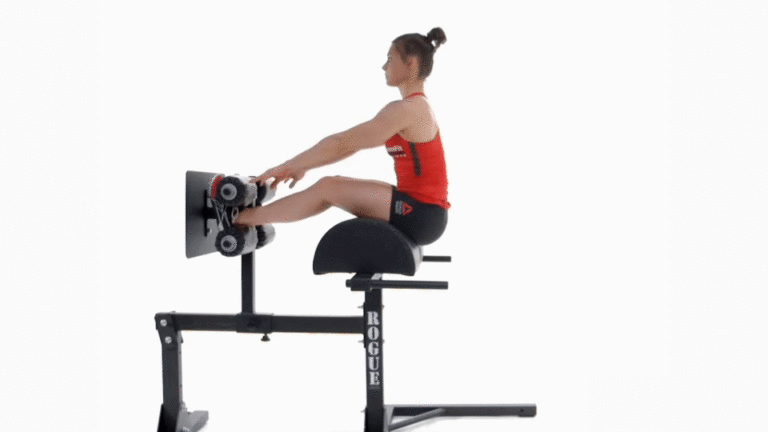
The GHD is big and bulky, but not complicated. It is designed to develop the posterior chain — the glutes, hamstrings, and spinal erectors — along with the hip flexors and the deep core musculature.
- The hip extension develops the capacity to open the hip aggressively and hold the spine neutral while doing it — the same demand made by every pull, every squat, every Olympic lift.
- The back extension teaches deliberate vertebral control, unfurling one segment at a time from flexion back to neutral.
- The hip and back extension combines both, developing great midline and hip strength and control. These are not accessory exercises in the way a bicep curl is an accessory. They are foundational capacities disguised as simple movements.
Then comes the GHD sit-up, and this is where core training takes a turn some people don’t expect. The crunch displaced the GHD-type sit-up from mainstream fitness decades ago, driven by claims that the hip flexors — not the abs — were doing the work, and that this was both ineffective and dangerous. The lecture examines that argument and finds it wanting on both counts.
The GHD sit-up takes the trunk from slight hyperextension to full flexion — a range of motion no crunch can match. The abdominals, far from being bypassed, work powerfully throughout — not as the primary movers, but in the way they work best: isometrically stabilizing the spine against forces that would otherwise compromise it.
The trainers make the point with characteristic directness: The most functional and developmental contractions of the trunk are isometric stabilization contractions, not flexion contractions. The GHD sit-up, the L-sit, the overhead squat — these are what that looks like in practice.
The dosing conversation that follows is equally important. The GHD sit-up is notorious for producing debilitating soreness in people who do too many too soon, even very fit people who have no trouble with demanding workouts. The lecture is explicit about this: start small, progress deliberately, assess the response before adding volume. The principle is the same one running beneath the entire weekend — mechanics first, then consistency, then intensity — applied now to a single movement on a specific piece of equipment.
The Muscle-Up Breakout: Getting Above the Rings
There is no lecture for the muscle-up. Rather, there is a brief introduction, and then everyone is on their feet. This is deliberate. The muscle-up sits in a different category from the nine foundational movements — it is aspirational rather than foundational, a benchmark of gymnastics capacity rather than a prerequisite for everything else. The breakout is less about achieving the movement and more about understanding its structure, so when participants return to their gyms, and their athletes start asking about it, they know what they’re looking at and where to start.
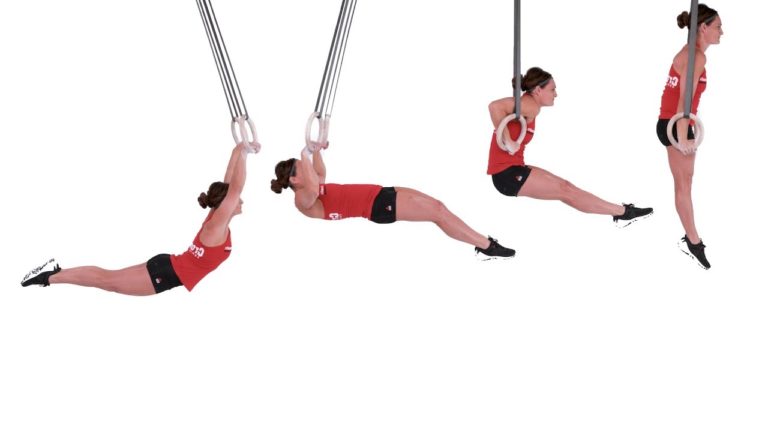
The muscle-up is three things joined together: a pull, a transition, and a dip.
The pull is a chest-to-ring pull-up, close-grip, with the false grip that allows the wrist to stay above the ring and makes the transition possible.
The transition is the part that defeats most people — the moment where the body passes through the rings, and the athlete arrives in the support position above them, ready to press out.
The dip finishes the movement.
Each piece has its own prerequisites, common failures, and progressions. A trainer needs to be able to see where the breakdown is happening — in the pull, the transition, and the dip — because the fix depends on the problem.
The breakout works through the progressions on low rings: ring support holds that build the stability needed for the dip and the catch, ring rows with a false grip that develop pulling strength with proper mechanics, and feet-assisted muscle-ups that allow the transition to be felt and practiced before strength is sufficient for an unassisted rep.
For some people in the room, a muscle-up happens. For others, the progressions reveal exactly what needs to be developed before they can get one. Both outcomes are instructive, and both are wins.
The Snatch Breakout: The World’s Fastest Lift, Taught Slowly
If the muscle-up breakout is about aspiration, the snatch breakout is about simplifying.
The snatch — one continuous movement from the floor to overhead, receiving the load in a full overhead squat — is widely considered the most technically demanding lift in weightlifting. It requires a wide grip, an aggressive and precise hip extension, a bar path that stays very close to the body, and a receiving position — the overhead squat — that demands everything: shoulder stability, midline control, and mobility at the ankles, hips, and shoulders. Done well, it is one of the most powerful movements in sport. Done poorly, it is a bar arcing out in front of a confused athlete who has no idea why it feels so awkward. The thing is, with a proper progression and effective cueing, everyone can learn how to snatch relatively quickly.
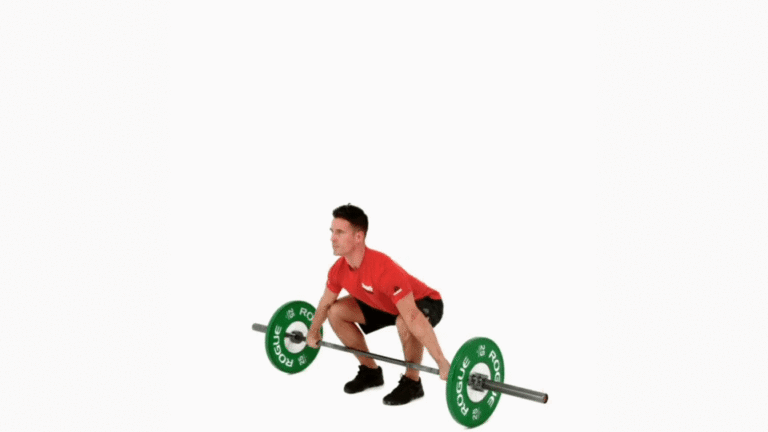
The breakout begins with a PVC pipe and the Burgener Warm-Up, a teaching progression developed by Olympic lifting coach Mike Burgener that has become a staple of CrossFit coaching.
It breaks the snatch into its components — the down-finish, the muscle snatch, the landing positions — and drills each one in isolation before connecting them.
The trainer calls out each piece: establish the grip, set the feet, hinge to the hang position, JUMP, pull the elbows high and outside, fast feet, fast hands. The room moves in unison, with PVC flying overhead, then resetting at the hips. The cues and corrections come fast.
The value of learning with a PVC pipe is that many reps can be done in succession, and the athletes improve at a rapid rate. The snatch breakout is a great example of how to teach anything complex: take the skill apart, drill each component until it is mastered, and then reassemble the parts. This is the same lesson the entire weekend has been delivering from different angles. CrossFit is elite at teaching movement.
The Programming Lecture: Putting It All Together
After the breakouts, the group gathers for the last lecture of the weekend: programming. It is the one that answers the question everyone has been circling for two days without quite asking: Now that I understand what CrossFit is, how do I actually do it?
The lecture begins with the prescription everyone learned on Day 1 — constantly varied functional movements executed at high intensity — and unpacks what that means for a coach sitting down to build a week of training.
Variance is not randomness. A hopper produces variety; a programmer produces intentional stimulus.
The goal is to move through all three modalities — gymnastics, weightlifting, and metabolic conditioning — across time domains that develop all three energy pathways, using functional movements that develop all ten general physical skills, without repeating patterns so frequently that adaptation stalls. That is the map. The art is in navigating it.
The lecture introduces the workout structures participants have become familiar with throughout the weekend — for time, for rounds, for load — and explains why each one has a specific intent that produces different stimuli.
Short workouts tax the phosphagen and glycolytic pathways, developing speed and power.
Long workouts develop aerobic capacity.
Single-modality days allow for focused skill development and heavier loading.
Couplets and triplets — two and three movements combined — elegantly produce the metabolic demand that is a hallmark of CrossFit’s conditioning effect.
Each format has a purpose, and a well-designed week uses all of them.
There is also a conversation about what programming cannot do: It cannot rush the development of an athlete who hasn’t yet established the movement mechanics to train at higher intensity. Scaling is critical. A coach’s job is not just to program workouts, but to understand where each athlete is in their development and meet them there. The wise words of a top CrossFit trainer are regularly repeated here: “Scale more, more often.” It’s one of the keys to a lifetime of steady, safe, and healthy progress.
The Final Q&A: The Questions That Stayed Overnight
The last Q&A of the weekend is different from the one that kicked off the day. That one was about clarity — filling in gaps, tightening understanding. This one is about something harder to define. The questions come from a different place now, less about what was said in the lectures and more about what people are going to do with the information.
Someone asks how to handle the athlete who only wants to do what they’re already good at. The answer circles back to the hopper — and to the courage it takes, as a coach, to program what your athletes need rather than what they prefer.
Someone asks about the gap between knowing a movement and being able to teach it. The answer is honest: That gap closes with repetition, observation, feedback, and time.
Someone else asks, more quietly, whether they’re ready — ready to coach, ready to hold the standard, ready to take what they’ve learned here into a gym full of people who are counting on them. The trainer pauses before answering. Readiness isn’t a threshold you cross, they say. It’s a direction you commit to.
The room goes a little quiet after that.
What the Weekend Leaves Behind
There is a brief closing on Day 2. It’s been described as “a friendly hug goodbye.” And the Flowmaster delivers this flawlessly, addressing a room that was full of strangers 48 hours ago, but is now a group of friends and colleagues.
The weekend experience has fundamentally changed everyone in attendance. Each participant came in with a version of CrossFit they’d heard about or built from their own experience — from the workouts they’d done, the coaches they’d had, the articles they’d read, the results they’d seen. Over the course of two days, that version has been disassembled and reassembled on a more solid foundation. They understand now why the movements are the movements. They understand what intensity actually means and how to calibrate it. They understand that the needs of every human body — elite athlete and aging grandparent — have the same needs, and that a good coach meets each one where they are.
They’ve also learned something about themselves that had nothing to do with the curriculum. They learned it in the workouts, in the breakouts where they coached someone they’d met the day before, in the moments where a trainer looked at them and said, “That’s it, that’s the position,” and something clicked.
They learned that the standard is real and achievable, that the work is hard in the right ways, and that the people who have dedicated their professional lives to teaching this thing — the Seminar Staff, who will do this again next weekend at a different gym in a different city — are genuinely, uncommonly good at it.
What happens next is different for everyone. Some will open the door to their gym on Monday morning and start coaching. Some will go home and train differently, with more intention, with better questions, with a clearer picture of where they’re trying to go. Some will spend the next six months filling in the gaps the weekend revealed — working on the overhead squat, studying the snatch progressions, and practicing the GHD movements in small doses before they earn the right to more. All of them will be changed in some way that won’t be fully visible for months.
That’s the thing about the Level 1. It doesn’t give you mastery. It gives you a map, a standard, and two days in a room with people who care — genuinely, demonstrably care — whether you get there.
The rest is up to you.
About the Author
 Stephane Rochet is a Senior Content Writer for CrossFit. He has worked as a Flowmaster on the CrossFit Seminar Staff and has over 15 years of experience as a collegiate/tactical strength and conditioning coach. He is a Certified CrossFit Trainer (CF-L3) and trains athletes in his garage.