Last time we discussed what happens on the morning of day one at the CrossFit Level 1 Certificate Course. Today, we’re diving into the afternoon.
Lunch, Unofficially in Session
The conversations that started in the morning breakouts continue in small groups clustered around the gym floor and wherever people end up eating. Someone is still talking about the overhead squat. Someone else has already pulled out their phone to look something up from the “What Is Fitness” lecture. Trainers who are not working out at lunch move through it all, answering questions, listening, and filing away what they hear for the afternoon ahead. By the time everyone is back from lunch, the room feels different from the way it did at 9 a.m. Looser. More curious. Ready.
The Presses: Core-to-Extremity, in Action
The afternoon opens with the presses lecture, and it begins with a movement almost everyone in the room expects they already know: the shoulder press. Bar at the shoulders, elbows point down and slightly in front of the bar, flex the quads, squeeze the glutes, brace, and press in a direct path to lockout overhead. Simple but not easy. The shoulder press teaches how to develop tension through the core to transfer forces from the ground, through the shoulders, upper back, and arms into the bar. The legs may seem like they are out of the equation entirely, but they actually provide a solid foundation on which to press.
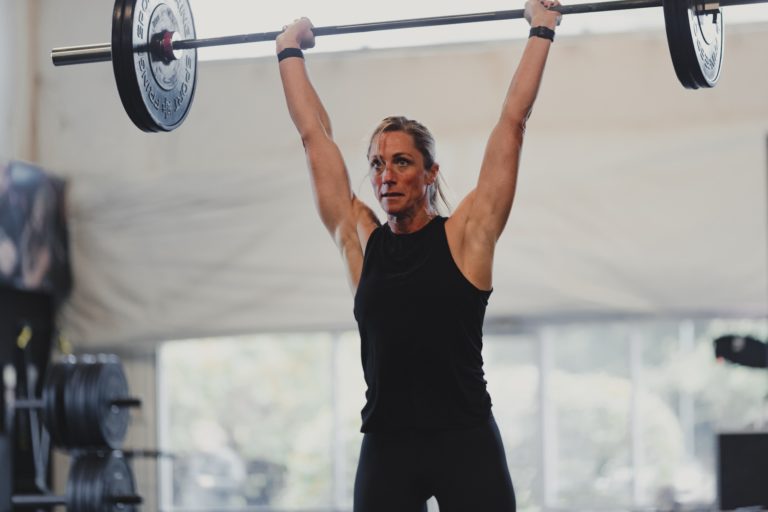
The complexity increases with the next movement, the push press. The lecturer points out that the setup is identical to the shoulder press, but now a shallow dip into a sudden violent extension of the hips and legs launches the bar off the shoulders before the arms engage to complete the lockout overhead. The result is that most athletes can move roughly 30 percent more weight overhead than they could with a strict press. That number is not just a fact about loading. It also highlights and revisits an important movement theme discussed in the squats lecture, and that comes up all weekend: the body moves most efficiently from the center out, core-to-extremity. The hips are not a supporting player. They’re the engine.
The push jerk extends this idea to its logical conclusion. Same dip, same violent leg and hip extension, but now as the bar leaves the shoulders, the athlete punches their body under it, catching the load with arms locked out overhead in a partial squat before standing tall to finish. Again, an athlete can expect to lift 30 percent more with the push jerk than they can with the push press. The push jerk requires coordination and timing that the previous two movements don’t, and the first few demo reps make that obvious. The lecturer explains that, since the push press and push jerk each unlock a little more of the hip and require a little more speed and coordination, the trainers use highly effective teaching progressions within the movement groups.
The breakout that follows is more spirited than the morning groups. There’s something about the push jerk, specifically — the jump, the punch, the land — that makes people want to get it right. Trainers move through the groups calling out cues, demonstrating corrections, and going hands-on to put athletes in the proper positions. When it clicks for someone, when the timing lines up and the bar travels just past the face, and they land with it locked-out overhead, the look on their face is unmistakable. They’ve felt the difference between a disconnected movement pattern and actually producing power.
Virtuosity: What the Technique Lecture Is Really About
With the energy of the breakout still resonating, the group reassembles for a lecture that, at first, sounds like it might be the most straightforward of the day. It is not.
The technique lecture is built around a single idea drawn from gymnastics: virtuosity, defined as performing the common uncommonly well. In competition, a gymnast can complete a flawless routine and earn a 9.7. To get the remaining three-tenths of a point, they must demonstrate risk, originality, and virtuosity. Risk is a movement likely to be missed. Originality is something the athlete alone does. But virtuosity is different. It is elusive in a way the other two are not, and yet it is immediately recognized by everyone when they see it, even in a squat, in a snatch, in a clean. It is the difference between doing a movement and owning it.
The deeper point of the lecture is not really about gymnastics. It’s about what it means to coach and to train. There is a powerful and very human tendency, in any discipline, to rush past the fundamentals toward the advanced and the impressive. Coach Greg Glassman called this the novice’s curse. A new trainer wants to teach the snatch. A new athlete wants to skip the air squat. Both are in a hurry to get somewhere that can only be reached by advancing deliberately. What the Level 1 is arguing, and demonstrating all weekend, is that there is no shortcut through the fundamentals, only through them. A trainer who insists on the basics, who really insists on them, does not bore their clients. They earn their respect. The clients advance faster, and the trainer becomes, over time, genuinely good at their job.
For many people in the room, this lecture reframes the entire morning. The reason the squats breakout went so long, the reason a trainer would spend 20 minutes on an air squat with someone who has been doing CrossFit for three years, it’s this. Virtuosity is the goal. The fundamentals are the way. The breakout groups represent CrossFit’s charter of mechanics, consistency, and intensity in action. There is relentless coaching to develop proper mechanics in the movements, so they can be performed properly, rep after rep. This is the level of mastery required before an athlete has earned the right to add intensity. This is the charter that goes on every day, with every athlete, in CrossFit gyms all over the world. The process of mechanics, consistency, and then intensity builds skill and capacity safely, effectively, and efficiently. It is the path to virtuosity.
The Kipping Pull-Up: Power, Not a Shortcut
The kipping pull-up is introduced and explained as a different expression of the same movement, one that produces dramatically more power and allows greater volume. The mechanics of the kip, the swing from hollow to arch, the aggressive hip drive, the timing of the pull, the push back from the top to set up the next rep, are demonstrated slowly and then at speed, and the difference in output between the two versions is obvious. Scaled versions of the kipping pull-up are also provided, making the movement accessible to everyone.
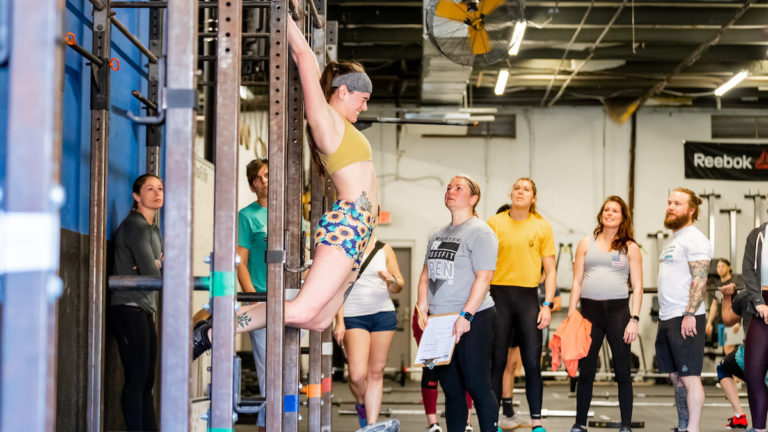
The pull-up breakout is, for many participants, a humbling experience. This is where the morning’s technique lecture comes to life. And attendees get to practice coaching each other through the progression. Some find their kipping pull-up mechanics are inefficient. Others discover that what they’ve been calling a kip is something else entirely. For those who haven’t done many pull-ups, they’re encouraged that the progressions the trainers offer — practicing the kip swing, the press into the bar, or jumping pull-ups from a box — make the movement accessible in a way they hadn’t expected. At no time are the trainers giving anyone a shortcut. They are scaling the movement to the athlete so the athlete can feel the positions that matter and then build from there.
The Thruster: A Preview of What’s Coming
Late in the afternoon, there’s one more thing left to do before the workout: the group learns the thruster.
In the thruster, a front squat flows directly into a push press. The bottom of the squat generates the momentum that drives the bar overhead, so the two movements become one. The challenge comes from trying to sustain tempo and technique, at any meaningful weight, for any meaningful number of repetitions. The thruster has a way of finding every weakness simultaneously: tight hips, a soft midline, shoulders that don’t want to stay active overhead, and lungs that weren’t ready for what the legs just asked of them. The power output of successive thruster reps can quickly humble even the fittest athletes.
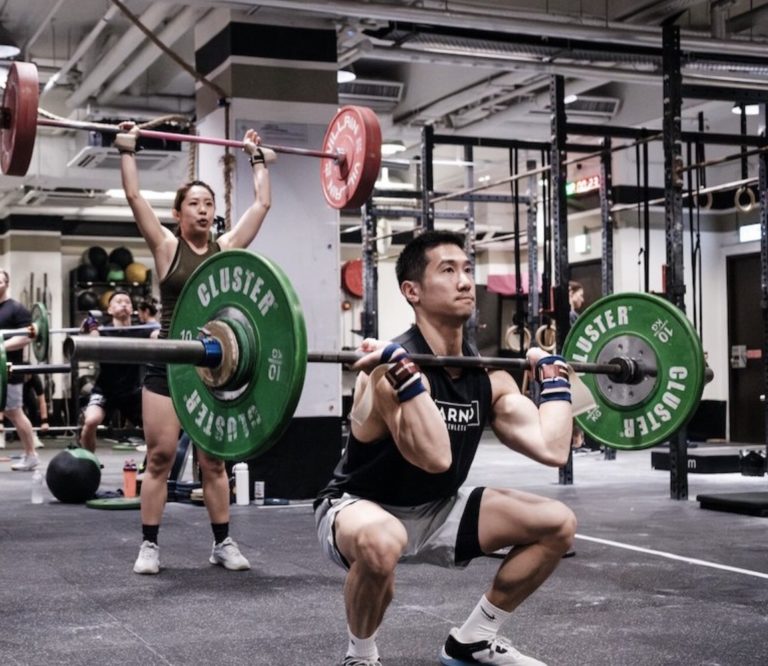
The thruster breakout is methodical and a great way to warm up for a workout. Utilizing an empty barbell, working through the points of performance. Athletes move through the necessary ranges of motion while installing proper mechanics and developing consistency. There’s a little nervous laughter during the thruster work as participants begin to realize what the workout entails. The tension builds.
The Workout
Fifteen thrusters, 12 burpees, 3 rounds. That’s it. The whole thing, for most people, lasts less than eight minutes, with hard-charging athletes finishing in under four minutes. The barbell is 95 lb for men and 65 lb for women, scaled to whatever weight each individual needs.
The buildup for the workout is quick, as the load is light but guided by the trainers. The structure and movement standards are described and demonstrated. Scaling options have been confirmed, and each athlete has secured their spot at a bar. One last check that everyone is good to go, and the countdown starts: 3, 2, 1 … go!
What follows is hard to describe to someone who hasn’t witnessed a group CrossFit workout. There is the noise, the barbells clanging, the grunting, the breathing, and the blur of activity as burpees and thrusters go down everywhere. Everyone is suffering at the same time, and everyone can feel it. It is not a team workout, but it becomes one anyway. The person next to you is working as hard as you are, and you can hear them, and that matters more than you’d expect.
Those who finish first don’t walk away to recover. They stay and cheer for the people still working. The trainers are everywhere, calling out names they learned this morning, offering cues and encouragement that get the athlete through the next rep. The coaching is relentless to the very end. When the last person finishes, the room erupts, not politely, not perfunctorily, but genuinely, the way rooms do when a meaningful shared experience is celebrated.
The day has covered more ground than most people absorb in weeks of ordinary training. Two movement groups, three lectures, a conversation about what it actually means to coach and train, and a workout that introduced the whole group to what it looks like when everything comes together, and CrossFit happens.
For the next hour, as everyone catches their breath and the inevitable “Fran cough” sets in, trainers and participants review the day’s events and talk shop excitedly. The morning nervousness seems so far away now, replaced by the elation of an experience that far surpassed expectations. This is a group of friends now.
Day 2 promises more of the same. That’s what the next piece is about.
About the Author
 Stephane Rochet is a Senior Content Writer for CrossFit. He has worked as a Flowmaster on the CrossFit Seminar Staff and has over 15 years of experience as a collegiate/tactical strength and conditioning coach. He is a Certified CrossFit Trainer (CF-L3) and trains athletes in his garage.