A Room Full of Strangers — and a Whole Lot of Tension
At 9 a.m., participants file into the “classroom.” Folding chairs are neatly arranged with a full view of the whiteboard, and attendees are searching for seats while quietly sizing each other up. The tension in the air is palpable, an inevitable consequence when a group of strangers comes together to do something uncomfortable.
How the Flowmaster Sets the Tone
The Flowmaster senses the tension and knows exactly how to break it: with a well-designed, rehearsed opening. First, the day’s schedule is reviewed so everyone knows exactly what to expect. The tension drops a notch because the day ahead sounds fun rather than daunting.
Next, the Seminar Staff trainers are introduced, highlighting their amazing skill level, blended with a touch of humor to demonstrate how close the team is. The participants cannot help but relax a little, knowing they are in good hands. The Flowmaster continues to put everyone at ease by outlining the expectations for the weekend: “Have fun, do your best, and ask questions incessantly. The team is here to share every ounce of CrossFit knowledge and experience with you, so take advantage of that. If there is any evolution you find yourself struggling with, or if you have an injury or limitation you need to work around, we’ve got you.”
No matter what, everyone gets the full meat-and-potatoes experience. The final piece of the introduction examines the participants’ overall experience level. With a show of hands, an informal survey reveals who has been doing CrossFit for one, two, three, five years or more. On the flip side, there is always someone who raises their hand when asked, “Who has never done CrossFit before?” The group applauds the individual’s courage, and the trainers assure them they are in for a great experience they’ll never forget.
The Morning Gets to Work
Very quickly, the group has started bonding, and the initial nervousness has given way to eagerness to engage with the course material. To this end, the morning instruction does not disappoint. The deep dive into the CrossFit program begins with the “What Is CrossFit” lecture, followed by the “Squats” lecture and breakout group, and wrapping up before lunch with the “What Is Fitness” lecture.
What Is CrossFit — and Why Every Word of the Answer Matters
“What Is CrossFit” not only introduces the nuts and bolts of the CrossFit methodology but also demonstrates CrossFit’s tenacity in defining its terms, removing any ambiguity about how things are done and what results to expect. Right up front, the question is answered: CrossFit is constantly varied functional movements executed at high intensity. Simple enough. Then every word of that definition gets pulled apart and examined.
Functional movements, it turns out, are not just movements that seem useful. They share a specific set of characteristics, among them the ability to move large loads over long distances quickly, and it’s precisely this capacity that gives them their unique ability to generate high power output. Which brings us to intensity. The lecture defines intensity not as effort or discomfort, as most people instinctively understand it, but as power: work accomplished per unit of time. That distinction matters more than it might initially seem. Because if intensity is power, and power is calculable, then the results of training become measurable, observable, and repeatable. The guesswork goes away. You can know whether you’re getting fitter.
The third piece of the definition, constant variation, isn’t randomness for its own sake. It’s the mechanism by which CrossFit builds its hallmark broad, general, and inclusive physical capacity. The logic is straightforward: We tend to fail at the margins of our experience. The way to push those margins further out is to broaden the stimulus. Broaden the stimulus, broaden the adaptation. By the time this section wraps up, most participants have quietly resolved several arguments they’ve been having with skeptical friends and family for years.
The Break That Isn’t Really a Break
A 10-minute break ensues, and lively chatter fills the room. The trainers mingle, spending time answering questions, reviewing the concepts discussed, or just getting to know everyone better. Every opportunity to engage one-on-one or in a small group is an opportunity to share knowledge about CrossFit. In a world ruled by 10-second social media hooks and posts, an interactive conversation and the time to explain nuanced thoughts is gold.
The Squat Group: Where Theory Meets the Floor
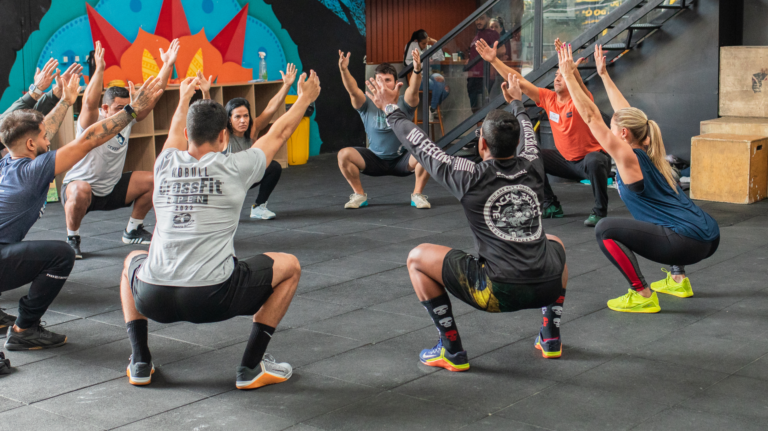
Back in the classroom, the participants receive the first movement lecture of the weekend: squats. This lecture introduces and explains movement themes that are common across functional movements — midline stabilization, posterior chain engagement, full range of motion, core-to-extremity movement pattern, and active shoulders. These are skills an athlete must master to achieve peak technique, performance, and results. The rest of the time is spent explaining and demonstrating the points of performance and most common faults and fixes for the air squat, front squat, and overhead squat.
Once all questions have been answered, the participants separate into their movement groups. Under the watchful eye of a trainer, they practice the squat movements, receiving relentless cueing and coaching, including a very detailed demonstration of squat therapy.
These breakout groups are the heart and soul of the course. This is the practical application of everything learned in the classroom. Years of experience and the constant refinement of teaching methods have taught the staff trainers to elicit improvement in each participant, all while keeping the group captivated and demonstrating virtuosity in coaching.
No one does it better. Time and time again, as a trainer moves through the group and adjusts someone’s stance, depth, or torso angle by an inch or two, the person looks up as if something were just explained to them that they’d been trying to figure out for years. This is the magic and value of the movement groups. When the breakout ends, everyone is amazed at how much they learned about movements they were already good at. They’re also amazed at how hard bodyweight or PVC-loaded movements can be when you’re striving for the proper positions.
What Is Fitness — and Why the Answer Changes Everything
Grabbing their water and snacks, the participants head back to the classroom. There’s one more lecture before lunch — “What Is Fitness?” — and this one usually blows some minds.
Intuitively, it makes sense that if you want to measure fitness and determine whether you’re getting fitter, you first need to define fitness. CrossFit would have happily borrowed a definition of fitness if one existed. But no one, not Merriam-Webster and not even the NSCA, was offering a suitable definition. This dereliction of duty, as CrossFit saw it, was both a problem and an opportunity — and so CrossFit seized its chance to provide the industry with the first workable definition of fitness.
Over the years, four models were developed to support and explain our definition of fitness:
Model 1: The 10 General Physical Skills.
Cardiovascular and respiratory endurance, stamina, strength, flexibility, power, speed, coordination, agility, balance, and accuracy. An athlete is only as fit as they are competent across all 10. Not eight of them or the six their current training happens to develop. All 10.
Model 2: The Hopper Model.
Imagine a hopper loaded with an infinite number of physical challenges, drawn at random. One’s fitness is one’s capacity to perform well at whatever comes up, including things one has never seen before. This is not a metaphor about being well-rounded. It’s a direct argument against the way most people train: keeping up with what they’re already good at. The hopper doesn’t care about strengths; it mercilessly reveals weaknesses.
Model 3: The Metabolic Pathways.
The phosphagen pathway, which powers efforts lasting under about 10 seconds; the glycolytic, which covers moderate-intensity work up to a few minutes; and the oxidative, which runs everything longer than that. Total fitness, CrossFit argues, requires genuine competency in all three.
Model 4: The Sickness-Wellness-Fitness Continuum.
Every measurable marker of health can be ranked, based on established medical ranges, on a spectrum spanning from sick to well to fit. Fitness, or “super-wellness,” provides a strong buffer against the ravages of time and disease. A fitness regimen that doesn’t support health is not CrossFit.
All of these models culminate in a specific, data-driven definition: Fitness is work capacity across broad time and modal domains. Fitness is the power output an individual can demonstrate across an unlimited set of physical tasks. And this can be measured objectively.
Fitness Is Health — and That Changes Everything
The lecture ends with the very powerful insight that fitness and health are inextricably linked. In fact, we get our definition of health from our definition of fitness. While fitness is a snapshot of an athlete’s work capacity at this moment, health reflects their work capacity over the course of their lifetime. Health, then, is defined not as the absence of disease but as work capacity across broad time, modal, and age domains — fitness measured across one’s lifetime.
The goal of CrossFit is to maximize one’s work capacity and then hold onto that capacity for as long as possible. This discussion about health is often a lightbulb moment for many. People walk into the Level 1 thinking about fitness, performance, and getting better at workouts. The idea that their fitness, pursued seriously and sustained over a lifetime, is also the most powerful health intervention available to them reframes the entire endeavor. We’re not just training. We’re building the best version of ourselves we can to ensure the highest quality of life in our later years. This is a revolutionary concept in the fitness industry.
By Noon, Everything Has Shifted
By noon, the group that filed in awkwardly a few hours ago has moved together, argued quietly about squat depth, made each other better at something, and absorbed a framework for thinking about fitness that most of them will spend the rest of the course, and the rest of their lives, filling in.
Now it’s time to refuel. The afternoon promises more movement, more thought-provoking concepts, and a workout. That’s what we’ll discuss in the next article in this series.
Read to Level Up?
Over 300,000 people have taken the Level 1 to sharpen their movement, master the CrossFit methodology, and find their community. You could be next. Courses run every weekend at affiliates around the world. Find one near you.
About the Author
 Stephane Rochet is a Senior Content Writer for CrossFit. He has worked as a Flowmaster on the CrossFit Seminar Staff and has over 15 years of experience as a collegiate/tactical strength and conditioning coach. He is a Certified CrossFit Trainer (CF-L3) and trains athletes in his garage.