So far, we’ve covered prepping for the Level 1 and what to expect during the first morning and the first afternoon of the course. Today, we’re going to dig in to Sunday morning.
—————–
Something has changed overnight, and everyone in the room can feel it.
It’s visible in the way people arrive on Day 2 — less tentative, less careful about where they sit. Conversations pick up mid-sentence from where they left off the night before.
Technically, there are still strangers in the room, but that’s not really how it feels anymore. The workout did that. Shared suffering has a way of collapsing the distance between people faster than almost anything else, and the group that reassembles on Day 2 is noticeably different from the one that filed in nervously 24 hours ago.
The Flowmaster opens the morning the same way the previous day closed: by taking the temperature of the room. How is everyone feeling? What came up overnight — questions, realizations, things that didn’t quite land that the group wants to revisit? This Q&A is not a formality. It’s a genuine accounting of where people are, and it tends to reveal something important: that the concepts from Day 1 have been quietly working in people’s minds in the hours since.
Someone asks a question about scaling that is really a question about the mechanics of intensity and threshold training.
Someone else wants to revisit the sickness-wellness-fitness continuum because they’ve been thinking about a client.
The trainers move through it carefully, connecting the morning’s conversation back to what the group already knows, reinforcing the framework rather than adding to it. By the time the Q&A winds down, the room is focused in a way it couldn’t have been yesterday. There’s a foundation under them now.
The Deadlift: The Movement You Do Every Day
The first lecture of the morning covers the deadlift, and the trainer opens with a statement that takes a moment to fully register: The deadlift is nothing more than picking something up off the ground.
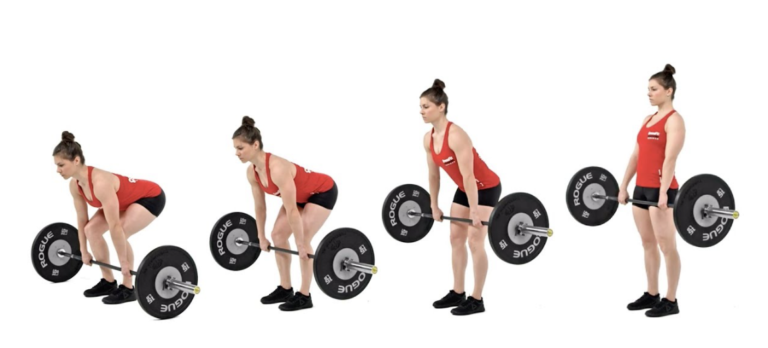
That’s it. That’s the movement. You’ve been doing a version of it your whole life — every time you’ve lifted a bag of groceries, picked up a child, hauled something heavy from one place to another. The deadlift is not an exotic exercise. It is the formalization, the deliberate and systematic perfection, of a movement pattern so fundamental that it predates the gym by 100,000 years. CrossFit’s original name for it, borrowed from an older era of physical culture, was the healthlift. That name, the trainer suggests, was probably more accurate.
The lecture takes that ordinary action and shows exactly what’s happening inside it — and what can go wrong when it’s done carelessly.
- The setup is precise: feet under the hips, a symmetrical grip just outside the legs, the bar over the midfoot and against the shins, shoulders slightly in front of the bar, chest up, lats engaged, arms straight and locked.
- The lumbar curve is established and maintained. The athlete has their weight shifted back toward the heels. No yanking or jerking the bar off the ground.
- The feet push into the ground, and the hips and shoulders rise at the same rate until the bar clears the knee.
- The top position is achieved as the hips drive through to full extension.
Every cue has a reason.
- Chest up protects the lumbar.
- Bar close to the body shortens the movement of the arms and protects the lower back.
- Shoulders and hips rising together prevent the forward tip that leads to an inefficient bar path.
The movement is conservative by design — built on the principles of orthopedic safety, functionality, and mechanical advantage — and the trainer is explicit about this: No exercise will do more to protect the back from the accumulated damage of sport and aging, and no exercise is more frequently avoided out of misplaced fear. The deadlift’s reputation for danger is almost entirely a function of doing it wrong.
There is a moment in nearly every deadlift lecture where the conversation shifts from mechanics to meaning, and it tends to arrive by way of a simple question: Who are you going to train?
The answer, if you think about it seriously, is everyone. The elderly woman who needs to get down and back up from the floor. The firefighter who needs to move a body. The teenager who is learning to hinge for the first time.
The deadlift scales to all of them, not by changing the movement but by changing the load. It is the same pattern at every level of human capacity — functional dominance for the athlete, functional competence for everyone else — and the underlying mechanics never change. This is what it means to say the needs of an Olympic athlete and your grandparents differ by degree, not kind.
The Breakout: Meeting the Bar
If the morning Q&A settled the group and the lecture gave them a framework, the deadlift breakout is where both are tested against reality — and reality is that even when the movement is loaded with a PVC pipe, finding and holding the required positions can be challenging.
Thirty seconds in the setup position seems like an eternity. The body awareness, as well as leg and midline strength, required for the hips and shoulders to rise at the same time, grabs everyone’s attention. The most common corrections are predictable and instructive — the bar drifts forward around the knees and away from the body. A trainer steps in to demonstrate why that matters with a simple physics lesson. The back rounds at the bottom, and the fix is almost always the same — establish the lumbar curve before you pull, not during. Inevitably, someone lets their hips rise faster than their shoulders, turning the lift into a stiff-leg deadlift that hits the lower back harder than we’d want.
But then there are the reps that go right, and those are something else entirely.
- The bar stays close to the body.
- The whole posterior chain fires in sequence.
- The hips drive through at the top, the athlete stands tall, and the movement pattern feels smooth and efficient.
The look on their face in that moment is the same look from the presses breakout the day before, and the squats before that, and it will happen again and again in every course: the sudden physical understanding of a principle the lecture could only describe.
The Workout: Moving and Coaching
The Day 2 workout arrives without ceremony, just as yesterday’s did.
It is short. It is hard.
It involves the medicine-ball clean and sit-ups — the morning has been building to this — and it offers the group a chance to apply everything from the last breakout with the added pressure of a clock and a little accumulated fatigue.
The scaling conversation is fast now; the group has been through this once, and they know how it works. They know to be honest about where they are. They know the trainers will find the right version for them.
What’s different about this workout compared to yesterday’s is that athletes are paired up, and one athlete completes the workout at a time while their partner practices coaching them. As the workout starts in a burst of activity, a chorus of cues and encouragement from the “coaches” rises above the breathing, moving, and dropping of med balls. Eight minutes and the first heat is done, and now the coach and athlete switch roles. Although the first athlete is tired, they give their all, coaching their partner to do their best. The cheering when the last person finishes is just as genuine as it was the day before. Maybe more so, because now they know each other by name.
The Nutrition Lecture: Fueling Everything You Just Learned
After the workout and a short rest, the group gathers for the nutrition lecture, and the trainer opens with a premise that most people in the room have heard before but haven’t necessarily examined: You cannot out-train a bad diet.
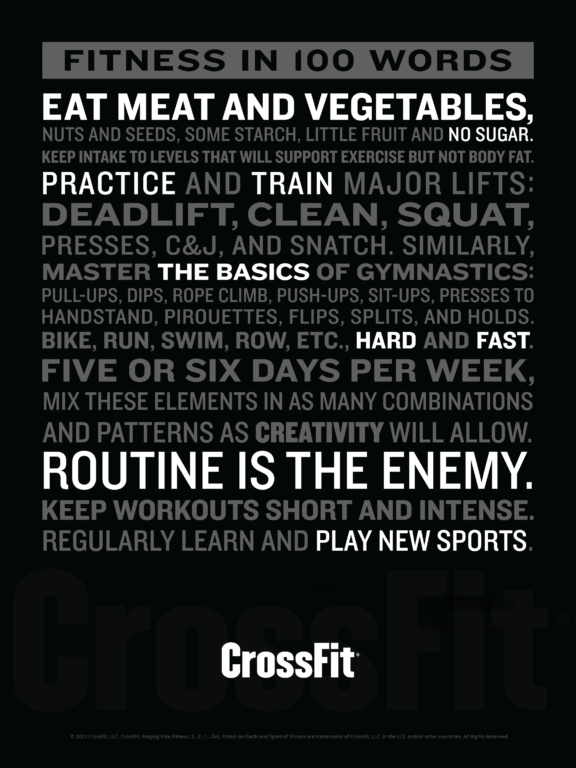
CrossFit’s nutrition prescription starts with a qualitative foundation and then builds toward quantitative precision. The foundation is simple enough to fit in a single sentence: Eat meat and vegetables, nuts and seeds, some fruit, little starch, and no sugar in quantities that support exercise but not body fat. That sentence carries more practical guidance than most people’s entire understanding of nutrition, and the lecture unpacks it carefully — what each word represents and what happens physiologically when everything is dialed in.
From there, the lecture moves into the quantitative layer. Food quality gets you most of the way there; food quantity gets you the rest.
The CrossFit prescription targets a macronutrient balance of roughly 40 percent carbohydrate, 30 percent protein, and 30 percent fat, calibrated to an individual’s lean body mass and activity level.
Measured, trackable, concrete portions are a tool for precision: a way to stop guessing and start knowing what you’re actually eating. Whether it’s calories, blocks, or grams, you build meals from quality, unprocessed foods in the amount you need to support your health and training goals.
The lecture carefully positions nutrition not as a separate discipline layered on top of CrossFit, but as the base of the entire performance pyramid.
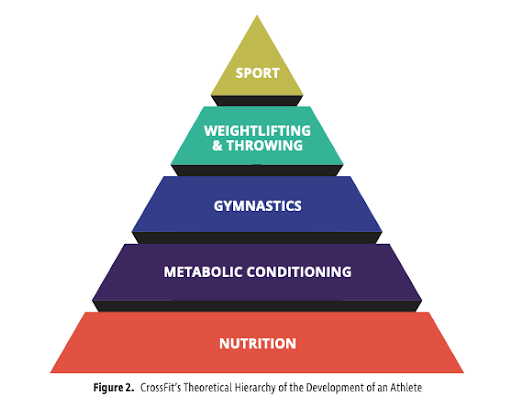
Nutrition sits beneath metabolic conditioning, gymnastics, and weightlifting for a reason. A deficiency at the base compromises everything above it. The one to two hours of training someone does each day are 5 percent of their waking life. The other 95 percent — what they eat, how they sleep, how they recover — is where most of the adaptation actually happens.
For many people in the room, this is the lecture that makes everything else click. The movements are the visible part of CrossFit. The methodology is the structure underneath them. Proper nutrition, as a foundational part of that methodology, allows those adaptations to take root and flourish. The trainer doesn’t moralize about it; they simply present the data, lay out the prescription, and let the room do the math.
The afternoon is the last stretch — more movement, and the final lectures. The morning has done its work. The group leaving the classroom after the nutrition lecture is not the same group that came in 24 hours ago, wondering what the weekend would ask of them.
They’re figuring it out.
About the Author
 Stephane Rochet is a Senior Content Writer for CrossFit. He has worked as a Flowmaster on the CrossFit Seminar Staff and has over 15 years of experience as a collegiate/tactical strength and conditioning coach. He is a Certified CrossFit Trainer (CF-L3) and trains athletes in his garage.