Social psychologist Jonathan Haidt popularized a useful analogy for understanding human behavior: the elephant and the rider.
Imagine a person riding an elephant. The rider represents our rational, deliberate thinking. It understands consequences, makes plans, evaluates information, and sets goals. The elephant represents our more automatic processes, including instincts, emotions, reflexive actions, learned habits, and reward-seeking behavior.
The rider might decide that losing 20 pounds of fat would improve health, make exercise easier, and reduce the risk of chronic disease. The elephant sees a cinnamon bun.
Guess who’s driving?
The rider has the illusion of control, but if the elephant decides to charge off in a different direction, there’s little the rider can do to stop it.
Trying to overpower a determined elephant through sheer force of will is exhausting. Unfortunately, this is precisely what most conventional dieting advice asks us to do. Count every calorie. Weigh every portion. Resist every craving. White-knuckle through hunger. Exercise more. Repeat indefinitely. All of it represents the rider desperately tugging at the reins of a disgruntled elephant.

For a while, the rider might successfully maintain control. But eventually, fatigue, stress, distraction, or a uniquely drool-worthy cinnamon bun gives the elephant an opportunity to charge off on its preferred route.
A more effective strategy is to work with the elephant’s instincts, teach the rider to make better decisions, and arrange the environment so the easiest path leads toward healthier behavior.
To do that, we first need to understand what the biggest food companies in the world already know: what makes the elephant hungry.
The Problem of the Fixed Stomach
Imagine you’re running a food company.
There are only so many people, and the population grows slowly and predictably. Each person only eats so much food, and there are only so many meals in a day. If you want your company to grow and turn a profit, you need the market to consume more of your products, but there doesn’t seem to be room for growth.
This is described as “the problem of the fixed stomach.”
Fortunately for the food industry, humans don’t eat exclusively in response to physiological energy requirements.
We also eat because food tastes good, because we’re bored, because we’re stressed, because we saw an advertisement, because someone offered us something, or because it’s 8 p.m. and we’ve developed a deeply entrenched habit of eating potato chips while watching television.
Food companies invest heavily in understanding and leveraging these behaviors.
Product placement at eye level in grocery stores, the smell of freshly baked goods, packaging colors, flavor combinations, and the frequency and placement of advertisements are all opportunities to influence purchasing and eating decisions. It’s why packaging, brand names, and ads are everywhere.
Environmental cues trigger learned associations and cravings before we’ve consciously considered whether we’re actually hungry. The smell of cinnamon buns might remind someone of baking with their grandmother. A certain restaurant logo might evoke childhood memories of Friday night family dinners. The resulting desire to eat can be entirely disconnected from the body’s immediate energy requirements. In other words, the elephant has been hijacked.
Protein: Nature’s Appetite Suppressant
Protein is essential for building and repairing muscle, producing enzymes and hormones, supporting immune function, and maintaining numerous other physiological processes. It also has an interesting relationship with appetite.
The protein leverage hypothesis, developed by researchers David Raubenheimer and Stephen Simpson, proposes that animals, including humans, regulate food consumption largely to meet a protein intake target. When the proportion of protein in the diet is low, individuals consume more total food to obtain sufficient protein.
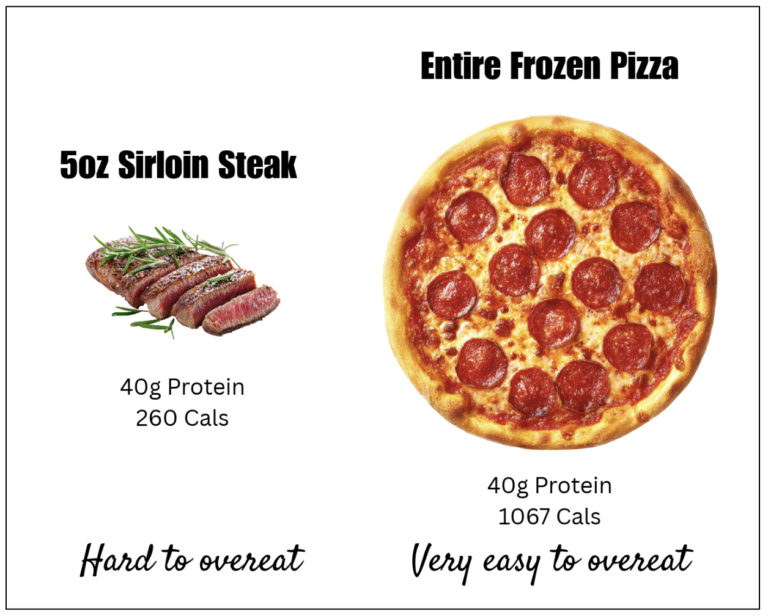
Imagine getting 40 grams of protein from a 5-ounce sirloin steak compared with obtaining the same amount from a large quantity of low-protein junk foods. The second option requires consuming far more calories, carbohydrates, and fat along the way. This phenomenon is known as protein dilution, and it is a hallmark of ultra-processed foods (UPFs).
In one study, researchers tested diets of 15% vs. 30% protein. While being allowed to eat as much as they wanted of either diet, participants reported greater satiety and spontaneously reduced their daily energy intake by an average of 441 calories on the 30% protein diet. Over 12 weeks, they lost approximately 11 pounds (4.9 kg). These findings suggest that changing the proportion of protein in our diet can influence how much food we naturally consume, eliminating the need for willpower-based caloric restriction.
Protein also stimulates satiety-related signaling, including hormones such as peptide YY and GLP-1, and generally produces greater fullness than an equivalent amount of energy from refined carbohydrates.
For CrossFit athletes, the benefits extend beyond appetite regulation. Adequate protein supports muscle protein synthesis, recovery, and lean-tissue preservation during weight loss. This is important because losing weight without protecting muscle mass can undermine the very physical capacity we’re trying to improve.
Of course, food manufacturers have noticed our growing enthusiasm for protein, and supermarket shelves are now overflowing with protein-fortified cookies, cereals, ice cream, and snack bars. Most are bulked up with cheap protein isolates extracted from soy, peas, or dairy. Does adding protein to an ultra-processed food suddenly make it as healthy and satisfying as real food? Of course not.
Adding 20 grams of pea protein to a cookie does not eliminate the characteristics that made the cookie so easy to overeat in the first place. For reliable satiety and overall nutritional quality, build your meals around protein-rich whole foods rather than relying on the protein claims printed across the front of a package.
A useful target for exercising adults is approximately 1.4 to 2.2 grams of protein per kilogram (0.6 grams to 1 gram per pound) of ideal body weight per day (note: for those significantly under or overweight, we use ideal body weight for this calculation rather than current body weight).
The real-life application is wonderfully straightforward. The rider builds meals around a substantial serving of protein. Meat, fish, eggs, and dairy are the highest-quality options, providing not only a complete set of essential amino acids but also the best source of the vitamins and minerals the body needs to function optimally.
When eating at a restaurant, consider ordering a protein-rich appetizer or eating the meat portion of your meal first. If your favorite part of dinner is the steak, lucky you, you get to eat your favorite food first. The objective is to quell the elephant by reaching comfortable satiety before you’ve consumed an enormous amount of food.
Why Donuts Are So Difficult To Stop Eating
Consider three foods: a plain baked potato, a stick of butter, and a donut.
Most people would struggle to consume an enormous quantity of plain baked potatoes. Even fewer would enthusiastically sit down with a spoon and eat an entire stick of butter.
BUT … combine simple carbs and fat together into a donut, and suddenly eating these ingredients seems like an offer you simply can’t resist. Ultra-processed foods with unnatural combinations of carbohydrate and fat are uniquely enticing, triggering reward pathways in the brain that natural, whole foods can’t reach, since they never contain high concentrations of carbs and fat together.
Add a few flavor and texturizers, and you’ve got a food that feels impossible to stop eating. In their continued quest to get you to eat more, food manufacturers exploit this evolutionary novelty with products such as pastries, cereal, crackers, cookies, ice cream, pizza, and countless snack foods. The rider can avoid unnatural combinations of fat and carbs, because the elephant simply can’t stop when it comes to them.
The Modern Food Supply Has Removed the Brakes
Consider an orange.
It comes wrapped in a peel, contains considerable water and fiber, and requires chewing. Eating several oranges takes time and effort, and the fruit’s physical volume contributes to fullness.
Now think about orange juice.
There is no need to peel the fruit, so that saves time. Juicing removes much of the fiber and eliminates the need to chew, which also increases consumption speed. The liquid form concentrates the sugar from several oranges into a single glass and makes the whole thing drinkable in about 30 seconds.
The sugar molecules haven’t changed fundamentally. But the food structure, concentration, rate of consumption, and accompanying satiety signals have changed dramatically.
AMRAP in 20 minutes: Which one could you consume more of?

Modern food processing repeatedly applies this principle.
Wheat becomes refined flour. Sugar is extracted and concentrated from cane and beets. Oils are separated from their original food sources like seeds and beans. These ingredients are recombined into products that are exceptionally energy-dense, convenient, and easy to consume quickly.
In a landmark 2019 randomized controlled feeding study conducted by Kevin Hall and colleagues at the National Institutes of Health, participants consumed approximately 500 additional calories per day when provided an ultra-processed diet compared with when they were given a minimally processed diet. The diets were designed to be matched for as many nutritional characteristics as possible, and participants were allowed to eat as much or as little as they wanted.
During the two-week ultra-processed phase, participants gained weight. During the minimally processed phase, they lost weight. On the UPF diet, they simply ate more before they felt like stopping. The elephant charged off toward more food without the rider even noticing what was happening.
This study illustrates something fundamental about appetite regulation: The food itself influences how much we consume. The rider can choose whole foods, so the elephant has no opportunity to overconsume.
Sleep: The Appetite Intervention We’re Not Acknowledging
Imagine spending the entire day resisting cravings, carefully preparing nutritious meals, and exercising with admirable consistency. Then you stay up until 1 a.m. scrolling through your phone. The next day, your appetite is noticeably harder to manage.
Sleep restriction affects several systems involved in hunger, food reward, and energy regulation. Some studies have demonstrated changes in ghrelin, leptin, and endocannabinoid signaling following insufficient sleep. Brain imaging research also suggests that sleep deprivation can increase the appeal of highly rewarding foods.
Controlled experiments have found that sleep-restricted individuals often consume more calories, particularly from snacks and energy-dense foods. In one randomized trial involving overweight adults who habitually slept less than 6.5 hours, extending sleep by approximately 1.2 hours per night reduced daily energy intake by roughly 270 calories compared with controls.
Participants weren’t prescribed a weight-loss diet. They simply slept more.
Think about that for a moment. People looking to change their future health are often given elaborate diets, expensive supplements, serious medications, and increasingly complicated strategies to reduce calorie intake, without ever addressing sleep. They may even be setting an alarm to work out early in the morning, inadvertently undermining the main behavior that can influence appetite before breakfast even begins.
For most adults, consistently obtaining seven to nine hours of quality sleep is the optimal target. It’s difficult to make excellent decisions about food when your brain is exhausted and demanding an immediate reward for surviving another day. The rider chooses to put their phone down, says no to some commitments, and prioritizes getting to bed in time to wake up without needing an alarm. If not, the deranged elephant is in charge the next day, and that beast wants treats.
What French Chefs and Competitive Eaters Know
As we eat a particular food, our desire to keep eating it tends to decline in what’s known as palate fatigue. The first bite of an excellent steak might be extraordinary, the perfect blend of warm, savory, and salty. But three quarters in, we’re satisfied and ready to stop. It might even become difficult or downright nauseating to swallow one more bite. The body is naturally signaling, “that’s enough.”
But switch to something sweet, cold, and creamy, and suddenly eating seems appealing again.
A fabulous multi-course meal prepared by a world-class chef leverages this effect. Between courses of rich, warm, savory foods, restaurants serve a “palette cleanser,” usually a small portion of sorbet. Cold and sweet resets the taste buds so warm and savory becomes appealing once again.
Competitive eaters exploit the same effect. In an infamous episode of “Man v. Food” — a reality show in which the host, Adam, travels the world taking on various food challenges — Adam takes on an ice cream challenge called the Kitchen Sink. The goal is to consume a massive bowl of ice cream, whipped cream, and toppings in under one hour. When he’s struggling and cannot stomach one more bite, he orders a side of French fries. He counters cold, creamy, and sweet with hot, crunchy, and salty … and voila! He’s back in the game and finishes the challenge. He got himself to eat more food by eating more food.
Most of us have experienced a less theatrical version of this phenomenon. It’s hard to eat a large plate of scrambled eggs on its own. But add a side of yogurt and fruit, or toast and jam, and you’ll be able to finish it all. The processed food companies know this, too, always offering to upsell your burger and fries with a soda or milkshake.
Knowing this phenomenon exists gives you power over your behaviors. The rider can build real, satisfying meals while keeping palate sensations in one lane.
Stop Eating Every Minute You’re Awake
Many people have become accustomed to eating from shortly after waking until immediately before bed.
Breakfast, a midmorning snack, lunch, an afternoon snack, dinner, and something to eat while watching television can easily create a 15- or 16-hour daily eating window. One study observed habitual eating patterns of a group of individuals and found the top 10% had 11 eating episodes per day! Some of these eating occasions are driven by genuine hunger; most happen largely out of habit or boredom.
Time-restricted eating offers a simple way to reduce unnecessary eating opportunities. Rather than counting calories or weighing food to restrict quantity, set a consistent daily window for meals. For example, someone might eat between 9 a.m. and 7 p.m., creating a 10-hour eating window and a 14-hour overnight fast.
Studies have found that time-restricted eating can produce spontaneous reductions in energy intake and modest weight loss in some individuals. Much of the benefit comes from reducing opportunities to eat, which is a very legitimate advantage. If eliminating late-night snacking causes someone to consume less energy, we’ve accomplished precisely what we wanted.
You don’t need to endure heroic fasting periods or ignore genuine hunger. People with diabetes, a history of eating disorders, pregnancy-related nutritional needs, or other medical considerations may require individualized advice.
For many healthy adults, simply establishing regular meals and avoiding mindless grazing and late-night snacking is an accessible starting point. The rider decides the schedule and plans for proper meals.
The Food Environment: Make Good Choices Easy
In addition to the elephant and the rider, we have another important variable to consider: the path.
The rider might have an excellent plan. The elephant might even be reasonably cooperative. But if the path leads directly through temptation every afternoon, we’re creating unnecessary opportunities for things to go sideways.
Our surroundings influence behavior through convenience, visibility, habit, learned associations, and our social circle.
If there’s a bag of chocolate-covered almonds in the cupboard, resisting them requires a decision every time you walk into the kitchen. The rider has to strain against the elephant. If there aren’t any in the house, eating them requires getting dressed, finding your keys, driving to the store, and making a purchase. At that point, your craving has to compete with your laziness. You may as well co-opt laziness as your ally. Arrange your home so nutritious foods are readily available and the foods you tend to overconsume simply aren’t there.
But your environment extends well beyond your kitchen cupboards. The people you spend time with help establish what you consider normal. If your friends routinely exercise, prepare nutritious meals, prioritize sleep, and take care of their health, these behaviors become ordinary parts of everyday life. Conversely, if every social gathering revolves around excessive drinking, fast food, and sitting around, making healthier choices feels like swimming upstream.
In his bestselling book “Atomic Habits,” James Clear offers useful advice: “Join a culture where your desired behaviors are the norm.” This is one of the most powerful, yet underappreciated aspects of joining a CrossFit affiliate. You become part of a community where people prioritize exercise in their schedule, celebrate personal records, talk about protein intake, and consider doing burpees together a perfectly reasonable way to spend a Saturday morning. Things that might seem bizarre to the outside world become completely normal within the group. Instead of constantly relying on willpower to behave differently from everyone around you, surround yourself with people who reinforce the behaviors you want to establish.
Get your family involved, too. You don’t need everyone in your life to share your exact dietary preferences, but people who support your goals make the journey much easier. Make healthy living part of your social identity, rather than a private battle you fight against your surroundings.
Ultimately, the objective is to create a path where healthy behaviors are convenient, socially reinforced, and so deeply ingrained in your daily routine that they require very little conscious effort. When the people around you are already heading in the direction you want to go, the elephant happily follows the herd.
Of course, there will still be situations where the path requires some planning. Next up in our series, we’ll look at managing our appetite and staying on track through the holidays.
- Read Lean for Life, Part 1: How To Control Your Appetite and Maintain a Healthy Body Weight Forever
- Read Lean for Life, Part 3: Surviving the Holidays Without Derailing Your Health
About the Author
 Jocelyn Rylee (CF-L4) and her husband David founded CrossFit BRIO in 2008, starting in a modest 1500 sq ft space and focusing on personal training. Her dedication to excellence has also earned her a position on CrossFit LLC’s Level 1 Seminar Staff, a role that allows her to share her passion and expertise with aspiring coaches. Jocelyn holds specialties in Endurance, Gymnastics, Competition, and Weightlifting and is also a certified Strength and Conditioning Specialist through the NSCA. As a Level 2 Olympic Weightlifting Coach and a Level 3 referee, she has been deeply involved in the sport, even serving as a board member of the Saskatchewan Weightlifting Association for five years. Her achievements include being Saskatchewan’s top-ranked female Olympic Weightlifter from 2012 to 2015, during which she held provincial records in the Snatch, Clean & Jerk, and Total in her weight class. With an MS in Human Nutrition, Jocelyn loves sharing her knowledge on nutrition and performance through her blog and Instagram as “The Keto Athlete,” where she delves into the science of nutrition and its impact on athletic performance.
Comments on Lean for Life, Part 2: Your Brain Has an Elephant Problem
0 Comments