The secret to lifelong weight management may have less to do with how much food you’re willing to give up and more to do with understanding why you want to eat in the first place.
There are approximately 3,500 calories in a pound of body fat. Divide that by seven days, and the math is wonderfully simple. Eat 500 fewer calories every day, lose one pound of fat every week, and in six months you’ll be 26 pounds lighter.
Congratulations. You’ve solved obesity.
Except, of course, you haven’t.
The human body is far more complicated than a simple formula, and anyone who has tried to lose weight by meticulously counting calories has probably discovered the arithmetic doesn’t translate well (or at all) to a dynamic biological organism. In this scenario, weight loss is often unpredictable and slow, hunger becomes a menace, energy expenditure changes without you even realizing it, and eventually the prospect of spending the rest of your life measuring peanut butter with a teaspoon becomes just too depressing.
We have spent decades telling people to eat less and move more. Meanwhile, obesity rates have climbed to levels that would have been almost unimaginable a few generations ago. The advice is not working.
The ultimate goal of weight management should be to achieve a healthy body weight and maintain it indefinitely. We want to preserve muscle mass, bone density, metabolic health, and the physical capacity to enjoy life while avoiding excess body fat that contributes to chronic disease. Ideally, we would do all this without being perpetually hungry, obsessing over food, or needing the willpower of a Buddhist monk every time someone brings donuts into the office.
To understand how, we need to investigate the biology of appetite, the peculiarities of our modern food environment, and the surprisingly limited control our rational brains have over our everyday behavior.
The Fattening of Humanity
For nearly all of human history, the threat was starvation. Today, 2.6 billion adults, or 45% of the world’s adult population, are overweight, and global obesity has more than doubled since 1990.
The shift has crossed every border and culture, from the U.S., where more than 70% of adults carry excess weight, to Egypt, where 43% have obesity. And it has happened in just two or three generations. Our genes haven’t changed in that time, but our environment has. The biology that drove our ancestors to eat whenever food appeared now operates in a world where the corner convenience store stocks 47 varieties of chocolate bars and upsells a giant soda at checkout. Food manufacturers know exactly which ancient buttons to push, and they push them relentlessly.
The Four Faces of Hunger
1. Routine Hunger: Your Body Has a Schedule
Ghrelin is a hormone produced primarily by the stomach that helps stimulate appetite. Its circulating concentrations tend to rise before habitual mealtimes and fall between them. Digestion is a very active process, and like a warehouse gathering its staff in anticipation of a big delivery, the body prepares for expected mealtimes.
If you routinely eat breakfast at 7 a.m., lunch at noon, and dinner at 6 p.m., your body begins anticipating those meals. Blood flow, digestive enzymes, and the smooth muscle action of your gut all ramp up. Around noon, your stomach starts growling and your body signals, “Hey, we’re ready. It’s time to eat.”
Ghrelin does not simply increase indefinitely until you eat, though. Its secretion follows pulses and rhythms, and hunger sensations can rise and fall even during prolonged periods without food. Perhaps you’ve been busy at work, missed lunch, and suddenly realize it’s 3 p.m. The hunger that seemed urgent at noon has largely disappeared.
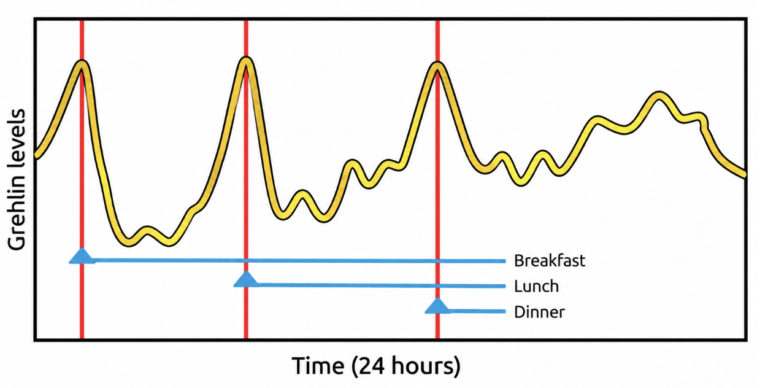
Knowing this, you can train your physiology to be hungry more or less often each day. Regularly eat five times per day? You’ll experience this ghrelin pulse five times per day. Regularly eat two times per day? You’ll experience this hunger signal two times per day. Food companies know this, of course, and constantly push new meals and new eating times. With this awareness, you can create structure around your hunger signals by building a routine of two to three square meals per day.
The bottom line: Hunger follows the schedule you set, so build a routine of two to three square meals a day to train your body to expect food only then.
2. Stomach Emptiness: The Background Noise
The stomach contains mechanoreceptors that detect stretching and signal fullness when we have a belly full of food. When food leaves the stomach, those mechanical signals subside. We may feel a lightness or emptiness in the stomach at this time.
But an empty stomach doesn’t necessarily mean the body is running out of energy. Even relatively lean adults carry tens of thousands of calories in stored body fat. Under normal circumstances, the body mobilizes fatty acids from adipose tissue and uses them to supply energy between meals. This is literally what your body fat is for.
Someone with good metabolic flexibility can go many hours, even a few days, without eating while staying mentally alert, physically comfortable, and able to do normal activities. They might notice that their stomach is empty, but the sensation remains in the background rather than demanding immediate attention.
The bottom line: An empty stomach and/or stomach growling is NOT an emergency, so treat that hollow feeling as background noise while your body draws on the energy it already has stored.
3. Hangry: When Hunger Becomes an Emergency
We’ve all encountered someone who becomes a thoroughly unpleasant human being when they miss a meal. Perhaps you’ve been that person.
The ability to switch between available fuels, including glucose and fatty acids, is known as metabolic flexibility. When we eat, we use the incoming fuel to make energy. Whatever we don’t need right now is stored for later, mostly as body fat. Between meals, the body can tap these fuel reserves to keep everything running.
Insulin is the primary hormone that regulates this process. After eating, especially when we eat carbohydrate-rich foods that raise blood glucose, the pancreas secretes insulin to promote nutrient storage and suppress fat mobilization. As insulin declines between meals, lipolysis (the breakdown of fat stores) increases, and stored fatty acids become available for use. This is known as the fed state (storage mode) and the fasted state (mobilization mode).
But when insulin levels run chronically high, lipolysis is blocked, and we have trouble accessing our onboard fuel tank. And when we are not very good at using our own body fat for energy, a missed meal can trigger a cellular-level energy crisis as organs and tissues run out of fuel.
Headaches, irritability, difficulty concentrating, shakiness*, and an overwhelming preoccupation with food characterize this energy crisis. We all know this as being hangry. Shirts, stickers, and water bottles carry funny phrases like “I’m sorry for what I said when I was hangry.” Snickers chocolate bars even turned this phenomenon into a whole marketing campaign, espousing, “You Act Like a Diva When You’re Hungry.”
*Note: Frequent or severe episodes of shakiness, dizziness, or confusion deserve medical evaluation, particularly in people using glucose-lowering medications.
For the everyday athlete seeking long-term health, the goal is to develop an eating pattern and metabolic environment that can handle occasional delays between meals without turning it into a hostage negotiation.
Build your diet around whole, minimally processed foods that promote satiety without repeatedly producing large insulin responses. Prioritize protein-rich foods such as meat, fish, eggs, or dairy, along with vegetables and other nutrient-dense whole foods, while reducing refined carbohydrates, added sugars, and frequent snacking. Regular exercise, especially strength training and sprinting, also improves insulin sensitivity, allowing the body to manage blood glucose with less insulin.
Over time, these habits can help restore a healthier rhythm between the fed and fasted states, making it easier to access stored body fat between meals and go about your day without requiring an emergency granola bar in your purse at all times. Oh, the freedom!
The bottom line: Getting hangry signals that your body struggles to tap its own fat stores, so build meals around protein and whole foods, cut refined carbs and frequent snacking, and train hard to restore the metabolic flexibility that lets you skip a meal without a crisis.
4. Cravings: When the Brain Wants Food the Body Doesn’t Need
This is perhaps the most interesting form of hunger because it can occur even when we’re already physically full.
Imagine finishing a large Thanksgiving dinner. You’ve eaten turkey, potatoes, stuffing, vegetables, and enough gravy to float your boat. You couldn’t possibly eat another bite. Then someone brings out pumpkin pie. Miraculously, a previously undiscovered compartment opens in your stomach (as a kid I would say, “I have room in my back!”). We have an overwhelming desire for the pie, even when we’re so physically full we’re unbuttoning our pants.
This phenomenon involves several processes, including food reward, learned associations, and sensory-specific satiety. The brain’s reward circuitry responds to the anticipation and experience of pleasurable foods. Dopamine participates in motivation, reinforcement learning, and the desire to pursue rewards.
This hedonic hunger contributes to persistent cravings, loss of control, and compulsive eating patterns — behavior that looks closer to addiction than just poor habits. Researchers have even developed instruments such as the Yale Food Addiction Scale to investigate addiction-like eating behaviors. Whether food addiction should be classified as a distinct clinical disorder remains debated, but the experiences of preoccupation with food, consuming more than intended, persistent intake despite negative consequences, and repeated unsuccessful attempts to stop are very real.
Our goal should be to spend most of our lives experiencing ordinary, manageable hunger while minimizing the kinds of cravings that make food feel like an unwanted monkey on your back.
The bottom line: Cravings come from the brain’s reward system rather than a real need for fuel, so learn to recognize them for what they are and aim for a life of ordinary, manageable hunger instead of a constant fight against food you don’t need.
Fortunately, several practical strategies can help. In Part 2, we’ll explore our conscious choices, our biological drives, and the environment in which we live.
About the Author
 Jocelyn Rylee (CF-L4) and her husband David founded CrossFit BRIO in 2008, starting in a modest 1500 sq ft space and focusing on personal training. Her dedication to excellence has also earned her a position on CrossFit LLC’s Level 1 Seminar Staff, a role that allows her to share her passion and expertise with aspiring coaches. Jocelyn holds specialties in Endurance, Gymnastics, Competition, and Weightlifting and is also a certified Strength and Conditioning Specialist through the NSCA. As a Level 2 Olympic Weightlifting Coach and a Level 3 referee, she has been deeply involved in the sport, even serving as a board member of the Saskatchewan Weightlifting Association for five years. Her achievements include being Saskatchewan’s top-ranked female Olympic Weightlifter from 2012 to 2015, during which she held provincial records in the Snatch, Clean & Jerk, and Total in her weight class. With an MS in Human Nutrition, Jocelyn loves sharing her knowledge on nutrition and performance through her blog and Instagram as “The Keto Athlete,” where she delves into the science of nutrition and its impact on athletic performance.
Comments on Lean for Life, Part 1: How To Control Your Appetite and Maintain a Healthy Body Weight Forever
1 Comments
Great article! But how could you leave out the medically proven fact that we all have a second stomach reserved for dessert?
Now I'm hungry for Part 2!