The CrossFit landscape is crowded. Today, anyone with a smartphone can access an endless stream of training templates sold by Games athletes, coaching drills, and car-selfie lectures — the content is relentless. In a way, this is the result of what our founder envisioned with an unregulated, open-source program. But for the affiliate owner and the daily class coach, this saturation surfaces an existential question:
If “great” workouts are everywhere, where does my value actually lie?
That question often leads to the urge to add an ever-growing list of extras, like yoga classes or goal sessions, to hold members’ attention. Having recently passed the Level 4 evaluation, though, I’ve spent a lot of time reflecting on what truly separates a high-level CrossFit coach from a fitness instructor, and how the program itself already has all the answers.
The truth is simple: the CrossFit methodology works. The elegant, timeless framework outlined in the Level 1 and Level 2 Certificate Courses delivers results nothing else can match, but it doesn’t deliver itself. That’s the coach’s job.
The Allure of Novelty vs. the Power of the Basics
Look at the fitness industry at large, and you’ll see a desperate chase for novelty. Programs are constantly introducing complex variations and bizarre exercise combos, usually just to keep clients from getting bored. They are moving athletes further and further away from the basics.
But as experienced coaches, we know there is profound gold to be found in the fundamentals. When we look back at the frameworks that form the foundation of effective training, two timeless principles stand out, ones that are increasingly being lost in the broader fitness landscape:
#1 – The Charter of Mechanics, Consistency, and Intensity
This isn’t just a checklist for beginners; it is a permanent operational framework. You establish the mechanics, you demand consistency in those mechanics under fatigue, and only then do you introduce the accelerator of intensity. Ironically, it is often our most experienced members who need to be reminded of this challenge, but it takes a coach to point it out. It takes a coach to guide and reward them through this, which leads to the second point.
#2 – Threshold Training
This is the art of guiding an athlete to the exact boundary where their mechanics begin to degrade, and coaching them to maintain control right on that line.
Many modern training programs fail because they skip right to intensity or novelty, completely bypassing the mechanics and consistency required to make that intensity safe and effective, especially for the long-term development of our members. Threshold training is common in the program, but perhaps the missing piece is that threshold training is a tool for the coach, not the athlete – meaning it’s up to us to ensure this concept is delivered each class.
The Siren Song and the “Curse of the Novice”
When I passed my Level 3 exam, a whole new world of information opened up to me. Tasked with pursuing continuing education units (CEUs), I immersed myself in external perspectives — seeking out specialty courses, seminars, and articles. This pursuit is absolutely pivotal for a coach’s development; it expands your horizons and sharpens your toolset.
Naturally, you want to bring this new knowledge back to your athletes. It’s exciting to layer these fresh elements into a class. For a while, I found myself introducing elaborate drills and intricate band set-ups during the warm-up. The members loved the novelty, and frankly, it made me feel like a mad scientist of movement.
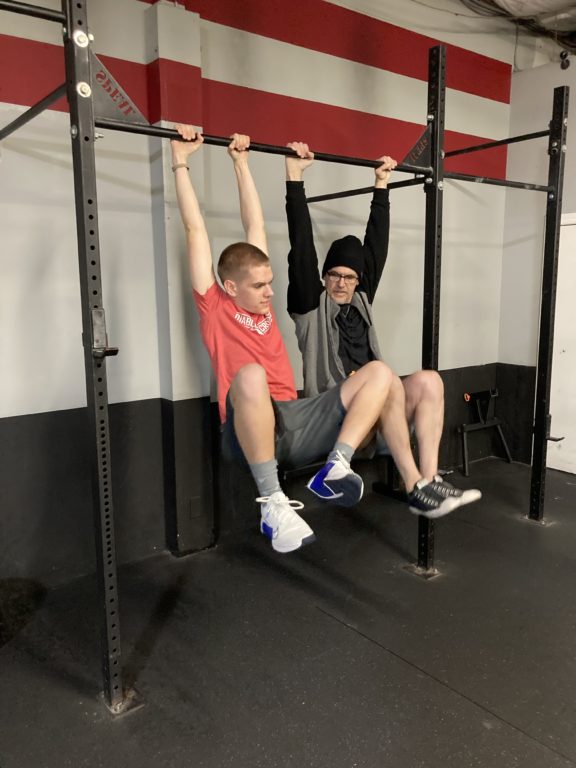
Photo courtesy of Matt Michalesen
But ironically, despite holding a high-level designation, I had fallen headfirst into the curse of the novice.
I was spending an exhausting, sometimes frustrating, amount of time lesson-planning around creating complex drills, rather than focusing on mastering the basics. Then, during these drills, I would become distracted by the performance of the drill rather than by its intended purpose of helping the person in the class. I had mistaken complexity for sophistication. In our eagerness to provide value, we often think we need to invent something new. But real high-level coaching is much quieter. It’s the ability to look at a fundamentally flawed movement, strip away the noise, and use a simple, elegant cue to fix it in real-time and coach the people in front of you.
Threshold Training in “Game Speed”
Managing the threshold is not the athlete’s responsibility — it’s ours. Left to their own devices, athletes will choose intensity over mechanics almost every time. It is our job to police that boundary by being as specific and actionable as possible. They also don’t know what they don’t know. We provide the perspective they can’t see and then must either confirm that what they are doing is correct or that it needs to be altered.
Consider a standard class working through a simple toes-to-bar progression. As the coach, you are watching your athletes progress through these steps.
Kip swing > Kipping knee raises > Kipping straight leg raise > Toes to bar
Enter “Steve.”
Steve manages to hit his toes to the bar, but he has to do a double kip every single time. His rhythm is broken, his shoulders are losing tension under fatigue, and his mechanics are degrading just to achieve the standard of touching the toe to the bar.
A novice coach sees the toes touch the bar, knows something is up, but thinks he’s doing it so he can do the workout as prescribed, and walks away. A professional coach recognizes that Steve has crossed his threshold into a mechanical breakdown, and steps in with clear, specific communication:
“Hey Steve, you’re hitting the toes-to-bar, which is great, but for today I would like you to do the straight leg raise with a kip, and kick your toes to eye level every time. I’ll be watching to make sure you maintain that rhythm the whole time.”
That is specific and clear, and it lays the foundation for effective threshold training. Steve can now move with real intensity, but at a level that allows him to continue developing and practicing at “game speed.”
The real magic — the force multiplier Nicole Carroll has spoken about — comes mid-workout. You walk back over to him mid-workout and say, “Steve, great job on those leg raises. Your swing looks way more natural now.” Steve catches his breath and responds: “It feels more natural, too.”
Bam. Now he’s bought in. He isn’t just scaling; he’s learning. You didn’t just manage a class; you altered an athlete’s trajectory. He’s bought in for another week, and the groundwork for further scaling has been laid. Mechanics, consistency, then intensity.
The Highest Concentration of the Basics
My ultimate wake-up call regarding this philosophy came when I decided to test myself at the highest level. My first attempt at the Level 4 evaluation required traveling across the continent to Seattle, Washington, where I was tasked with stringing two flawless classes together in front of a panel of strangers.
That attempt was unsuccessful as I wrote about in a previous article.
In hindsight, I was coaching for the wrong audience. In my head, I was planning a performance — an attempt to showcase my advanced skills, my intricate drills, and my accumulated knowledge to a group of evaluators. I was trying to prove my worth rather than provide value.
Then, the Level 4 program changed. With its relaunch as a digital evaluation program, the entire paradigm shifted. You no longer had to fly across the country to put on a show. Instead, the evaluation returned to its roots. You now achieve CrossFit’s highest credential by doing exactly what CrossFit intended all along: helping the people directly in front of you. The people who needed that depth from you all along.
When I recorded my classes for the digital L4 in my own affiliate, there was no room for performative complexity. And through that process, I realized something vital: Not only does CrossFit work, but the CrossFit education path works really, really well.
Unlike the Level 3, which opens the floodgates to an expansive world of continuing education, pursuing the Level 4 demands the exact opposite. It is a pursuit of distillation. It forces you to strip away the noise and boil everything back down into the highest concentration of the basics, expressed purely through the foundations of effective training.
The Ultimate Buy-In
Through the L4 process, I learned to communicate more clearly and be more direct about my scaling options. I renewed my commitment to the basics, realizing that a massive win for an athlete’s day could come from a PVC pipe rather than a loaded barbell.
The result? My members were happier. They were learning more and showing up to class more consistently. They stopped looking elsewhere for novelty because they caught a new, exciting commitment to the basics.
They realized what has been written in CrossFit scripture from the very beginning: virtuosity is where the results hide.
The fitness industry will continue to churn out an infinite number of training apps and programs in an ever-increasing race to the bottom. Let them. They will work on moving their salt shaker all over the table, where we will keep it firmly and securely in the center of the table. Our value lies in our ability to take the timeless, elegant frameworks of the Level 1 and Level 2 Courses, refine them through the credentials of the Level 3 and 4, and apply them with relentless precision day after day. Do that, and your members will show up to class more consistently — seeking out the value that’s already delivered in the program.
It’s almost like … CrossFit works.
Want More Experiences That Will Uplevel Your Coaching?
This July, CrossFit’s top Seminar Staff coaches are gathering in San Jose for a conference built entirely around one thing: making you a better coach.
This is not a lecture series or a panel of talking heads. This is a full-immersion, hands-on experience where you’ll work through real coaching challenges alongside some of the most experienced coaches out there. Learn more and get your tickets today.
 Matt Spencer (CF-L4) has owned CrossFit Orillia since 2019, where he’s applied over a decade of CrossFit experience to building a thriving affiliate. He also coaches other gym owners on business development, helping affiliates grow and succeed.