Next to be considered in our review of the elements of science are models and predictions, the ultimate end of scientific models.
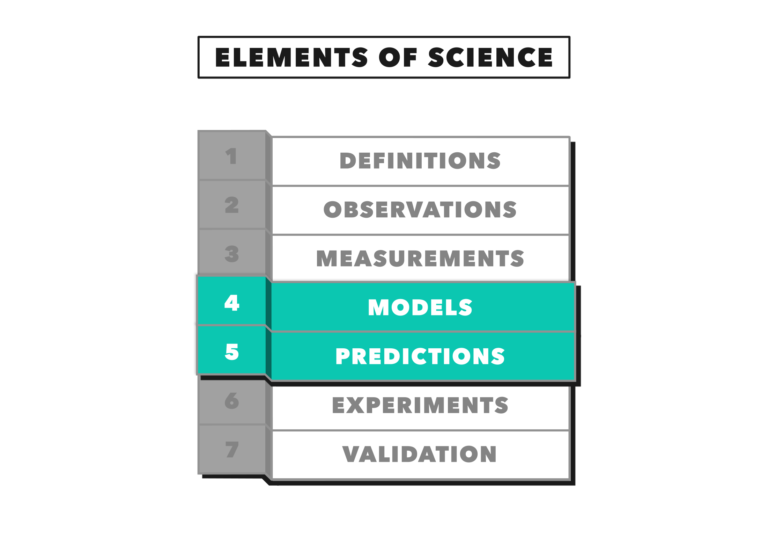
Scientific Models
A scientific model is an extraction of a direction or pattern from observed and measured phenomena: a real-world cause and effect relationship expressed in natural language, logic, or mathematics.
Scientists find patterns in observations: patterns of change and patterns of constancy. To the extent that any model works, it presumes cause and effect to predict the pattern will persist under some minimal set of criteria. Put another way, modeling is an attempt to fix causative conditions from which a particular effect — a predictable event — will ensue.
We can look back at our original discussion of modern science for three definitional claims regarding models (listed in the earlier post as points 4 – 6):
- Science creates models that account for observations of the real world. Science creates objective models that replace private, subjective models. These scientific models account for all relevant facts in their domain and predict new phenomena or relationships.
- Scientific models build on measurements of the observations. Measurements, the result of comparing observations with standards, provide consistency in observations and permit the sharing of experiences in an objective way. Measurements create facts; facts are measurements.
- Scientific models require validation through demonstrated predictions of qualitatively new phenomena or relationships. A qualitatively new phenomenon is one involving different parameters than those that formed the facts the scientist used to create the model.
We can also recall from our previous discussion that every model starts with definitions, made as precise as necessary and possible. From there, the model proceeds like mathematics, bound to follow the precepts of logic. The definitions are a direct link in the chain that connects the model to the real world.
Predictions
This chain connecting science to the real world operates according to two rules:
- Scientists create models from real data or by reasoning from real data.
- Models must admit validation through verification of their predictions of new data.
The objective of scientific modeling is to create generalizing and unifying descriptions that define and incorporate all relevant data and predict results for future experiments.
Put simply, science must do better than chance to a prescribed error level.
The claim of this series is not that the principle of prediction is sufficient in science. The claim is that in order for a science to be complete, prediction is necessary, not sufficient. Any science may be decomposed into a number of constituent parts, some of which would be missing prediction. Scientists can stake out a legitimate scientific career in a portion of their science, such as in making measurements and observations, developing taxonomies, developing and applying databases, or developing theorems. These are tangential or support roles, not primary scientific enterprises.
Prediction is thus proposed as the ultimate objective for science, replacing either simple explanation or description.
Grading Models
With this in mind, four recognizable categories form a natural, progressive system of ranking for models:
- Conjecture: an incomplete but consistent model or a model adapted from another domain and unsupported by relevant data.
- Hypothesis: a model (conjecture) based on existing data, making a non-trivial prediction but yet to receive any validation.
- Theory: a model (hypothesis) based on existing data with supporting confirmation, at least one validating datum, and no counter examples.
- Law: a model (theory) for which all explicit and implicit predictions have been validated to known levels of accuracy.
We will consider these model categories in greater detail in our upcoming discussion of experiments and validation.
For further reading on scientific models, consider Jeff Glassman’s earlier contributions previously published on CrossFit.com:
Comments on Elements of Science: Models & Predictions
3 Comments
When most people hear the words “crypto recovery service, " their guard immediately goes up—and for good reason.
In today’s online environment, finding a legitimate service feels like finding a needle in a haystack. Ask about trusted crypto recovery on any major forum—Reddit, Bitcointalk, or Twitter—and you’ll be met with immediate hostility. It has become a cultural bias: victims often prefer to file police reports (which rarely yield results) rather than seek private help, fearing that speaking openly will only attract more scammers.
But here is the harsh truth: Silence doesn’t bring your funds back.
The reality of the crypto landscape is brutal. Less than 10% of “recovery agencies” online are genuine. Fraudsters have mastered the art of mimicking trust, preying on the desperate and the skeptical alike. So, how do you separate the wolves from the professionals?
The Golden Rule: No Upfront Fees
If there is one single sign that separates a scam from a legitimate operation, it is the payment model.
The Red Flag: Upfront Demands
Predatory scams will always demand money before they lift a finger. They will invent reasons such as:
"Processing fees.
"Software license costs
"Tax payments or legal retainers
If an agency asks you to pay before they recover your assets, walk away. This is not a service; it is a secondary scam designed to bleed you dry after your initial loss.
The Green Flag: Success-Based Fees
A genuine agency knows its value lies in results, not promises. We operate on a transparent, success-based fee structure—typically around 10% of the recovered amount.
Simply put: No recovery, no payment.
We only eat when you do. This aligns our incentives entirely with yours. We don’t want your money upfront; we want to prove our competence by returning what is rightfully yours.
Enter TechY Force Cyber Retrieval
At TechY Force, we understand the skepticism. We’ve seen the forums. We know the stigma. That’s why we built our reputation on transparency, technical expertise, and a zero-risk model for our clients.
We don’t ask for trust blindly; we earn it through action.
How We Work
1. Free Initial Consultation: We analyze your case without cost. If we can’t help, we tell you honestly.
2. Investigation & Tracing: Our cyber-forensic team uses advanced blockchain analytics to trace stolen funds.
3. Recovery Execution: We engage with exchanges, legal entities, and black-hat actors where necessary to secure your assets.
4. Payment Upon Success: You only pay our agreed-upon percentage after the funds are securely returned to you.
Breaking the Cycle of Fear
The crypto industry was built on the idea of decentralization and personal sovereignty. But when things go wrong, isolation is your enemy. Scammers thrive in the shadows of your fear. Professionals thrive in the light of transparency.
Don’t let the fear of secondary scams prevent you from seeking genuine help. Look for the golden rule. Look for the no-upfront-fee guarantee.
Look for TechY Force Cyber Retrieval.
---
Lost crypto? Don’t pay a dime until it’s back. Contact us today for a free, no-obligation case review.
[Website/Contact Page https://techyforcecyberretrieval.com]
[support@techyforcecyberretrieval.com]
---
Tips for Publishing on Medium:
Add Images: Use a high-quality header image related to cybersecurity or blockchain technology. Break up the text with simple graphics showing the "Red Flag vs. Green Flag" comparison.
Tags: Use tags like #Crypto, #CyberSecurity, #Bitcoin, #ScamRecovery, and #Blockchain to reach the right audience.
Call to Action: Ensure your contact link is prominent at the bottom and possibly in the middle of the article.
Stolen Crypto? How to Recover Lost Bitcoin Online: My Experience with Decentralized Codex Security I never believed the stories of recovered cryptocurrency. Like most, I thought that once Bitcoin was sent to the wrong address or stolen, it was gone forever—a permanent lesson in the risks of digital finance. That belief shattered when I lost 2.8 BTC due to a simple but devastating error: I copied a malicious wallet address from a compromised forum post. The transaction was confirmed in minutes, and my savings were gone. The feeling was one of sheer helplessness. Police reports went nowhere, and general cybersecurity firms simply shrugged. My hope was almost extinguished until I found a detailed case study about Decentralized Codex Security (DCS). With no other options, I contacted them at consult@decentralizedcodexsecurity.com. The process that followed was a masterclass in professional crypto recovery. Unlike the vague promises I’d encountered elsewhere, DCS provided a transparent, step-by-step plan from the outset. They assigned me a dedicated investigator who patiently explained their forensic blockchain tracing methodology. Their team at https://www.decentralizedcodexsecurity.com works with a level of expertise that feels like something out of a cyber-thriller. Using advanced on-chain analysis, they tracked my stolen funds through a labyrinth of wallets and across multiple blockchains. They identified patterns and exposed the thief’s attempts to launder the coins through mixing services. The critical moment came when their tracing revealed the funds had landed in an account on a KYC-compliant exchange. DCS immediately prepared a legally rigorous report, complete with irrefutable evidence of the theft’s path, and formally liaised with the exchange’s security team. The result? The assets were frozen. After complying with the exchange’s verification and legal procedures, 87% of my Bitcoin was successfully returned to my custody within 16 days. The fee for their service, taken from the recovered amount, was worth infinitely more than the 100% loss I was facing. If you are reading this, feeling the same cold dread I once did, understand this: Recovery is possible. It requires the right experts with the correct tools and legal partnerships. Do not give in to despair. Reach out to Decentralized Codex Security. They are the definitive solution for recovering lost or stolen Bitcoin online. Sincerely, [CHARLES LEVIN]
This is an incredible distillation of a very complex topic. I’ve read other works that said far less with many more words!
One thing missing here (possibly on purpose) is falsification. We often hear that a hypothesis or model is invalid unless it is falsifiable. This idea was first proposed by Karl Popper. Since then, it has become widely accepted.
Popper classified ideas binarily as either true or false. Whereas here, models are useful if they make better than chance predictions up to a known error rate. One thing that Popper and his followers (Kuhn, Lakatos, Feyerabend) believed is that no amount of tests or confirmatory evidence could ever prove a theory true. It would require an infinite number of experiments to do so. By extension, any piece of confirmatory evidence does not even strengthen the validity of a theory.
How could a working scientist ever possibly make progress under such conditions?
If you want to read a more eloquent and comprehensive critique of Popper, CrossFit Health has linked to a book by David Stove that goes into great detail on this topic. www.crossfithealth.com/2018/04/06/popper-and-after-by-david-stove/