The muscle-up is the moment your ring fundamentals get tested all at once. Pulling strength, pressing strength, false grip control, and technique all have to show up together, in the right sequence, at the right time. Get one piece wrong, and the rep falls apart.
This article, Part 3 of our four-part series, walks through how the muscle-up comes together and the faults that stall most athletes. (Part 1, Part 2)
What the Muscle-Up Actually Requires
Strip away the drama around the muscle-up, and it’s two movements from the last article chained together: a pull-up that continues past its normal range, and a dip that starts from an unusually low position. The false grip makes the connection between the two possible without changing hand position.
Coaches in the calisthenics and gymnastics-strength space are consistent on the prerequisites before you attempt the movement. Daniel Vadnal, founder of FitnessFAQs and a physiotherapist with over a decade coaching calisthenics, points to basic strength benchmarks — roughly 5 strict pull-ups, 5 dips, and 10 push-ups — as the floor before ring work gets serious. That’s a starting point, not a finish line. You’ll likely need pulling strength well beyond a single strict pull-up, plus a false grip you can hold under tension, before a strict ring muscle-up becomes realistic.
Christopher Sommer, the former U.S. national gymnastics team coach and founder of GymnasticBodies, takes this a step further. His approach to ring strength emphasizes strict positional control before anything resembling a full movement: bent-arm work with elbows never drifting forward of the shoulders, false-grip lock-offs held for time, and a slow build in straight-arm strength that most CrossFit programming skips entirely. Sommer’s broader point, drawn from years of coaching both elite gymnasts and adult athletes, is that connective tissue adapts far more slowly than muscle. Rush the muscle-up before your shoulders and elbows can handle the load, and you’ll trade a milestone skill for a nagging injury.
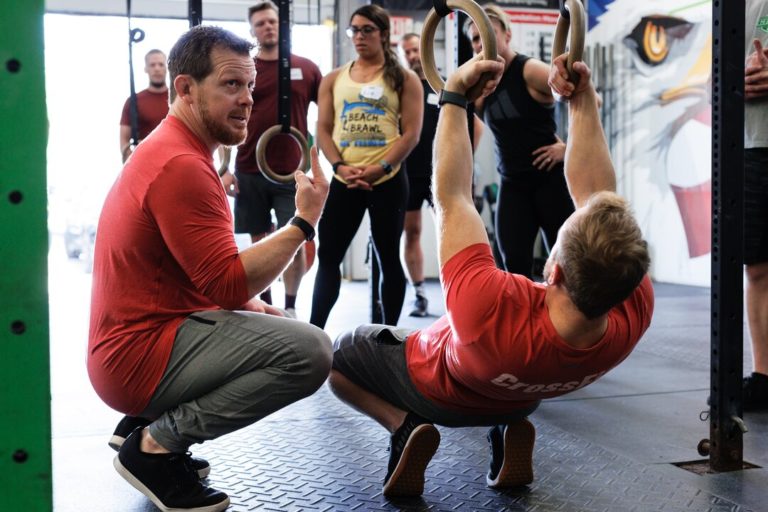
The Progression, In Order
A reasonable progression toward your first ring muscle-up looks something like this:
Strict pulling strength. Ring rows and ring pull-ups, built to a level well past what you need for a single pull-up, since the muscle-up demands pulling your chest above the rings, not just your chin.
False-grip tolerance. False-grip ring rows, false-grip hangs, and false-grip pull-ups, building the grip and forearm endurance to hold the position under load without it slipping mid-rep.
Deep ring dips. Full-range ring dips with control, since a shallow dip won’t prepare you for the bottom position of a muscle-up transition.
The transition drill. Low-ring muscle-up transitions, often practiced with your feet still on the ground or a box, to build the specific movement of pulling your body up and over the rings without the aggressive kip that masks a lack of strength.
Banded or jumping muscle-ups. A reduced-load version of the full movement, used to groove the timing and sequencing before you remove the assistance entirely.
The strict or lightly kipped muscle-up. Once the pieces are in place, attempt the full movement, first with as little kip as possible so you can feel where your strength gaps remain.
Most athletes need two to four weeks in the earlier stages before the full movement becomes realistic, and that timeline stretches if you’re still building baseline pulling and pressing strength.
Where Muscle-Up Attempts Usually Go Wrong
A few faults show up again and again, regardless of who is coaching the movement:
Not pulling high enough and letting the rings flare out. If you can’t pull the rings to your chest, you’ll often pull the rings out to the sides in an attempt to generate momentum, which moves your hands away from the center of your body and makes it harder to transition on top of the rings. Keep your hands close together until they reach your sternum, then drive your chest forward through the rings to position yourself on top of them.
Losing the false grip mid-transition. If you never trained the false grip to the point of being secure under fatigue, it tends to slip exactly at the transition, the one moment you can’t afford it.
Skipping the deep dip. If you’ve only practiced shallow ring dips, the bottom of the muscle-up transition will feel unfamiliar, and you’ll often lose control of the rings right as you need the most stability.
Relying entirely on the kip. A large, uncontrolled kip can get you over the rings once or twice, but it doesn’t build a repeatable skill, and it places significant stress on your shoulders. Coaches across both the CrossFit and gymnastics-strength worlds generally agree that strict strength should come first, with kipping technique layered in afterward as an efficiency tool, not a substitute for missing strength.
The final article in this series moves away from skill acquisition and delves into the role rings play in long-term shoulder health, particularly for athletes who plan to keep training on rings well into their 40s, 50s, and beyond.
About the Author
 Stephane Rochet is a Senior Content Writer for CrossFit. He has worked as a Flowmaster on the CrossFit Seminar Staff and has over 15 years of experience as a collegiate/tactical strength and conditioning coach. He is a Certified CrossFit Trainer (CF-L3) and trains athletes in his garage.