Walk into almost any affiliate, and you will find a pair of rings hanging from a rig or the ceiling. They look simple: two circles, a set of straps, nothing that spins, clicks, or lights up. But few pieces of equipment in the gym demand more from an athlete’s body, or reveal weaknesses faster.
Rings are not an accessory in CrossFit. They are a core part of what CrossFit trains.
A Tool Borrowed From an Unlikely Place
The rings CrossFit athletes train on today trace back nearly two centuries. Friedrich Ludwig Jahn, the German gymnastics pioneer often called the “Father of Modern Gymnastics,” is credited with developing an apparatus in the early 1800s, originally called “Roman rings” because of their earlier roots in Italy. Adolf Spiess later introduced a swinging version in 1842 that he called Ringeschwebel, or “flying rings.” Circular rings eventually replaced that design, and the materials evolved from metal to leather-wrapped metal to the wood-laminate rings used in competition today.
Rings entered the Olympic program at the very first modern Games in Athens in 1896, and men’s rings have been contested at nearly every Olympics since. For most of that history, rings belonged almost entirely to gymnastics, and access to serious ring training was limited to those already competing in that world.
CrossFit changed that. When Greg Glassman built the CrossFit methodology in the early 2000s, he pulled rings out of the gymnastics-only world and put them into general physical preparedness programming alongside barbells, kettlebells, and monostructural conditioning. The ring muscle-up became one of the defining movements of CrossFit and CrossFit athletes. Rings have appeared regularly at the CrossFit Games, from ring dips paired with power cleans in the classic workout Elizabeth, to the muscle-up-heavy Cinco 2 event, to ring handstand push-ups woven into later Games tests. That history reflects something important: CrossFit did not water rings down. It took a demanding gymnastics tool and made it accessible to everyday athletes willing to put in the work.
Rings Do Not Care How Strong You Are on a Fixed Bar
A pull-up bar does not move. A barbell, once loaded, behaves predictably. Rings are different. The moment your hands grip the straps, your shoulders, core, and stabilizers must organize in real time to control two independent points of suspension.
That instability is the point. Ring work demands a level of shoulder stability, scapular control, and midline engagement that fixed equipment simply doesn’t require. An athlete can be strong on a bar and still struggle badly the first time they try a ring row or a support hold, because the rings expose gaps in stabilization that other equipment can hide.
This is why rings show up across so much of CrossFit’s movement library: ring rows, ring dips, ring push-ups, ring pull-ups, ring muscle-ups, and eventually ring handstand push-ups. Each one builds strength that transfers back into barbell work and gymnastics skill under load.
Rings Are Not a Men’s Movement
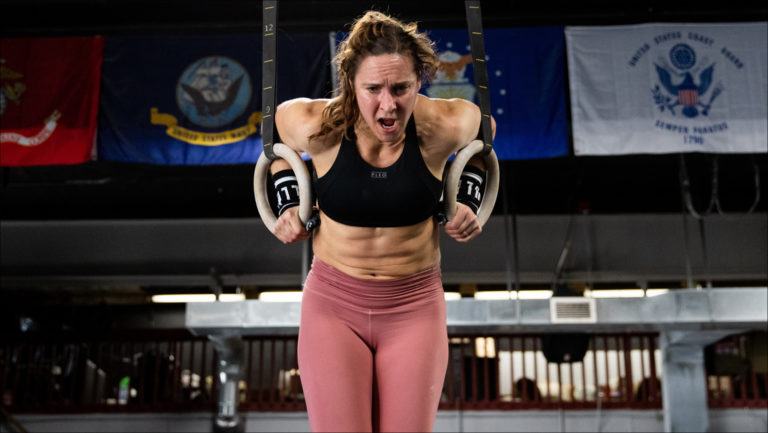
One detail people often miss when they assume CrossFit borrowed rings wholesale from the gymnastics playbook: In gymnastics, rings are a men’s-only apparatus. Women’s artistic gymnastics has never included rings as a competitive event. Women compete on vault, uneven bars, balance beam, and floor. Rings sit alongside the pommel horse as an apparatus reserved for men’s competition.
CrossFit does not honor that division. Women in CrossFit train ring support holds, ring rows, ring dips, ring pull-ups, and ring muscle-ups with the same expectations and programming as men. Some of the sport’s most decorated female athletes, from Games champions to top affiliate competitors, have built ring muscle-ups and strict ring strength into their training. In CrossFit, rings measure what an athlete’s shoulders, core, and grip can do, not what gender is allowed to attempt the movement. That is a meaningful departure from the apparatus’s original sport, and one of the clearest examples of how CrossFit reshaped a piece of gymnastics equipment into something built for every athlete.
Setting Up the Rest of This Series
Rings reward patience. The path from a shaky support hold to a controlled muscle-up is built in stages, and skipping stages is usually where niggling injuries and plateaus creep in.
Over the next three articles, we will walk that path. Part 2 covers ring fundamentals: the support hold, ring rows, ring push-ups, ring dips, and the false grip — the foundation every ring athlete needs before chasing bigger skills. Part 3 builds toward the muscle-up itself, with the progressions and common faults that separate athletes who get stuck from those who progress. Part 4 closes the series by looking at the role rings play in long-term shoulder health as CrossFit athletes age.
Rings have been part of serious training for two hundred years. In CrossFit, they remain a clear test of whether an athlete’s strength has real-world application.
About the Author
 Stephane Rochet is a Senior Content Writer for CrossFit. He has worked as a Flowmaster on the CrossFit Seminar Staff and has over 15 years of experience as a collegiate/tactical strength and conditioning coach. He is a Certified CrossFit Trainer (CF-L3) and trains athletes in his garage.