For Sarah Atkin, PA-C, DMSc, CrossFit is more than a workout. It’s something she has relied on through some of the most physically and emotionally demanding stages of her life, and something that has shaped the way she thinks about overall health as a healthcare provider.
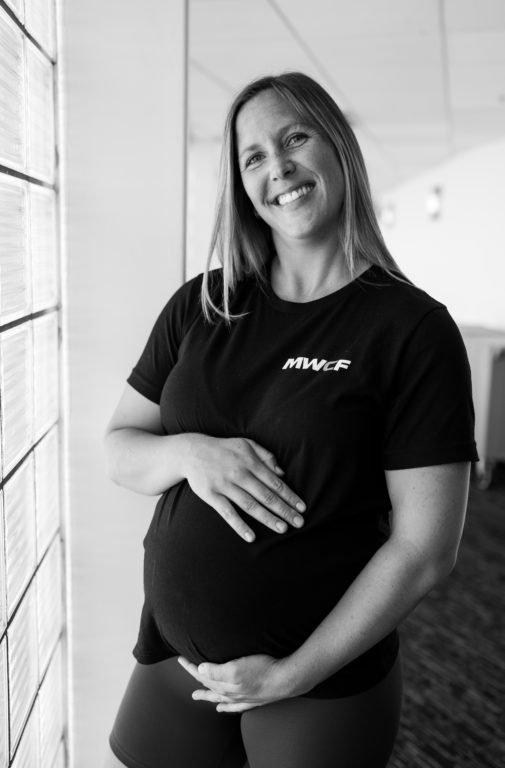
(PHOTO : JOHANY JUTRAS)
A physician assistant in interventional pain management, Atkin works daily with patients managing chronic pain and mobility issues. But her perspective on movement isn’t formed solely by what she sees in the clinic; it’s also shaped by her own experience as a longtime CrossFit athlete.
“CrossFit played an invaluable role in my pregnancy and postpartum journeys,” Atkin said.
Maintaining her strength and aerobic capacity throughout pregnancy helped prepare her physically for labor and contributed to what she describes as a smooth postpartum recovery. But the biggest impact came after giving birth.
“The most important role CrossFit played in my postpartum recovery was mental,” she said.
Returning to the gym gave Atkin something she desperately needed during a major life transition: an hour surrounded by people who had supported her throughout her pregnancy, along with a tangible sense of accomplishment.
Her workouts didn’t always look like they did on the whiteboard. She modified movements and intensity to meet what her body could do at each stage, while still showing up and being part of her community. That consistency helped ground her during a period when so much of life had changed.
Her experience has also reinforced something she sees in her patients: Movement can be intimidating, particularly for people who have spent years associating exercise with pain or injury.
Atkin frequently sees patients who have stopped moving because they’re afraid that doing so will make their pain worse. She describes this as the “fear-avoidance cycle” — the idea that fear of movement can lead to inactivity and deconditioning, which can ultimately increase the risk of injury and reinforce the fear.
This is one way she communicates the approachability of CrossFit.
“If a patient feels ‘too old’ or ‘too out of shape’ to start CrossFit, I remind them of the fear-avoidance cycle,” she said.
For Atkin, the solution isn’t necessarily avoiding challenging movements. It’s finding the right starting point. A skilled coach can modify workouts based on an individual’s abilities, limitations, and comfort level. The benefits she sees in patients who become more active extend well beyond changes on a scale.
Some of the most meaningful victories, she said, are everyday ones: being able to lift groceries into a cart, walk the dog, or load the washing machine with greater ease.
“They are most importantly proud of the independent tasks they can do with greater ease again,” she says.
That idea of maintaining independence is central to Atkin’s philosophy. She believes a comprehensive fitness routine should develop strength, mobility, aerobic capacity, and, perhaps most importantly, a sense of community.
CrossFit checks all four boxes.
The community component has been particularly meaningful to Atkin personally. The people around her weren’t simply workout partners; they became part of her support system through pregnancy and postpartum recovery.
As a healthcare provider, she also sees a connection between exercise and mental well-being. She points to the neurological effects of exercise and the role physical activity can play in mood, energy, and focus. But her own experience illustrates something that can’t always be captured in a clinical setting: Sometimes the value of a workout is simply knowing you showed up.
Atkin is also passionate about changing how women think about strength training during pregnancy and throughout life. She believes outdated assumptions about lifting and exercise during pregnancy are beginning to give way to a more nuanced understanding of what women can safely do with appropriate guidance.
“What we do know is that exercise during pregnancy and postpartum decreases rates of pregnancy and postpartum complications like gestational hypertension and postpartum depression,” Atkin said. “We also know that it’s particularly important for women of all ages to participate in resistance training to reduce the risk of osteoporosis, which typically occurs in menopause.”
“Because of the adaptability of CrossFit to people in all physical ages and stages of life, I believe it is the superior form of exercise that can be started at any point in a woman’s life,” she continued. “We have begun, and will continue to see, the narrative around CrossFit and weight training in pregnancy change as research continues.
Her professional perspective strengthens a belief she has already experienced firsthand: Women shouldn’t have to choose between being strong and being cautious about their health.
For Atkin, CrossFit offers a way to continue building strength and capacity through different stages of life. That may mean scaling a workout during pregnancy, modifying movements postpartum, or simply starting with less than someone once thought they were capable of.
The goal remains the same: Keep moving. Keep getting stronger. Keep showing up.
And for Atkin, that philosophy applies both inside the gym and outside of it.
“I believe CrossFit is the single, most effective training program for preventing chronic illness and maintaining functional independence as we age,” she said.
It’s a belief she brings to her patients every day, but one she first learned by living it herself.
Comments on CrossFit During Pregnancy and Postpartum: How Sarah Atkin Stayed Strong Through Every Stage
0 Comments