If there was ever a training methodology made for the menopausal woman, it’s CrossFit.
That, of course, is my opinion. But I say it as a menopausal woman, an 11-year recreational CrossFit athlete, a CrossFit Level 1 Trainer, and a physician specializing in menopause health and women’s athletic performance.
In the first article, “Training Through Menopause: What Does the Evidence Tell Us,” we saw that the evidence points to resistance training, conditioning, and meaningful loading with enough stimulus to drive adaptation.
Now consider the CrossFit methodology: constantly varied, functional movements performed at relatively high intensity. The overlap is difficult to ignore.
The Things Women Are Often Told To Avoid
CrossFit incorporates squats, deadlifts, presses, Olympic lifts, and carries across a wide range of loads and rep schemes. Cardiovascular conditioning comes through running, rowing, biking, and other modalities, while power and impact are trained through weightlifting and jumping. Together, these develop many of the physical capacities we are trying to preserve through menopause and into later life.
That doesn’t mean every woman entering menopause should start deadlifting heavy or doing 24-inch box jumps. Scalability is central to CrossFit methodology. A box jump can become a lower jump or step-up; a pull-up can become a banded pull-up or ring row. Load, repetitions, range of motion, speed, and duration can all be modified while preserving the intended training stimulus.
Menopausal women don’t necessarily need different exercises. They sometimes need a different dose.
But Isn’t CrossFit Too Intense?
High intensity does not mean maximal intensity. In CrossFit, intensity is relative to the individual. A 28-year-old firefighter and a 70-year-old woman six months post hip replacement surgery can perform versions of the same workout, each at an intensity appropriate for their abilities.
That intensity can also change from one day to the next. If hot flashes kept her awake half the night, yesterday’s training left her unusually fatigued, or something simply doesn’t feel right, reducing load, repetitions, speed, or complexity may be appropriate. On another day, she may be well-recovered and ready to push.
CrossFit provides a useful framework: mechanics, consistency, then intensity. Learn to move well, demonstrate consistency, then progressively increase the challenge. Load and speed should follow movement proficiency while scaling preserves the intended stimulus.
What About Injury?
CrossFit has a reputation in some circles for being dangerous. Injuries occur in CrossFit, as they do in running, weightlifting, recreational sports, and virtually every form of physical training. But the available literature does not establish an unusually high injury rate compared with other strength-training activities. A systematic review of 25 studies involving more than 12,000 CrossFit participants found injury incidence similar to weightlifting and powerlifting. A prospective study by Moran and colleagues reported 2.1 injuries per 1,000 training hours. The evidence has limitations, including inconsistent injury definitions and reliance on retrospective studies, so concerns about injury shouldn’t simply be dismissed.
Instead, they bring us back to how CrossFit is implemented.
CrossFit done badly can absolutely be a bad choice for a menopausal woman or any athlete. So can almost any exercise program done badly.
If an athlete cannot maintain safe mechanics, a skilled CrossFit coach reduces the load or stops the workout, and intensity builds only after mechanics and consistency are in place. This is where coaching becomes critical.
The Coach Matters
A good coach isn’t simply standing beside the whiteboard counting repetitions. They should understand the intended stimulus, know the athlete in front of them, recognize deteriorating mechanics, and adjust the workout accordingly.
The athlete has responsibilities too. Menopausal women need to feel comfortable telling their coach when something may affect training. Communication helps determine whether today is a day to push or modify.
And sometimes good coaching means telling an athlete who wants to go harder to back off. The leaderboard should never outrank the athlete standing in front of it.
Training for More Than Menopause
Perhaps my favorite argument for CrossFit has little to do with menopause specifically. CrossFit describes fitness through 10 general physical skills: cardiovascular endurance, stamina, strength, flexibility, power, speed, coordination, agility, balance, and accuracy. Viewed through the lens of aging, that list looks a lot like a blueprint for maintaining physical independence and longevity.
We aren’t training simply to improve a DXA scan, maintain muscle mass, or lower blood pressure. We’re training to carry our own luggage, shovel snow, hike mountains, kayak, chase grandchildren, react when we trip, and continue saying yes to physically demanding things for decades.
But building those capacities for a lifetime requires more than a good exercise prescription. It requires an environment that keeps people engaged. This is where another defining feature of CrossFit becomes important: community. Affiliates bring together people who may differ enormously in age and ability but share the goal of becoming stronger, fitter, and more capable. They train alongside one another, struggle through workouts together, celebrate progress, and build relationships around the shared pursuit of health and fitness.
Menopause may be the reason we’re having this conversation, but longevity is the larger goal. When I look at what the evidence tells us women need during and beyond menopause, and then at a methodology built around strength, conditioning, power, functional movement, relative intensity, scalability, coaching, and community, the alignment is striking.
Which brings me back to where I started: If there was ever a training methodology made for the menopausal woman, it’s CrossFit.
In Part 3, we’ll cover how women’s nutritional needs change with age.
References
- CrossFit, LLC. CrossFit Level 1 Training Guide. CrossFit, LLC; 2020.
CrossFit Level 1 Training Guide - Rodríguez MÁ, García-Calleja P, Terrados N, Crespo I, Del Valle M, Olmedillas H. Injury in CrossFit®: a systematic review of epidemiology and risk factors. Phys Sportsmed. 2022;50(1):3-10. doi:10.1080/00913847.2020.1864675.
PubMed - Moran S, Booker H, Staines J, Williams S. Rates and risk factors of injury in CrossFit™: a prospective cohort study. J Sports Med Phys Fitness. 2017;57(9):1147-1153. doi:10.23736/S0022-4707.16.06827-4.
PubMed - Montalvo AM, Shaefer H, Rodriguez B, Li T, Epnere K, Myer GD. Retrospective injury epidemiology and risk factors for injury in CrossFit. J Sports Sci Med. 2017;16(1):53-59.
PubMed
About the Author
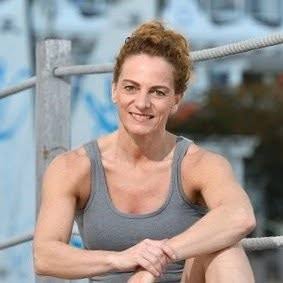 Dr. Carla DiGirolamo (Cf-L1) is a board-certified obstetrician-gynecologist, reproductive endocrinologist, and Menopause Society Certified Practitioner with nearly two decades of experience in women’s hormonal health and performance care. Drawing on her background in the fitness industry, she takes a holistic approach to wellness and performance, using fitness and nutrition as the foundation and integrating medical therapy as needed to help women thrive.
Dr. DiGirolamo earned her medical degree from Wake Forest University School of Medicine in 2001, completed her residency in obstetrics and gynecology at Brown University and Women & Infants Hospital, and completed her fellowship in reproductive endocrinology at Harvard University and Massachusetts General Hospital.