For years, exercise advice for women approaching menopause often sounded remarkably similar: walk more, add some light weights, stretch, and perhaps take up yoga.
We now know that advice was woefully inadequate.
The problem wasn’t simply what the advice included. It was what it left out — and what women were implicitly discouraged from doing: lifting heavy, training hard, jumping, running, and pursuing strength and fitness with intensity.
The menopause transition brings physiologic changes that extend well beyond hot flashes and disrupted sleep. Declining estrogen is accompanied by changes in bone, skeletal muscle, body composition, metabolism, and cardiovascular risk. These changes are not reasons for women to retreat from challenging exercise; they are compelling reasons to preserve it.
So what does the evidence actually tell us?
The answer is reassuringly straightforward: women need to lift, move, and challenge multiple physiologic systems.
The strongest evidence supports resistance training and aerobic exercise, with appropriate impact and sufficient intensity to create meaningful adaptation. Importantly, the research does not support a specialized “menopause workout” or entirely different training rules for menopausal women. Instead, it shows us which training stimuli matter.
Strength and Muscle: Keep Lifting
Maintaining skeletal muscle becomes increasingly important as women age. A 2026 narrative review reports lean muscle mass reductions of approximately 2.5% in perimenopause and 5.7% in postmenopause when compared with premenopausal women measured by DXA scan. Handgrip strength is a well-accepted marker of overall muscle strength. The Finnish/ERMA FLAME cohort found a statistically significant 2.1% decline in handgrip force across the menopausal transition.
Resistance training is one of our most powerful tools for preserving muscle mass and strength. A large systematic review and meta-analysis of 101 randomized trials involving nearly 5,700 postmenopausal women found that exercise increased muscle and fat-free mass while reducing fat mass, body-fat percentage, waist circumference, and visceral fat. Resistance and combined resistance-plus-aerobic training were particularly effective for increasing muscle mass.
For women and coaches, the message is simple: Keep lifting. And make the lifting sufficiently challenging to drive adaptation.
Bone: It Needs a Reason to Adapt
Bone deserves special attention during the menopause transition because declining estrogen accelerates bone loss. In the Study of Women’s Health Across the Nation (SWAN), bone loss accelerated about one year before the final menstrual period and remained elevated for about two years afterward. Over the 10-year study period, women lost an average of 10.6% of bone mineral density at the lumbar spine and 9.1% at the femoral neck, with much of that loss concentrated in the window surrounding menopause.
But bone is responsive tissue. Like muscle, it needs a reason to adapt.
A 2025 network meta-analysis involving 49 trials and 3,360 postmenopausal women found that combined aerobic and resistance training produced the largest improvements in bone mineral density at the lumbar spine and femoral neck. Resistance training also performed well, while lower-load activities such as walking were less effective.
The LIFTMOR (Lifting Intervention for Training Muscle and Osteoporosis Rehabilitation) trial provides an important example. In postmenopausal women with low bone mass, supervised high-intensity resistance and impact training improved bone density at the spine and hip.
This does not mean every woman entering menopause should suddenly lift near-maximal loads or jump onto a box. Training must reflect her experience, capacity, bone health, and medical considerations.
But the larger point matters:
Menopause is not, by itself, a reason to remove meaningful loading from training.
Conditioning Still Matters
Strength is only part of the equation.
Aerobic conditioning matters just as much.
The menopause transition is also associated with changes in body-fat distribution, glucose regulation, lipids, blood pressure, and cardiovascular risk. That makes aerobic conditioning equally important.
Across 39 trials involving more than 2,000 postmenopausal women, exercise improved waist circumference, triglycerides, HDL cholesterol, fasting glucose, and blood pressure. Moderate-intensity combined aerobic and resistance training was particularly effective.
A 2025 meta-analysis of 61 trials and approximately 4,100 postmenopausal women also found that aerobic exercise reduced blood pressure and favorably changed lipids. Resistance exercise contributes as well, with evidence supporting improvements in blood pressure and arterial stiffness.
Once again, the evidence argues against an either/or approach.
Women need strength and conditioning.
What About Training Order?
Once we agree women benefit from both, does it matter how we put them together?
Should strength come before conditioning? Should aerobic and resistance exercise be performed on separate days?
Here, it is important to distinguish what we know from what we think we know. The menopause-specific literature is surprisingly limited.
Only one randomized trial directly examined exercise order in older women. After 10 weeks, whether aerobic or resistance exercise came first did not significantly affect body composition, muscle strength, or functional performance. What did matter was intensity: moderate-intensity combined training produced greater improvements in dynamic balance than lower-intensity training, while all groups improved strength and gait performance.
Likewise, no postmenopausal-specific study identified in the literature directly compared performing aerobic and resistance training in the same session versus different days.
While the broader exercise literature may inform programming, we should be careful not to treat extrapolation as menopause-specific evidence.
Sometimes the scientifically accurate answer is simply: We don’t know yet.
What We Do Know
When we step back from individual studies, a remarkably consistent picture emerges.
Menopausal women benefit from resistance training and aerobic conditioning. Bone benefits from meaningful loading and appropriate impact. Metabolic and cardiovascular health benefit from regular conditioning. And training needs enough stimulus to create adaptation.
What the literature does not tell us is that menopause requires women to abandon intensity, avoid heavy resistance training, or replace challenging exercise with gentler movement simply because they have reached a particular age or reproductive stage.
Training may need to be individualized. A woman struggling with sleep, vasomotor symptoms, injury, osteoporosis, or inadequate recovery may require adjustments. A woman beginning resistance training at 55 should not train identically to a 55-year-old who has been lifting for 20 years.
But that is good coaching — not a different physiology of exercise reserved for menopause.
Perhaps the most useful message from the literature is not that menopausal women need a special way to train, but that they need continued access to the training stimuli that help preserve the capacities menopause and aging increasingly threaten: muscle, strength, bone, metabolic health, and cardiovascular fitness.■
References
- Greendale GA, Sowers M, Han W, et al. Bone mineral density loss in relation to the final menstrual period in a multiethnic cohort: results from the Study of Women’s Health Across the Nation (SWAN). J Bone Miner Res. 2012;27(1):111-118. doi:10.1002/jbmr.534. PubMed
- Pouillès JM, Tremollières F, Ribot C. Premenopausal and postmenopausal changes in bone mineral density of the proximal femur measured by dual-energy X-ray absorptiometry. Osteoporos Int. 1995;5(1):1-7. PubMed
- Xiaoya L, Junpeng Z, Li X, et al. Effect of different types of exercise on bone mineral density in postmenopausal women: a systematic review and network meta-analysis. Sci Rep. 2025;15:11740. doi:10.1038/s41598-025-94510-3. PubMed
- Watson SL, Weeks BK, Weis LJ, Harding AT, Horan SA, Beck BR. High-intensity resistance and impact training improves bone mineral density and physical function in postmenopausal women with osteopenia and osteoporosis: the LIFTMOR randomized controlled trial. J Bone Miner Res. 2018;33(2):211-220. doi:10.1002/jbmr.3284. PubMed
- Khalafi M, Habibi Maleki A, Sakhaei MH, et al. The effects of exercise training on body composition in postmenopausal women: a systematic review and meta-analysis. Front Endocrinol (Lausanne). 2023;14:1183765. doi:10.3389/fendo.2023.1183765. PubMed
- Grzyb K, Candow DG, Schoenfeld BJ, Bernat P, Butchart S, Neary JP. Effect of equal volume, high-repetition resistance training to volitional fatigue, with different workout frequencies, on muscle mass and neuromuscular performance in postmenopausal women. J Strength Cond Res. 2022;36(1):31-36. doi:10.1519/JSC.0000000000003422. PubMed
- Medeiros LHL, Sandbakk SB, Bertazone TMA, Bueno Júnior CR. Comparison of periodization models of concurrent training in recreationally active postmenopausal women. J Strength Cond Res. 2022;36(4):977-983. doi:10.1519/JSC.0000000000003559. PubMed
- Shiotsu Y, Yanagita M. Comparisons of low-intensity versus moderate-intensity combined aerobic and resistance training on body composition, muscle strength, and functional performance in older women. Menopause. 2018;25(6):668-675. doi:10.1097/GME.0000000000001060. PubMed
- Tan A, Thomas RL, Campbell MD, Prior SL, Bracken RM, Churm R. Effects of exercise training on metabolic syndrome risk factors in post-menopausal women—a systematic review and meta-analysis of randomised controlled trials. Clin Nutr. 2023;42(3):337-351. doi:10.1016/j.clnu.2023.01.008. PubMed
- Zhang T, Kabachkova AV, Deng Z, et al. Effect of different exercise interventions on metabolic syndrome risk factors in postmenopausal women: a network meta-analysis. Front Physiol. 2025.
This is particularly useful because it allows us to support the article’s broader argument that different exercise modalities contribute different benefits rather than suggesting that one modality addresses every metabolic outcome. It is included in your supplied OpenEvidence bibliography. - Carpeggiani Weber A, Borges Migliavaca C, Lacerda Tavares A, et al. Impact of aerobic exercise on cardiovascular and mental health in postmenopausal women: a systematic review and meta-analysis. Menopause. 2025;32(8):779-789. doi:10.1097/GME.0000000000002552. PubMed
- Zhou WS, Zheng TT, Mao SJ, et al. Comparing the effects of different exercises on blood pressure and arterial stiffness in postmenopausal women: a systematic review and meta-analysis. Exp Gerontol. 2023;171:111990. doi:10.1016/j.exger.2022.111990. PubMed
- Nappi RE, Chedraui P, Lambrinoudaki I, Simoncini T. Menopause: a cardiometabolic transition. Lancet Diabetes Endocrinol. 2022;10(6):442-456. doi:10.1016/S2213-8587(22)00076-6. PubMed
- El Khoudary SR, Aggarwal B, Beckie TM, et al. Menopause transition and cardiovascular disease risk: implications for timing of early prevention: a scientific statement from the American Heart Association. Circulation. 2020;142(25):e506-e532.
- Menzies C, Bowtell R, Shur N, Brook MS. Menopause, Female Sex Hormones, Skeletal Muscle Mass and Muscle Protein Turnover in Humans.(https://onlinelibrary.wiley.com/doi/10.1002/jcsm.70232 ) Journal of Cachexia, Sarcopenia and Muscle. 2026.
- Bondarev D, Finni T, Kokko K, et al. Physical Performance During the Menopausal Transition and the Role of Physical Activity. (https://pubmed.ncbi.nlm.nih.gov/33230535) The Journals of Gerontology. Series A, Biological Sciences and Medical Sciences. 2021.
About the Author
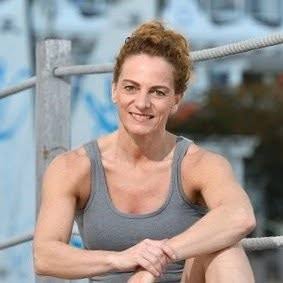 Dr. Carla DiGirolamo (Cf-L1) is a board-certified obstetrician-gynecologist, reproductive endocrinologist, and Menopause Society Certified Practitioner with nearly two decades of experience in women’s hormonal health and performance care. Drawing on her background in the fitness industry, she takes a holistic approach to wellness and performance, using fitness and nutrition as the foundation and integrating medical therapy as needed to help women thrive.
Dr. DiGirolamo earned her medical degree from Wake Forest University School of Medicine in 2001, completed her residency in obstetrics and gynecology at Brown University and Women & Infants Hospital, and completed her fellowship in reproductive endocrinology at Harvard University and Massachusetts General Hospital.
Comments on Training Through Menopause: What Does the Evidence Tell Us? (Part 1 of 3)
3 Comments
Great article. I suspect this concept would also apply to men with little or no testosterone.
Great article and recommendations, thank you! Looking forward to part 2 and 3.
Strong write up in favor for strong women no matter what age. Looking forward to part 2 Dr. DiGirolamo. Andy