Ask ten coaches what a beginning coach should focus on first, and you’ll get ten different answers. But spend enough time developing coaches at scale — across courses, mentorship programs, and affiliate floors worldwide — and patterns emerge.
We put four questions to our education team: which competencies matter most early on, which development methods actually work, where do new coaches consistently struggle, and how do you balance the classroom with the coaching floor? What follows is a frank look at how coaching skill is built and what it takes to make knowledge stick.
WHAT SKILLS OR COMPETENCIES ARE MOST IMPORTANT FOR YOU TO DEVELOP FIRST AS A BEGINNING COACH?
Most effective answers share a common thread: there’s a progression. You need to build in sequence from knowledge to application to relational skill, and the experience that cements it all comes through supervised practice, mentoring, and feedback.
Start with knowledge. Before you can teach a movement, you need a functional understanding of its points of performance and a basic grasp of how to communicate them simply and precisely. (All of these progressions and points of performance can be found in the CrossFit Level 1 Training Guide.) This matters more than most new coaches expect because teaching accelerates seeing. When you work through a sound movement progression — say, the push jerk progression taught at the Level 1 Certificate Course — athletes move better immediately, which in turn trains your eye. Fewer faults on the floor mean cleaner patterns to study. The technical knowledge doesn’t just inform your coaching; it creates the conditions for your observation to develop.
From there, the most practical tool you can have is a simple, repeatable teaching system you can overlay onto any movement in any class. Tell-Show-Do-Check does exactly that. Tell athletes what you want them to do and how to do it. Show them. Let them do it. Check what happened. That sequence keeps the class moving, gives you a diagnostic lens — is this a telling problem? A showing problem? — and scales from beginner to advanced coaching. The difference between a good coach and a great one isn’t whether you use this framework; it’s how well you execute it.
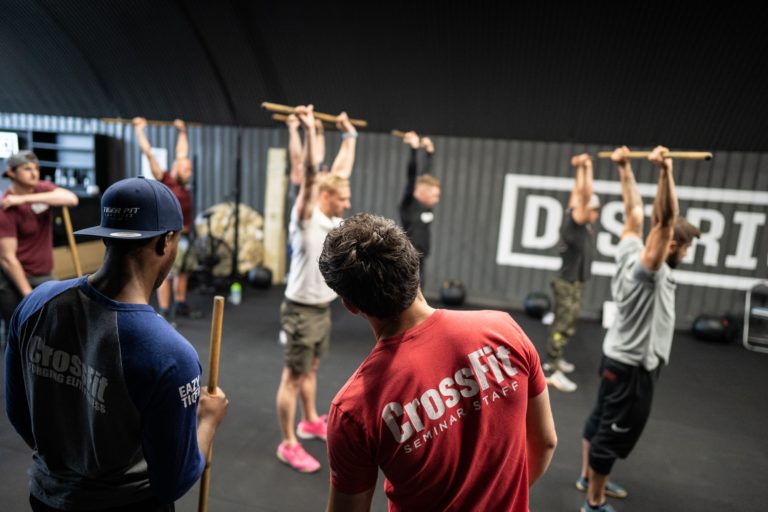
Once the technical foundation is in place, your effectiveness becomes relational. Building rapport, reading the room, and knowing how to interact with athletes in a way that earns trust are what allow your technical knowledge to land. And early on, that often starts simply: make eye contact, learn names, and, for a while, focus on one athlete per rep. Class-wide awareness comes with experience. Trying to coach the whole room before you’ve developed your coaching eye is likely to spread your attention too thin before you’ve built the foundation to support it.
What holds all of this together is time on the floor and consistent feedback. Supervised practice and mentorship compress the learning curve in ways that no amount of study can replicate.
WHICH EDUCATION OR MENTORING METHODS WILL SERVE YOU BEST AS A NOVICE COACH?
Frequent observation followed by immediate application is the most effective method. In our Level 1 and Level 2 Courses, you don’t just sit through lectures; you watch highly experienced trainers coach in real time, then practice the same skills yourself during the same session. That cycle of observe, attempt, receive feedback, and adjust mirrors how athletic skill is developed, and it works just as well for coaching skill.
Mentorship under experienced coaches is equally critical, and we build it into our model at the affiliate level. Reading about how to handle an athlete who is frustrated, fearful, or plateauing is useful, but watching a skilled coach navigate that moment in real time, and then being coached through your own attempt at it, is where real development happens.
Cohort-based learning also significantly accelerates development. When you learn alongside peers, debrief together, and give each other feedback in a structured environment, you build both skill and the habit of reflective practice faster than you would learning in isolation.
WHAT COMMON CHALLENGES WILL YOU Likely FACE As a Newer Coach, AND HOW CAN YOU ADDRESS THEM?
The most universal challenge is the gap between knowing and doing — specifically, the ability to see a fault, correct it in the moment, and prescribe the appropriate dose of intensity. You may understand a movement conceptually but still struggle to identify what’s going wrong in real time, especially in dynamic situations. The solution is extensive observation practice: not just watching movement, but observing with a specific diagnostic lens and then verbalizing what you see.
One underrated step is to deliberately progress from one-on-one to group settings. Some of the most valuable development happens in introductory-style individual sessions, where you have the space to really assess movement, experiment with a range of corrective strategies, and focus without the added complexity of group management. That foundation makes the leap to class coaching significantly less overwhelming.
A second common challenge is managing the emotional dimension of coaching, which doesn’t get enough attention. Early on, you may struggle to earn athletes’ respect, and that pressure is real. Some coaches overcorrect by trying too hard to be liked; others go rigid in their standards. And many quietly battle imposter syndrome: Who am I to be coaching these guys? None of these responses serves your athletes well. Learning to hold high expectations with genuine compassion — to correct without deflating, to push without pressuring — requires more than curriculum. It requires modeling, practice, and feedback in real human interactions.
Finally, you will likely struggle with adaptability. You prepare a plan, only to get shell-shocked when an athlete doesn’t respond to the cue you expected to work. This isn’t a knowledge problem so much as a repetition problem; you simply haven’t yet logged enough time under tension to know when and how to deviate from the plan. The goal is to develop multiple tools for the same problem: different cues, progressions, and entry points. When the first approach doesn’t land, pivot instead of repeating yourself louder.
HOW DO YOU BALANCE THEORETICAL KNOWLEDGE AND PRACTICAL EXPERIENCE IN YOUR DEVELOPMENT AS A COACH?
Think of theory and practice not as competing priorities but as a reinforcing cycle, and be deliberate about never letting them get too far apart. In movement-based instruction, a lecture is rarely the end of a learning sequence. Theoretical content is introduced, tested in a practical setting, then debriefed and refined. That loop — tell, do, check — repeats throughout your development and proves just as effective whether it’s happening on the floor or on camera.
Not every topic lends itself to immediate hands-on application. Content areas like nutrition and programming are different — the theory stands on its own, and the practical integration happens over time, on the coaching floor, as you begin applying frameworks to real athletes and real classes.
What holds true across all of it is this: theoretical knowledge without practical application tends to stay abstract and won’t transfer reliably under the pressure of actually coaching people. Conversely, practical experience without a theoretical framework produces coaches who can do things but can’t explain, teach, or consistently replicate them. The framework gives you a language and a structure; the practice gives you the feel and the judgment. You must understand the foundational frameworks of CrossFit methodology to deliver the most benefit to your athletes — that’s non-negotiable.
As you develop, the balance shifts toward nuance and complexity, but the underlying principle stays the same. Master what you know before layering on more. There’s no shortage of knowledge available to you, and the temptation to keep accumulating it is real. But knowledge that doesn’t make it to the coaching floor isn’t serving anyone. The goal is always integration: understanding why something works and experiencing it working, in that order, over and over again.
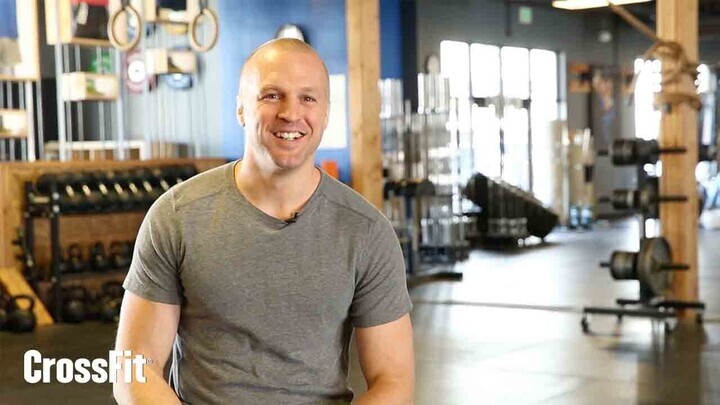 Eric O’Connor is a Content Developer and Seminar Staff Flowmaster for CrossFit’s Education Department and the co-creator of the former CrossFit Competitor’s Course. He has led over 400 seminars and has over a decade of experience coaching at a CrossFit affiliate. He is a