A CAP class plan is a complete coaching document. Every section serves a specific purpose, and knowing what each one contains is the difference between a coach who runs class with confidence and one who improvises. This guide walks through each section in order so you know exactly where to look, what to expect, and how to use it.
In this instance, we’re going to use the class plan for August 9, 2026.
The Workout
This section presents the workout of the day in three variations: Rx’d, Intermediate, and Beginner. Each version is written as a complete, standalone prescription so any athlete can find their starting point.
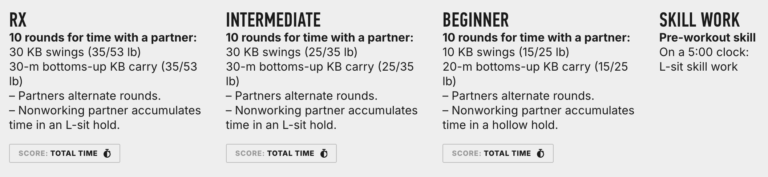
The Intermediate and Beginner variations are suggestions. They are one way to modify the workout, but not the only way. Think of each category less as a fixed tier and more as a point on a sliding scale. An athlete might follow the Intermediate loading but the Rx’d movement standard, or land somewhere between Beginner and Intermediate on volume. The variations give you and your athletes a reference point; good judgment fills in the rest.
The goal of any scaling decision is to preserve the intended stimulus of the workout. That is the standard every modification should be measured against, not comfort, and not participation for its own sake. We scale to progress, not to participate.
Skill Work
With the workout in mind, the next thing to review is the skill work. This section covers accessory or technique work to be completed either before or after the workout. These pieces are typically complementary to the movements in the workout; they reinforce a pattern, build capacity at a weak link, or give athletes extra practice on something they will see on the clock.
Skill work is also a great place to reinforce the monthly focus. If there is a theme running through the programming cycle, this section is where you can build on it with additional quality reps outside of the scored workout.
You will also find opportunities here to build load on a lift that appears in the workout. This gives athletes a chance to develop strength or confidence in a movement before it shows up under fatigue.
That said, skill work is secondary to the workout. If the class needs extra time, whether that is more coaching, a longer warm-up, or simply finishing on time, skill work is the first thing to cut. Do not sacrifice the main event to fit it in.
Intended Stimulus
Knowing what the workout is only answers half the question. This section answers the other half: What is it supposed to feel like?
Everything you need to calibrate effort and scaling is here. Expected finishing times, anticipated rounds or reps, how long a particular movement should take, how heavy the loading should feel, and how many reps an athlete should be able to string together are all specified. Think of it as the programmer talking directly to you, describing the experience a well-prepared athlete should have from start to finish.
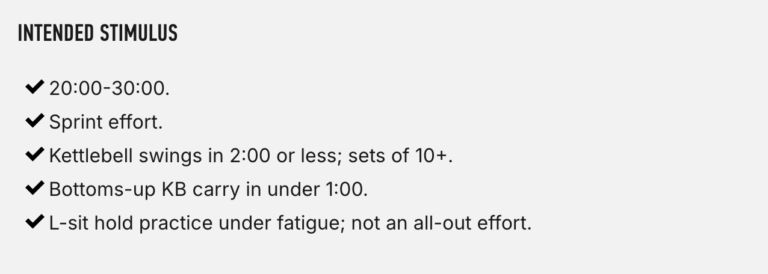
This section also answers the bigger question: what are you actually training today? The intended stimulus is the standard against which every coaching and scaling decision should be measured. If an athlete’s modification takes them outside it, whether they finish too fast, rest too long, or grind through a load meant to move quickly, something needs to adjust. When in doubt, come back here.
Coaching Goals
While the intended stimulus tells you what the workout should feel like, this section tells you what you should be doing about it. These are the priorities for the class: where to put your eyes, what to cue, and what to address before problems compound.
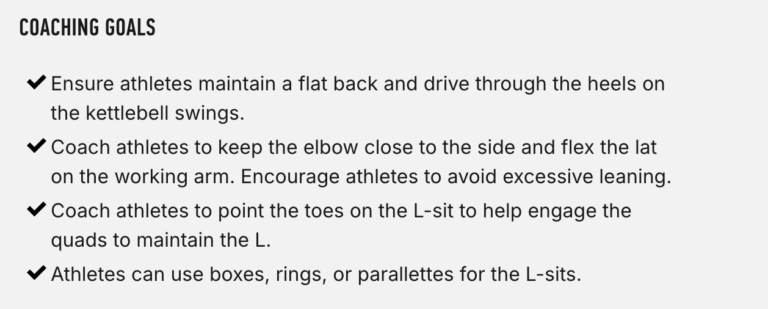
You will find specific positions and movement standards to focus on, along with the errors most likely to show up in the day’s movements. Rather than trying to coach everything at once, use this section to narrow your focus to what matters most on this particular day. A coach who is looking for one or two specific things will catch and correct them far more reliably than one who is scanning for everything.
The coaching goals are also a useful prep tool before class. Read them alongside the intended stimulus and the workout, and you will walk onto the floor knowing exactly what success looks like and what stands in its way.
Video Overview
Before diving into the operational details of the class, take a few minutes to watch the video overview. This is the programmer walking you through the class plan directly and providing context that does not always fit neatly into the written fields. It covers why this workout was programmed, what the programmer hopes athletes will feel, and any nuances in the scaling philosophy worth knowing before you coach it.
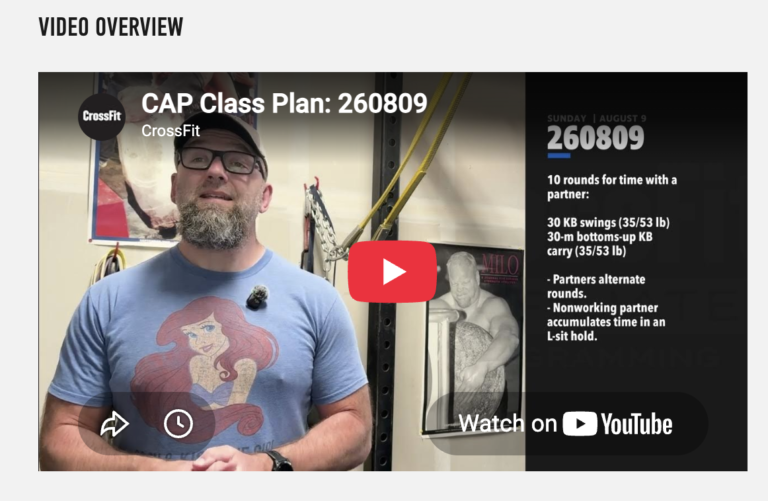
If a video is attached, watch it before class. It often surfaces intent that the written plan cannot fully capture.
Scaling Overview and Movement Substitutions
With a clear picture of the stimulus and coaching priorities, this section provides the practical toolkit for modifying the workout in real time. It is organized in a deliberate order that mirrors the priority of scaling decisions: start with loading, then consider volume, and only adjust movements when necessary. Working through that sequence keeps the stimulus intact for as long as possible before making more significant changes.
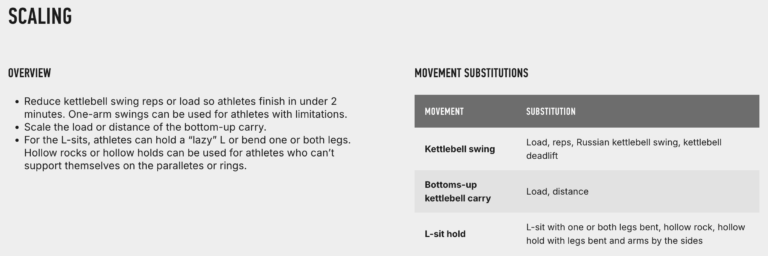
The movement substitutions go deeper, providing specific alternatives for each skill or strength-gated movement in the workout. When an athlete cannot perform a movement as written, this is where you find the right swap, not just any modification, but one that preserves the movement’s intent within the workout.
Read this section alongside the intended stimulus. Every substitution and scaling decision should point back to the same question: Does this still get the athlete where the workout is trying to take them?
Logistics
Once you understand the workout and how to scale it, it is time to figure out how to actually run the class. The logistics section handles the operational side and is where you go to answer the practical questions that must be resolved before athletes walk in the door.
You will find three alternative workout prescriptions here: At-Home, Masters 55+, and Odd-Object variations. Each is a complete rewrite of the workout tailored to a specific context or population, not simply a load reduction.
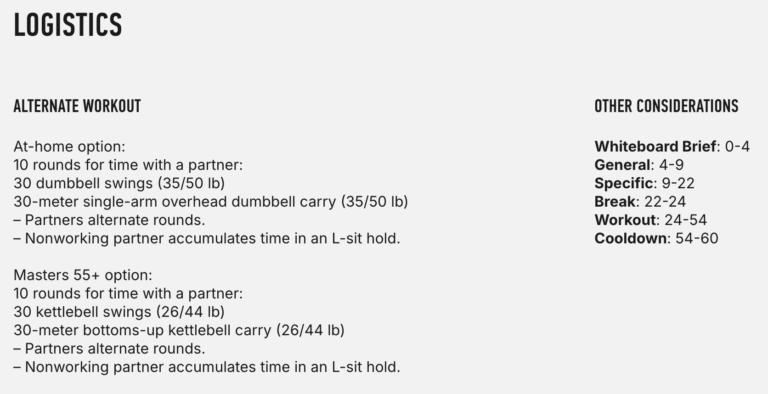
Logistics also includes a general timeline breakdown for the class, showing how much time is allocated to each section from warm-up through cool-down. Use this as a pacing guide to keep the class on track and ensure the workout gets the time it deserves.
Any equipment or space considerations are addressed here, including what is needed, how to arrange it, and what to do when you do not have everything on the list. If the gym is short on a particular piece of equipment, this section will offer options to accommodate the limitation so no athlete is left without a path forward.
Finally, if class size requires running multiple heats, you will find guidance here on structuring them. Knowing this in advance lets you manage transitions smoothly and keep the class’s energy consistent from the first heat to the last.
Video Resources
With the logistics sorted, this section gives you and your athletes a curated library of reference videos for the day’s class. You will find movement demonstration videos covering the workout itself, the skill work, and the cool-down, providing a visual reference for every major part of the session.
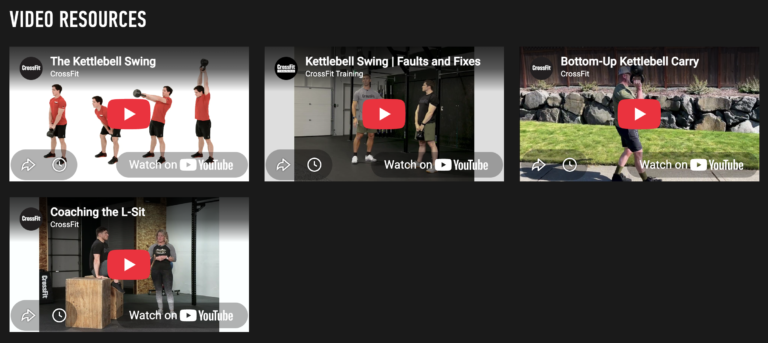
Coaching demonstration videos are also included here. These go beyond showing what a movement looks like and get into how to teach and cue it. This is especially useful if you want to sharpen your delivery before class or reference a specific teaching progression on the spot.
Pull up the relevant videos during the specific warm-up when introducing movements, or point athletes to them between classes for self-directed review. The more familiar you are with this section before class, the more confidently you can direct athletes to the right resource in the moment.
Whiteboard Brief
Armed with all of the above, you are ready to talk to your athletes. The whiteboard brief gives you the talking points you need to set the class up for success: what the workout is, what athletes should expect, and how to approach it.
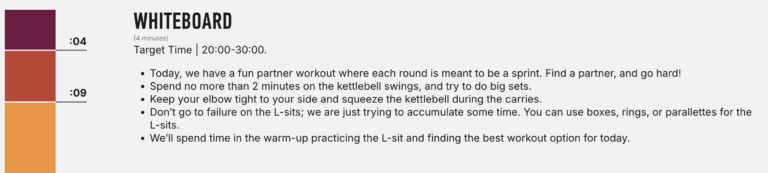
A good whiteboard brief answers three things: what athletes are doing, what it should feel like, and what decisions they need to make before they start. That last piece is critical. Athletes should walk away from the whiteboard knowing exactly how to scale their loading, manage their pacing, and structure their sets to hit the intended stimulus.
Keep it focused and keep it brief. This talk should come in at four minutes or less. The whiteboard brief is not the place to cover everything; it is the place to cover the right things. A clear, confident delivery here sets the tone for the entire class.
General Warm-Up
With the brief done, it is time to get the body moving. The general warm-up does exactly what the name suggests: it elevates heart rate, increases range of motion, and begins priming the movement patterns athletes will encounter in the workout.
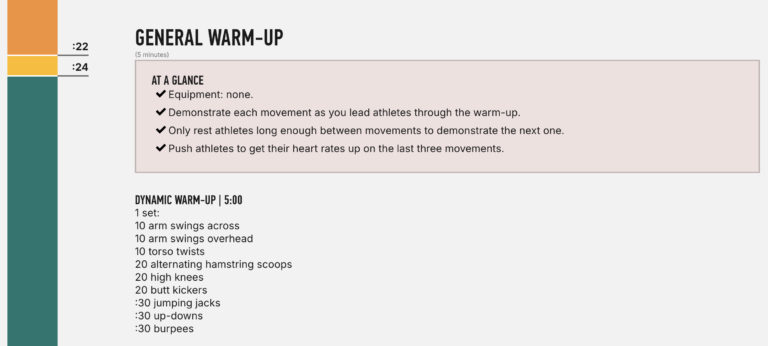
The movements in this section tend to mirror what is to come, so athletes build familiarity with the shapes and demands of the day even before the specific warm-up begins.
That said, do not linger here. The general warm-up supports the specific warm-up and the workout; it does not compete with them. Depending on the time domain and the complexity of the movements in the workout, spending too long in this section can leave the class short on time where it matters most. Get the body ready, then move on.
Specific Warm-Up
This is where the class starts to look like the workout. The specific warm-up is dedicated to preparing athletes for the exact movements they are about to perform, walking through progressions, identifying scaling options, and building toward workout-ready positions and loads.
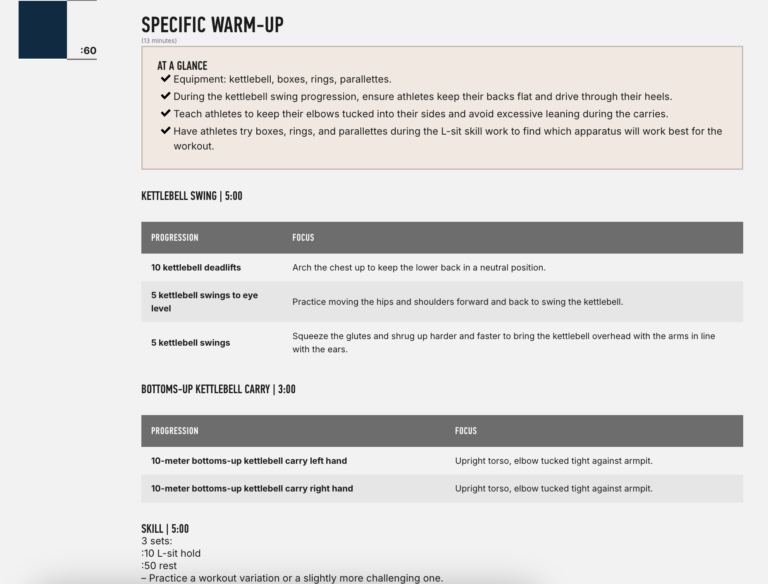
If there is a pre-workout skill session or lifting component, you will find it here. This section also includes time for athletes to build up in load on any barbell or weighted movement in the workout, so no one is guessing at their opening weight when the clock starts.
Expect to find mini-rounds as well, short simulations of the workout at reduced intensity to give athletes a chance to experience the movements at pace, make final decisions on scaling and loading, and arrive at the start line with confidence rather than uncertainty. By the time the specific warm-up is complete, every athlete should know exactly how they are approaching the workout.
Break
Here is the truth: athletes are like squids. The moment a squid senses danger, it releases ink. Athletes are no different. The second you say, “Alright, the workout is …” everyone suddenly needs to use the bathroom. It is universal and predictable, so plan for it.
The break gives athletes the time they need to take care of business, load their barbell, chalk up, and mentally prepare before the clock starts. A class that skips this step will spend the first two minutes of the workout waiting for athletes who were not ready.
That said, this is not a section to linger in. Three to four minutes is appropriate. Give athletes the window they need, then bring the energy up and get the class moving.
Workout
This section brings the coaching goals to life in real time. Once you say “3, 2, 1 … go,” this is the playbook for what happens next.
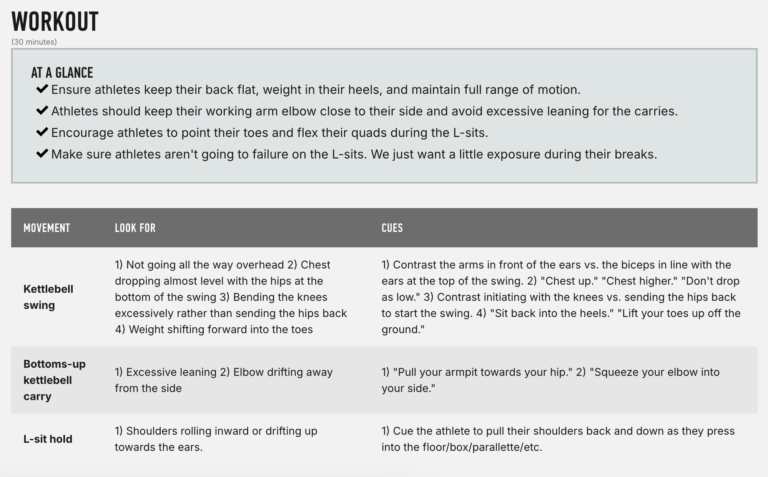
It starts with anticipation. You should know what to expect the moment the workout begins: which movements will break down first, where athletes are likely to slow down, and what the floor will look like two minutes in versus 10. When the expected things happen, this section tells you what to do about it.
You will also find guidance here for athletes who bit off more than they could chew. If someone chooses a load or variation that is clearly too much, there is a protocol for handling it mid-workout, including how to make the call, what to adjust, and how to keep that athlete on track without derailing their experience.
Finally, this section provides movement-specific coaching points: what to look for in each movement, the faults and inefficiencies most likely to surface under fatigue, and the cues to address them. The workout section turns preparation into action.
Cool-Down
This section brings the class home. After the intensity of the workout, the cool-down creates space to recover, reflect, and reconnect.
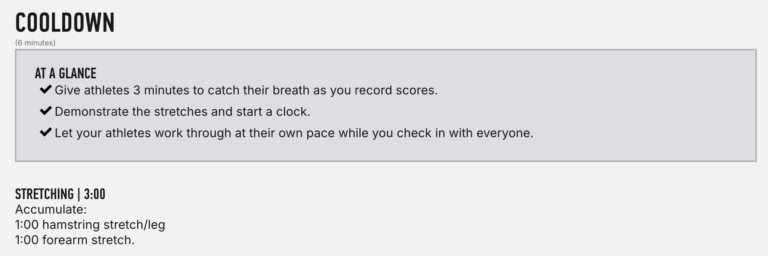
You will find guidance here on post-workout stretching and mobility targeting the primary muscle groups from the day’s session, as well as any post-workout skill or accessory work to be completed once heart rates have come down.
The cool-down is also when athletes record their scores. Build this into the routine. It takes 30 seconds and creates accountability and a reference point for future performance.
Perhaps most importantly, this is your opportunity to reconnect with your athletes before they leave the gym. The cool-down is not just a physical transition; it is the close of the class experience. Acknowledge the work, make contact, and send people out the door feeling seen and cared for.
Reading the Plan as a Whole
Individual sections do not exist in isolation. The strongest CAP plans have a coherent thread running through them: the stimulus defines the workout, the scaling options preserve it, the warm-up builds toward it, the whiteboard brief communicates it, and the cool-down addresses what the workout demands.
A complete, well-read plan means you can walk in, work through it once, and run the class confidently without improvising. That is the standard every section is built to support.
If you’re a CrossFit affiliate and you don’t yet use CAP, this is your nudge to give it a try.
 Spencer Hendel has been coaching in the CrossFit space since 2011 and is a Certified CrossFit Level 4 Coach with 14 years on Seminar Staff. On the CAP team, he leads program design and coach development. A former competitive athlete, he qualified for his first CrossFit Games in 2009 and competed for nearly a decade.