People do what they see. That’s not a coaching philosophy; it’s just how humans learn. And it means that every time you demonstrate a movement, you’re setting the standard your athletes will try to meet. The question isn’t whether your demo is teaching; it’s whether it’s teaching what you intend.
Demonstration is one of the six criteria for an effective CrossFit coach, right alongside teaching, seeing, correcting, group management, and presence. It gets less deliberate attention than most of the others. It shouldn’t.
If you’d rather listen or watch this conversation, you can do that here.
What a Real Demo Looks Like
Most coaches show a rep, maybe two, and move on. Athletes who were looking the other way catch up. Those who were watching gained a vague impression of the movement. Nobody really got what they needed, and the workout starts anyway.
A better demo has a structure and doesn’t take as long as you might think.
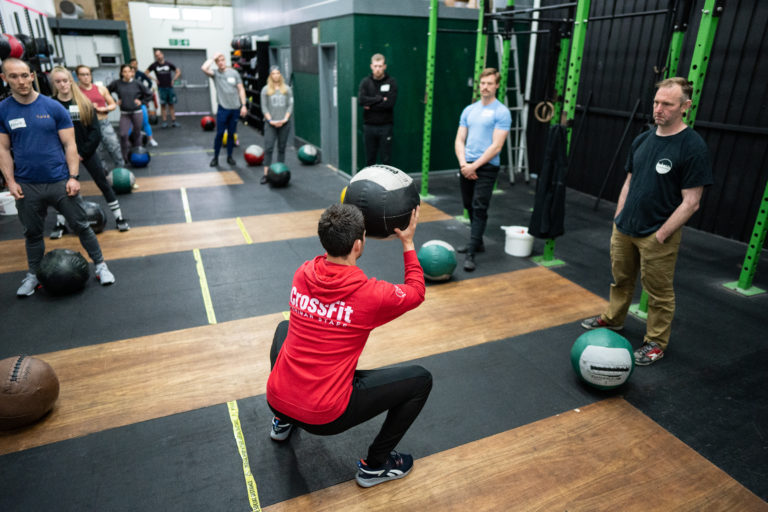
Start with position. Before you move, show people where everything is: feet, hands, bar, elbows, hips. Name it. Make it deliberate. Then do a few reps in silence. Don’t narrate. Just move, and let them watch. An awkward pause where nobody’s talking is fine — that’s the point. They should be watching, not listening.
Then do a few more reps while you explain. Move slowly. Stop at key positions. Walk them through what you’re doing and why. And then, before you send them to the bar, put it all together one more time — a few full-speed reps so they can see the finished product. That whole sequence might take 2 minutes. What it produces is a group that actually knows what they’re trying to do.
Compare that to, “Here’s a rep, here’s a rep, OK, put the bar on your shoulders.” The difference is significant.
Your Athletes Will Copy Your Faults
This is the part that requires honesty. If you demo a front squat with the bar off your shoulders, someone in your group will show up to their first rep with the bar off their shoulders because they thought that was the position. The feedback is uncomfortable but fair: yours wasn’t like that, so I thought this was how it was supposed to be.
We all have movements we struggle with. That’s not the problem. The problem is when those movements stay the same year after year while you’re coaching others to fix theirs. What’s the motivation for an athlete to improve a fault you’ve given up on improving yourself?
If the position genuinely isn’t available to you right now, say so. Acknowledge it explicitly — the bar should be on my shoulders, I’m working on getting it there — and then demo the best version you can. That kind of transparency is itself useful coaching. What doesn’t serve anyone is silently letting a compromised position become the standard.
The “Show the Fault, Show the Fix” Technique
One of the most underused visual tools in coaching is fault demonstration. When you see an athlete doing something you want to correct, don’t just describe the fix — show them what they’re doing first. Exaggerate it a little. Then show them what you want instead. Then have them try it.
The movement improvement you can get in 10 seconds of that kind of visual correction is remarkable. Athletes are wired to recreate what they see. Use that.
The same principle applies to peer demos. When someone in your group is moving well, pull them up and let the group watch. Point out what to look for — elbows, depth, positions. Then send everyone back to work. The improvement across the room will be immediate and noticeable, with no additional cueing required.
How to Get Better at This When No One’s Watching
Here’s what makes demonstration different from most other coaching skills: you don’t need an audience to practice it. Set up a camera. Run through your demos. Watch the footage. Make corrections. Do it again.
This process does two things at once. It sharpens your ability to demonstrate clearly, and it deepens your understanding of the movement itself — the nuances, the common breakdown points, the cues that actually transfer. Coaches who take demonstrations seriously tend to be better at correcting, better at explaining, and more relatable to struggling athletes because they know the movement from the inside.
Teaching others well and moving well yourself aren’t separate pursuits. They reinforce each other. The more you invest in your own movement, the better your demos get. The better your demos get, the better your athletes move. And the more your athletes see you putting in the work — actually improving, not just acknowledging faults and moving on — the more motivated they are to do the same.
You’re the standard in the room. Make it worth copying.
 Eric O’Connor is a Content Developer and Seminar Staff Flowmaster for CrossFit’s Education Department and the co-creator of the former CrossFit Competitor’s Course. He has led over 400 seminars and has over a decade of experience coaching at a CrossFit affiliate. He is a