Halloween is a pretty great holiday when you think about it. Kids and grown-ups get to dress up as dinosaurs, superheroes, witches, hot dogs, or whatever bizarre cultural reference has captured our imagination that year. We carve pumpkins, decorate the house, run around the neighborhood after dark, tell spooky stories, get together with friends, play games, visit neighbors, and spend an evening doing something completely different from ordinary life.
Yet somewhere along the way, the whole thing was overtaken and overshadowed by an astonishing amount of candy and treats.
And Halloween certainly isn’t alone. Ultraprocessed food companies now see every occasion as a sales opportunity to push more and more sugary products. Valentine’s Day has chocolates and candy hearts. Easter has marshmallow Peeps and chocolate eggs galore. Christmas has candy canes, cookies, more chocolates, and stockings stuffed with candy. Birthday parties send children home with treat bags after they have already eaten cake and ice cream. Even sporting events, school celebrations, and seemingly random Tuesdays have become occasions marked with sugar.
The treats have gradually become the event.
We live in a world where 1 in 5 kids is now overweight or obese, 50% of those kids have fatty liver disease, and, for the first time, kids are experiencing “adult” conditions like Type 2 diabetes, high blood pressure, and elevated triglycerides. Experts predict this will be the first generation in recorded history to have a shorter life expectancy than their parents. But it doesn’t need to be this way! We need to take back our holidays, make the festivities, the fun, the activities, and the quality time the main event, and keep the sugary snacks as a mere sideshow where they belong.
Kids Are Awash in Sugar
According to CDC data, American children ages 2 to 19 consume an average of about 17 teaspoons of added sugar* every day. And that’s just the “random Tuesday” intake from drinks, cereal, yogurt, granola bars, gummies, and the like. The sugar fest of Halloween and all the other special occasions pushes intake far, far higher.
For comparison, the American Heart Association recommends that children and adolescents consume no more than 25 grams, or about 6 teaspoons, of added sugar per day. Other countries have reached similar conclusions. The United Kingdom recommends that free sugars account for no more than 5% of daily calories, which translates to just 19 grams per day for children ages 4 to 6 and 24 grams for children ages 7 to 10. Canada recommends keeping free sugars below 10% of total calories and advises that candy and sugary drinks should not be consumed regularly. South Korea also recommends limiting added sugars* to no more than 10% of daily calories, while the World Health Organization suggests reducing free sugars* to below 5% for additional health benefits.
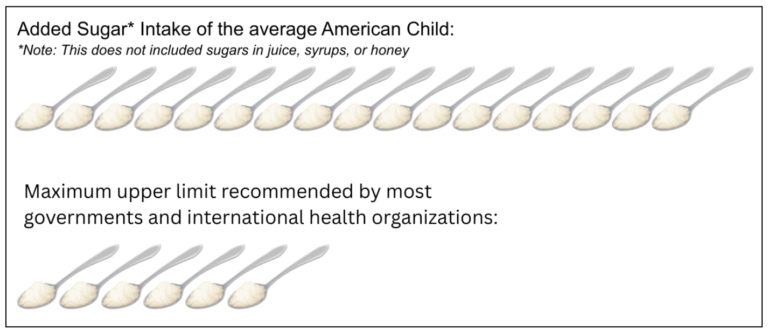
The United States has recently gone further. The 2025-2030 Dietary Guidelines for Americans state that no amount of added sugar is recommended as part of a healthy diet and specifically advise against added sugar for children younger than 11. While the recommendations differ in their precise limits and definitions, there is broad international agreement that children would benefit from consuming considerably less sugar than they currently do.
*Note: Countries vary in the way they track and report sugar intake. The U.S. reports “added sugar,” which represents sugar added during the manufacturing process. Other countries, such as the U.K., Canada, and Australia, report “free sugars,” which include added sugars plus the sugar found in honey, syrups, and fruit juice, but not the sugar found in intact fruit and plain milk.
High consumption of added sugar is associated with obesity, metabolic diseases such as Type 2 diabetes and fatty liver disease, cardiovascular disease, and mental health disorders. There are also immediate consequences for children’s teeth. In a recent study of more than 23,000 American children ages 1 to 5, children who consumed sugar-sweetened beverages four or more times per week had 2.8 times the adjusted odds of having a dental cavity compared with children who consumed none.
Saying children should not consume excess sugar is emphatically not the same as saying children should not have any fun. Quite the opposite, in fact. I firmly believe childhood should contain tons of enjoyment: ridiculous costumes, staying up too late, running around outside with friends, slinging pumpkin guts all over the kitchen table, traditions, parties, and plenty of experiences that serve absolutely no practical purpose beyond being fun. We just don’t need to teach children that fun is synonymous with sugar.
I’ve been doing CrossFit and have been an affiliate owner since 2008, and I’m the mom of two boys who are now 16 and 10 years old. To me, Halloween has always been the ultimate challenge: giving my kids a fun and memorable childhood without destroying their health in the process.
Start Before They Know Any Different
Parents of very young children have an enormous advantage: A 2-year-old has no idea what Halloween is supposed to look like. Toddlers don’t know that Halloween “requires” a bucket full of candy. They only know what you show them, and they are typically stoked about anything new and colorful.
For preschool-age children, Halloween can be almost entirely about the experience. Paint pumpkins, make ghosts out of tissues, decorate the house, dress up, read Halloween books, visit a pumpkin patch, make a spooky dinner, and turn off the lights and play with flashlights. With toddlers, the possibilities for fun are endless.
When my sons were in preschool, I made jack-o’-lanterns out of bell peppers for their school Halloween party. I carved little faces into them and filled them with veggies for dipping. They were festive and silly. Did the 3-year-olds complain that the macronutrient profile of their Halloween celebration was inconsistent with cultural expectations? They did not. A quick search on Pinterest reveals loads of fun and creative ideas for veggies, fruit, meatballs, and more.
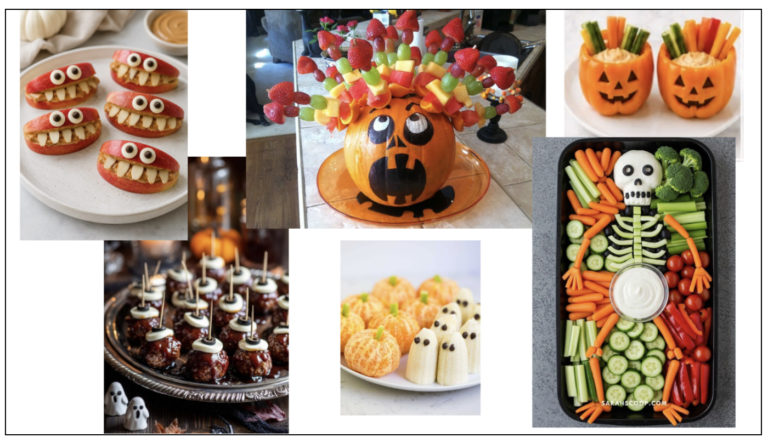
Young children learn what celebrations should be like from the adults around them. If every special occasion automatically comes with candy, they learn that association very quickly. If special occasions mean costumes, crafts, games, decorations, friends, family, adventures, and unusual foods, they learn that instead. This is one of the few periods of parenting when you have almost complete control over the script. Use it.
Make the Fun Stuff Better Than the Candy
Once kids reach elementary school, things get trickier. Now they have friends, and the trick-or-treating begins. It’s darn near a competitive event to see who can collect the biggest sack of candy. You aren’t going to convince an 8-year-old that a bell pepper is cooler than a Reese’s Peanut Butter Cup, so there’s no need to even try.
Instead, broaden the definition of a treat.
For the school treat exchange in third grade, my son and I made Halloween treat bags for his classmates and filled them with Play-Doh, stickers, glow sticks, and pencils. While adults may look at a plastic spider ring and see a piece of junk that will be under the couch by Thursday, an 8-year-old sees treasure. And kids love trinkets and treasures.
This gives parents plenty of room to make school celebrations exciting without adding to a candy pile that is already going to be enormous. Glow sticks, stickers, temporary tattoos, slime, erasers, pencils, little toys, trading cards, stamps, bouncy balls, and other inexpensive novelties can all scratch the same “I got something!” itch. Candy does not have a monopoly on delight.
What About Trick-or-Treating?
Trick-or-treating is objectively fantastic. Think about the experience from a child’s perspective: You put on a costume, meet up with your friends, wander the neighborhood after dark, knock on strangers’ doors, yell a magic phrase, and get something in return.
In our house, we leaned into the quest, like a video game. The fun is not in having the candy; it’s in getting the candy. The dopamine is in the pursuit, not the possession.
Once the boys had spent hours running around the neighborhood and collected a satisfactory sack, they would delight in sorting and counting their hoard. We’d let them keep 10 of their favorites and then offer to let them “trade in” the rest for a trip to the toy store. (Halloween was one of the few times I was OK with bribery as a parenting strategy, leveraging materialism over indulgence. Parenting is complicated.) Both my boys were way more excited about a new Lego set or Nerf gun and quickly forgot about the candy.
Trading in their Halloween candy became an event they planned for. Much like kids who make a Christmas list months ahead of time, they would start discussing in August what they were looking forward to trading their candy for that year.
Other parents do the Switch Witch, a fun tradition in which kids leave their sack of candy out overnight and it is stealthily replaced with a surprise new toy to find in the morning. The important point is that participating in trick-or-treating does not obligate your family to spend the next six weeks eating everything collected. The adventure can remain intact even if most of the candy leaves the house immediately.
Become the Coolest House on the Block
There is another side to the equation: What are you handing out to the kids who ring your doorbell?
Ever since I was a little kid, I’ve dreamed of being the coolest house on the block. Back then, I thought that meant being the house that gave out full-size candy bars. Now I know the true way to blow a kid’s mind is to give out … Hot Wheels. Never in my life have I seen more pure joy and excitement than from the kid ripping down my driveway, screaming at the top of their lungs, “Mom!!!! I GOT HOT WHEELS!!!!!!”
Pro tip: You can buy Hot Wheels in bulk 50-packs for around $1 apiece. If your budget allows, this is the true path to being the coolest house on the block, and it’s worth it for the entertainment factor alone.
Manufacturers other than candy companies now produce lots of items intended for trick-or-treating. Play-Doh makes Halloween minis, Pokémon produces Halloween three-packs, and Lego makes minifigures. There’s lip gloss, squishy toys, festive rubber ducks, and so much more. You don’t necessarily need one for every child who appears at the door. Depending on the cost, you can let kids choose one item from a basket or reserve the bigger items for younger trick-or-treaters and have inexpensive options for large crowds.
After visiting dozens of houses that give out nearly identical miniature chocolate bars, kids remember the house that gave them a toy car. Anything that breaks from the expected stream of candy and chocolate creates a moment of delight and excitement.
Congratulations. You have won Halloween.
Keep the Holiday, Lose the Sugar
We have allowed candy to become shorthand for celebration. Children move through the whole calendar year from one sugar-coated occasion to the next. But we can take back our holidays from ultraprocessed food companies without making childhood any less fun. In fact, I would argue that we will make it more fun.
Let Halloween be weird, spooky, and silly. Candy can be part of it, but it doesn’t have to be the whole point. With a little creativity and a bit of effort, you can create pure joy and happy memories without the added sugar. Twenty years from now, your kids will not remember whether they ate 14 or 47 pieces of candy on Halloween night. What they should remember is crafting the world’s coolest costume, building a haunted house together in the garage, trading a bucket of candy for the Lego set they desperately wanted, or carving pumpkins and making a giant mess at the kitchen table. Those are the treasured parts of childhood worth protecting.
About the Author
 Jocelyn Rylee (CF-L4) and her husband David founded CrossFit BRIO in 2008, starting in a modest 1500 sq ft space and focusing on personal training. Her dedication to excellence has also earned her a position on CrossFit LLC’s Level 1 Seminar Staff, a role that allows her to share her passion and expertise with aspiring coaches. Jocelyn holds specialties in Endurance, Gymnastics, Competition, and Weightlifting and is also a certified Strength and Conditioning Specialist through the NSCA. As a Level 2 Olympic Weightlifting Coach and a Level 3 referee, she has been deeply involved in the sport, even serving as a board member of the Saskatchewan Weightlifting Association for five years. Her achievements include being Saskatchewan’s top-ranked female Olympic Weightlifter from 2012 to 2015, during which she held provincial records in the Snatch, Clean & Jerk, and Total in her weight class. With an MS in Human Nutrition, Jocelyn loves sharing her knowledge on nutrition and performance through her blog and Instagram as “The Keto Athlete,” where she delves into the science of nutrition and its impact on athletic performance.