Sore is not a stop sign.
You crushed a workout. The next morning, you wake up, and your legs feel like concrete and are sore to the touch. Maybe it’s your shoulders, your back, your everything. The question almost every athlete asks at some point is: Should I train through this or rest?
The short answer is almost always to keep moving. But how you move matters.
If you’d rather watch or listen to this conversation, you can do that here.
Soreness Is Adaptation, Not Injury
Muscle soreness is a sign of adaptation. When you expose your body to new movements, new ranges of motion, or new volumes of work, you create small amounts of tissue damage and inflammation. Your body repairs that damage and comes back stronger. That process involves not only muscle fibers but also fascia, the connective tissue that surrounds your muscle fibers, tendons, and ligaments.
This is especially true for new athletes. A full air squat, for example, demands a range of motion most people have never loaded before. Even a couple of sets of 10 reps at bodyweight can leave a total beginner unable to sit comfortably the next day. That is not a failure of programming. That is the body doing exactly what it is supposed to do: adapting.
One thing worth knowing: Soreness often peaks 48-72 hours after the workout, not the day after. So if you feel fine on day one and wrecked on day two, that is completely normal.
The Couch Is Not the Cure
The instinct to rest is completely understandable, but it is usually the wrong call. Light movement, blood flow, and active recovery consistently outperform doing nothing when it comes to feeling better faster.
Go for a walk. Ride a bike. Do some stretching. Do some bodyweight movements slowly and for just a few reps. These low-intensity activities increase blood flow to the affected tissue and help the recovery process. If squats made you sore, doing some easy squats the next day, with reduced load and volume, will typically leave you feeling better than if you had stayed on the couch.
Let Your Warm-Up Make the Call
The most practical test is simple: Does the soreness change the way you move?
Start your warm-up and pay attention. If soreness begins to ease as you get moving and your mechanics stay clean, you can likely train. Scale the load or volume down from your usual effort, but go.
If, on the other hand, you find yourself compensating, shifting your torso to avoid depth, favoring one side, or losing position under load, that is a signal to adjust. You might skip the squat-heavy elements of the day, choose accessory work that targets less-affected areas, or focus on upper-body movements if your legs are the problem. The goal is to keep the training habit intact without piling more stress onto tissue that has not yet recovered.
Talk to Your Coach
If you are working with a coach, tell them how you are feeling. That information changes the session. A good coach will adjust the stimulus for where you are that day, not where you were last week. And if you are coaching others, check in before class starts. Your athletes are not always going to volunteer this information.
Soreness vs. Pain: Know the Difference
This is worth saying clearly: We are talking about muscle soreness, not pain. There is a meaningful difference.
Muscle soreness is typically diffuse, often symmetrical, and responds to warm-up. You feel it when you press on the tissue. It improves with movement and tends to fade over two to four days.
Pain around joints, tendons, or ligaments is something else entirely. Sharp pain, pain that worsens with movement, pain localized to a joint rather than a muscle belly, swelling, or stiffness that does not improve with warm-up, all warrant a different response. In those situations, you do not push through. You work around it, manage the load carefully, and monitor for any worsening after training. Keeping that effort at a two-out-of-10 discomfort or less is a reasonable standard.
Confusing the two is where people get into trouble. Soreness will make you uncomfortable. Pain that involves connective tissue can sideline you for weeks if ignored.
Play the Long Game
Here is the thing about soreness: It is not permanent. Athletes who train consistently and progressively, and who manage their intensity intelligently, stop getting severely sore over time. Their bodies adapt. The tissues become more resilient. The deep muscle soreness after a hard workout becomes manageable rather than debilitating.
That adaptation only happens if you keep showing up.
One missed session is not going to derail your progress. But making a habit of skipping whenever you are sore will. Think about the 50-year arc of your training life. One easy day because your legs are thrashed from Karen is completely inconsequential. What matters is that you come back, move, and stay in the process.
The Practical Summary
Soreness is normal. It is a sign your body is adapting. Keep moving through it with reduced load and volume. Use your warm-up as a diagnostic tool. Foam roll, walk, bike, and stretch. Make sure you are eating and hydrating well. And learn over time to distinguish muscle soreness from joint pain, because those two things require very different responses.
The goal is not to avoid soreness. The goal is to manage it well enough that it never stops you from training.
About the Author
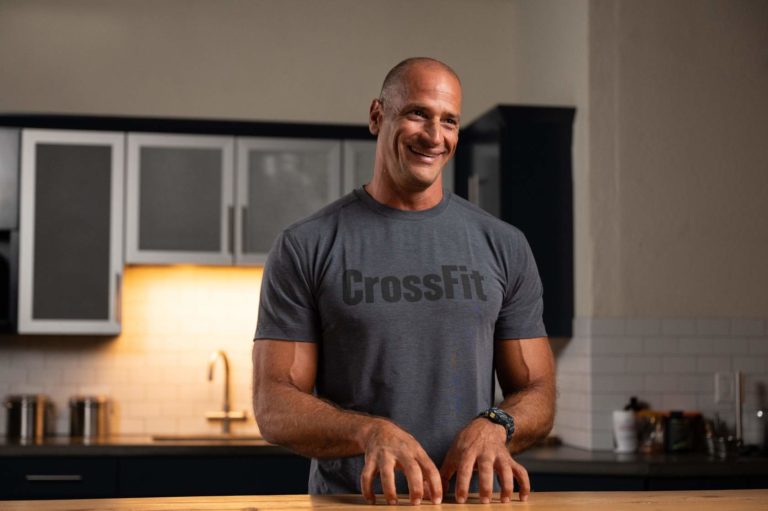 Stephane Rochet is a Senior Content Writer for CrossFit. He has worked as a Flowmaster on the CrossFit Seminar Staff and has over 15 years of experience as a collegiate/tactical strength and conditioning coach. He is a Certified CrossFit Trainer (CF-L3) and trains athletes in his garage.