The CrossFit New Year is here, and it’s time to take stock, reflect on the prior year, and plan for what comes next. Historically, the CrossFit Games served as a physical gathering point for the online commenters of CrossFit.com. They would convene annually to find the fittest, but also to compare training protocols. While they were all “doing CrossFit,” the margins were found where they chose to deviate, explore, and experiment. Ultimately, that experimentation is what we desire as CrossFit athletes: We want what works best.
“Valid criticisms of a fitness program need to speak to measurable, observable, repeatable data. If an alternative to CrossFit is worthy of our consideration, it ought to be presented in terms of distance, time, load, velocity, work, and power related to movements, skills, and drills. Give me performance data. CrossFit can be scientifically evaluated only on these terms.” — Greg Glassman
The Games are the validation of the CrossFit methodology. Every year, constantly varied functional movements performed at high intensity remain the gold standard for finding the Fittest on Earth. But world-class fitness is fluid; certain movements or efforts change our trajectory every year. As we progress, we listen when something more efficient in terms of work capacity emerges.
For instance, butterfly pull-ups weren’t a “thing” in 2007 when 70 athletes took on the original hopper workout. Athletes slogged away utilizing the kipping pull-up or the “frogger” variation coined by Greg Amundson. All, that is, except for Brett Marshall, who performed a style of pull-up that didn’t even have a name yet. It was controversial at the time, but fast-forward three years, and the butterfly pull-up became standard practice for anyone looking to increase work capacity across broad time and modal domains.
At other times, the Games humble athletes by reminding them that true fitness requires skills outside of “normal” movements. In 2013, a monstrosity of a rig was constructed, and by Sunday night, Legless was underway. No woman completed the event until Alessandra Pichelli beat the 10-minute cap by 20 seconds. Only two women finished, exposing a massive hole in nearly every athlete’s training. 2015 saw a similar effect with the introduction of the pegboard. Many athletes complained — which is ironic, considering the brand’s tagline is “unknown and unknowable.” As writer Mike Warkentin pointed out at the time, Greg Glassman had mentioned the pegboard as a staple in the classic 2002 CrossFit Journal article “Garage Gym.”
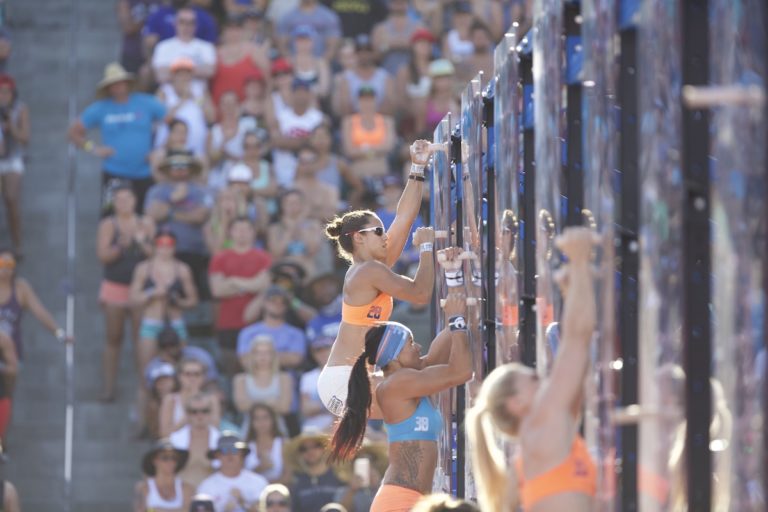
Pegboard at the 2015 CrossFit Games
Recalibrating the Journey
This evolution is why we watch and stay connected. Early CrossFit Journal articles signaled a new era, proving that the old isolation-machine, “globo-gym” style of working out was on its way out. A handful of people on the CrossFit.com message boards helped spawn arguably the largest fitness movement in history. But the secret is out. Fitness has been defined, and the annual winner of the Games is undeniably the Fittest on Earth. The questions now are: What is the signal this year? What are athletes doing that will expand the margins of our experience as practitioners?
The Games are an incredible recalibration of where you are on your CrossFit journey. It is the time for coaches, owners, and athletes to take stock of skills and deficiencies. We should celebrate successes and use what we saw during the season to increase the capacity of our clientele while keeping things exciting.
When was the last time you or your athletes worked on a forward roll to support? I’d guess it hasn’t been in the last two or three administrations. As J.R. Howell mentioned on the CrossFit Show, the “magic” is often found in the secondary adaptations of movements. Going inverted doesn’t just help you master a forward roll; it improves handstand work, push jerking, and overall body control. How often do we, as adults, go inverted? Anything beyond a handstand walk or push-up is rare for most, even CrossFit athletes. Yet, the value of consistent inversion is highly underutilized. If you don’t believe me, try five forward rolls on the ground and see how disorienting it is. If our goal is to maximize fitness across one’s lifetime — i.e., increase work capacity and keep it as high for as long as possible — learning new skills has to be part of your protocol.
Event 19 of the 2026 CrossFit Games was a great reminder: When you think you’ve mastered everything, go back to the basics. The forward and backward roll to support are not elite gymnastics movements; they are foundational gymnastics movements. There is tremendous value in teaching these for the development and enjoyment of your clients. As Glassman wrote in the 2006 article “Professional Trainer:”
“I understand that the modern and near-universal trend of skill-less and low-skill programming delivers inferior results and makes cheerleaders of trainers. I’ll have none of it. I have to understand the mechanics, cues, and techniques of complex movements and to be able to teach them to others. I bring a skill set to my training that scares off most trainers.”
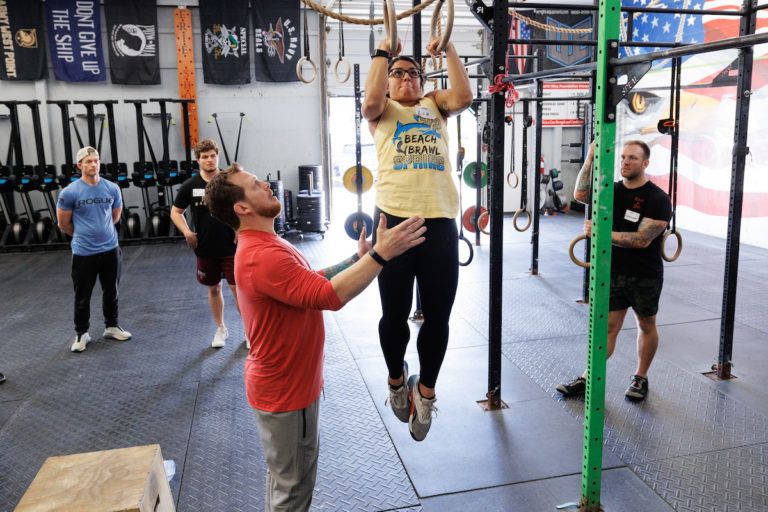
As CrossFit coaches, you are measured by your clients’ success. The Games are a perfect time to check in and recalibrate how you train them. Yes, learning the forward and backward roll to support is hard. It’s even more challenging to teach it, but that is where the most sought-after adaptations develop. Learning a new skill and being able to teach that to your athletes develops them, and you as a coach. If you aren’t challenging yourself and your clients, you’re doing everyone a disservice.
A United Community
Lastly, I noticed a unification of the community at the Games — all parts of the machine were finally pointed in the same direction. I saw old rivalries buried and conversations happen that had been stalled for years. Collectively, we have all contributed to CrossFit for over 20 years, and we love it in our own way. But united, the atmosphere felt overwhelmingly positive. Fans, affiliate owners, HQ employees, and athletes joined in a shared effort that leaves me optimistic for the coming year.
Now, if I could just get that backward roll to support. Hey, I’ve got a year.