There is no shortage of fitness influencers willing to tell you what to stop doing once you hit a certain age. After 40, avoid these exercises. After 50, never squat heavy again. After 60, scale everything back and play it safe.
CrossFit has a different answer: If you don’t use it, you lose it, so keep breathing, squatting, jumping, playing, and everything in between.
The movements do not change as you age. The standards do not change. The pursuit of a broad, general, and inclusive fitness across as many domains as possible does not change. What changes is the pace of progression, the implements you might use on a given day, and the conservatism with which you or a good coach manages your training load. The program itself stays intact.
If you’d rather watch or listen to this conversation, you can do that here.
The Real Risk Nobody Talks About
The conversation around aging and fitness almost always focuses on the risk of doing too much. Rarely does it focus on the risk of doing too little, which is the far greater risk.
When you remove a movement pattern from your training, you begin losing the capacity that movement developed. When you lose capacity as an older athlete, getting it back is genuinely hard. The recovery arc that takes a 25-year-old two weeks takes a 65-year-old considerably longer, and some qualities, once lost, do not come back fully. Power. Speed. The ability to get inverted. The coordination to move quickly under load. These are not skills you can set aside without a cost to your fitness.
Maintaining capacity is dramatically easier than rebuilding it. If a 60-year-old keeps doing what they are doing today, there is a strong likelihood they will be doing something very similar at 80. That is not a consolation prize. That is a remarkable outcome, and it should be the goal.
The Influencer Problem
Fitness content aimed at older athletes tends to converge on one message: protect yourself by doing less. Certain coaches with real credibility have built entire platforms around the idea that specific movements should be retired after a certain age. Some of it is well-intentioned. Most of it is wrong.
The athletes who follow that advice and remove the snatch, stop getting inverted, or abandon the squat because someone told them it was time often find that they feel worse, not better. Joints that were fine begin to feel stiff. The sense of physical capacity that CrossFit builds begins to erode. The movements that felt challenging but rewarding become movements that feel out of reach, not because of age, but because of absence.
CrossFit works because it is comprehensive. Pull pieces out, and it stops being CrossFit. It becomes something smaller, something that delivers less and asks less, and over the long term, produces less.
What Actually Changes
None of this means coaching an 80-year-old looks identical to coaching a 30-year-old. It does not. The differences are real, but they are differences of application, not philosophy.
Progression slows down. Steps that might take weeks for a younger athlete can take months or longer for an older one, and that is completely appropriate. The entry point for new movements is more conservative. A coach working with an athlete in their seventies is thinking carefully about every incremental advance, making sure the foundation is genuinely solid before adding load, volume, complexity, or range.
The implements you use may also shift. Dumbbells often replace barbells for older athletes, not because the movement is being watered down, but because dumbbells are more joint-friendly and allow the same pattern to be trained more comfortably. The athlete doing dumbbell thrusters in a class where everyone else is doing barbell thrusters is still doing a thruster. The stimulus is preserved. The movement is preserved. That is what matters.
And progressions that seemed far off can happen. A partial wall walk becomes a full wall walk. A pike hold becomes a genuine inversion. A goblet squat to a high target becomes a full-depth squat over time. The timeline is longer. The direction is the same.
Find the Entry Point, Then Never Stop Moving Forward
The art of coaching older athletes is identifying where they will be successful on day one and building forward from there without ever deciding that forward is no longer the direction.
Here’s a motivating story for you. A grandmother came to CrossFit when her daughter wouldn’t let her babysit her granddaughter because she wasn’t strong enough to safely pick her up and pull her from danger. Today, this grandmother can deadlift more than 200 lb. It took time. It changed her life. It happened because no one told her there was a ceiling on what she could accomplish.
That is the standard. Not bubble-wrapping people against risk. Instead, we remove the obstacles that stand between them and genuine capacity. Enhancing confidence by progressing in a smart and deliberate manner, and then looking back together at how far they have come.
Progress for older athletes does not always show up as a number on a barbell. It shows up as a range of motion that was not there before. A movement that was once out of reach. Something that happens outside the gym — a moment when they realize they can do something they could not do a year ago, and they were not even thinking about it. Those are the wins worth chasing.
The Bottom Line
CrossFit does not have an older-athlete version. There is no modified program reserved for people above a certain age, no list of movements that quietly get retired when someone hits their 50s, 60s, or 70s. The goals are the same. The application is the same. The commitment to variance, full range of motion in functional movements, and relative intensity does not expire.
What older athletes add to their training regimen is patience, conservative progressions, and an absolute refusal to let age limit their potential. The program that has always worked keeps working. The only thing that changes is that every baby step forward is cherished as a massive win in a life-and-death battle because, more and more, that’s exactly what we’re fighting as we get older.
About the Author
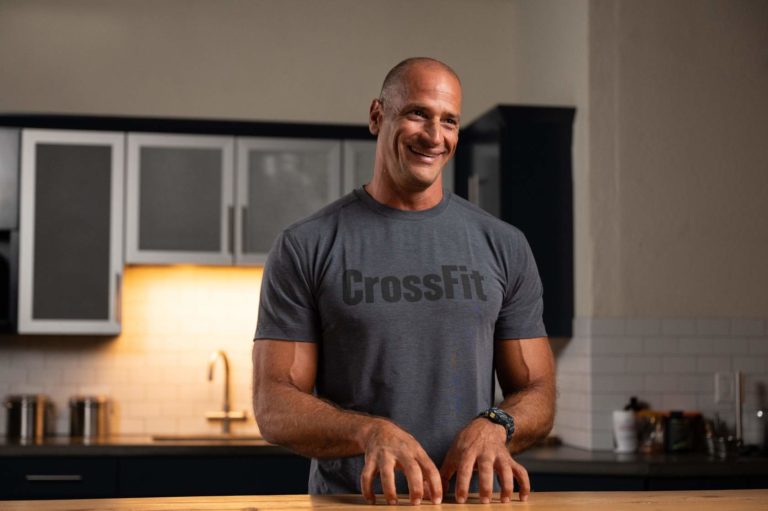 Stephane Rochet is a Senior Content Writer for CrossFit. He has worked as a Flowmaster on the CrossFit Seminar Staff and has over 15 years of experience as a collegiate/tactical strength and conditioning coach. He is a Certified CrossFit Trainer (CF-L3) and trains athletes in his garage.