You can be fit and unhealthy at the same time.
That’s not a contradiction. That’s just the reality of how the human body works, and it’s something most people miss when they think about training.
There’s a model that’s been part of CrossFit since the beginning that explains this. It’s called the sickness-wellness-fitness continuum, and understanding it might change how you think about your training — not for what it does for you today, but for what it does for you twenty years from now.
If you’d prefer to watch or listen to this conversation, you can do that here.
The Model: Three Zones
Imagine a line. On the left side is sickness. In the middle is wellness. On the right side is fitness.
Sickness is obvious. Chronic disease, medication, the low end of health. The medical model that treats disease once it shows up.
Wellness is the average. It’s the 95% of people who go to the doctor and hear “you’re doing pretty good.” You walk. You’re somewhat active. You eat some protein and some vegetables. You’re not on the standard American diet completely, but you’re not optimizing either. You’re fine. Just fine.
Fitness is super wellness. It’s the end of the spectrum where all your health markers are moving in the right direction. Blood work, body composition, cardiovascular capacity, strength, mobility. You’re not just fine; you’re thriving.
Here’s the key distinction: Fitness is a snapshot of where you are right now. Health is your fitness over the course of your entire lifetime.
The Surprising Connection: Performance Affects Health
For a long time, people thought fitness and health were separate things. You could be good at one without the other.
You lift heavy. Great. That’s fitness. But your blood pressure is high, and your cholesterol is bad. That’s separate from your “fitness.”
CrossFit changed that thinking.
Here’s what we discovered: Your performance markers and your health markers are connected. They’re not separate systems.
When you get better at your deadlift, when you improve your pull-ups, when you get faster at your 5K run, those things don’t happen in isolation. If you’re training intelligently, everything else follows along. Your blood work improves. Your body composition shifts. Your cardiovascular system gets better.
The reverse is also true: if you’re training but your health markers are trending in the wrong direction, something is wrong with your program. And it needs to be fixed.
What About the Fittest on Earth?
Someone asked on a live stream recently: “Where would you put Jayson Hopper on the sickness-wellness-fitness continuum?”
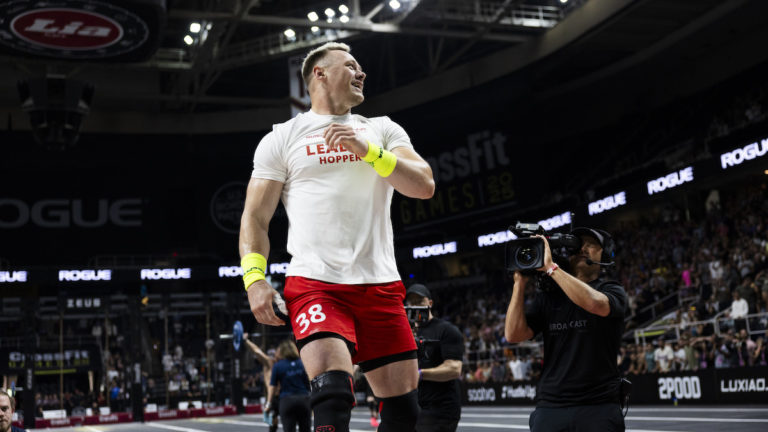
The question implies something: Hopper is incredibly fit. But maybe, with all that training volume, his health markers are slipping backward. So, where does that put him on the continuum?
The honest answer? We don’t know. We’d need to see his blood work, his body composition, and his actual health markers to tell where he is on this continuum.
Because remember: The continuum is primarily about health markers, not performance markers.
You can have an elite-level deadlift and bad cholesterol. You can have incredible work capacity and be constantly inflamed. You can be a Games athlete and have health markers that look terrible in the middle of a competition season.
And here’s the thing — in the short term, that might be acceptable. If you’re an elite competitor, there’s a time-bound sacrifice. You’re pushing hard for eight weeks to compete. Your health markers take a temporary hit. Then you back off and they recover.
But if you take that training volume and training style and turn it into your everyday fitness program for 10 or 15 years? The wheels fall off.
You can’t sustain that kind of compromise long term. Eventually, the degradation in health markers catches up, even if your performance keeps improving in the short term.
Why This Matters (More Than You Think)
Now let’s talk about why this actually matters for you, right now, in your life.
Fitness is a hedge against sickness.
That’s the most important part of this model. And it might be the most overlooked.
The idea is simple: If you build your health markers in the direction of fitness, toward super wellness, you’re creating a buffer and a hedge against the inevitable decline that comes with aging.
Let’s make this concrete.
You’re 45, and you’ve been training consistently, eating well, sleeping properly. Your health markers are solid. You’re fit.
Then at 75, you get injured. Maybe a fall, a car accident, or you just get sick.
If you spent the last 30 years maintaining that fitness hedge, you have something to work with. You recover faster, you heal better, and you bounce back. The incident that might have been catastrophic becomes something you overcome.
But if you spent the last 30 years living in the wellness zone, or worse, creeping toward sickness, that same incident might be the end. One fall, or one hospital stay for something “relatively minor,” and suddenly you’re in hospice.
When you build a 10- or 20-year buffer, you create space between fitness and sickness that takes decades to cross.
That’s the longevity piece, and that’s why this matters.
You Have More Control Than You Think
People talk about genetics. “My genetics will limit where I can be on this continuum.”
Maybe that’s true, but here’s the thing: it doesn’t matter.
Think of two boats crossing the ocean. One can go 35 knots max. One can go 20 knots max. But both only need to go 16 knots to reach their destination.
They both arrive at the same time.
That extra genetic potential? If you never call it into play, it doesn’t matter.
Most people aren’t making the consistent choices needed to reach their actual genetic potential. Not even close. They’re making choices that move them in the wrong direction.
So, regardless of genetics, you have control. You can make consistent choices to move yourself toward fitness, toward super wellness. Or you can make (often unknowingly) consistent choices that move you toward sickness.
Genetics might determine your ceiling, but most of us are nowhere near our ceiling. The gap between where you are and where you could be is huge. And that gap is controlled by consistent daily choices.
Build as big a hedge as you can. You don’t need to be a genetic elite or a Games athlete. You just need to build a substantial buffer between yourself and decrepitude.
This Is Actually What Fitness Means
Here’s something that gets lost: When we say fitness, we’re not talking about your deadlift or your 5K time.
We’re talking about being a capable human being.
Go back 1,000 years. If you were dropped into the world without modern conveniences, what would you need to do?
You’d need to lift heavy things, build a shelter, hunt and drag home food, walk and run and sprint, jump, climb, chase things, flee from things, and move in varied ways to handle all the different challenges life throws at you.
That’s fitness, and it’s what a human should be capable of.
Today, we call that “elite” because the average has dropped so far. But we’re not trying to create elite athletes. We’re trying to recreate what a human being should actually be capable of.
And when you look at people who die from car accidents or skiing accidents, they often aren’t dying from the accident itself. They’re dying because they don’t have the capacity to survive it.
The accident is the last trigger. The real killer is the decrepitude and the accumulated decline from years of not building capacity or maintaining fitness.
The Four Pillars (You Need All Four)
Here’s the thing: You can’t just train your way to fitness.
There are four nonnegotiables in the CrossFit methodology:
Variance – Moving in different ways, different ranges of motion, different intensities.
Functional movements – Movements that mimic real-world demands.
Intensity – Actually working hard, not just going through the motions.
Nutrition – Eating quality food to support your training and health.
The first three build your work capacity, enhance your muscles, and strengthen your tendons and ligaments. They’re important.
But they have to be supported by nutrition. You can’t out-train a bad diet. You can’t build health markers in the right direction if you’re eating garbage.
It’s not 90% kitchen and 10% gym. It’s not 80-20. It’s both. Both are required. Both are nonnegotiable.
And you have to do both consistently and persistently for the rest of your life.
What You’re Actually Training For
When someone asks you why you’re doing this work — why you’re squatting heavy, grinding through conditioning, tracking your food — here’s the real answer: You’re building a buffer for the future.
You’re creating the capacity to recover from injury, to survive accidents, to build a hedge against the sickness and decrepitude that come with aging and inactivity.
You might not feel like you need this hedge yet because maybe you’re young and healthy and fine, but you’re making deposits into an account you’ll desperately need when you’re 70 or 80 or 90. And the deposits you make now are worth way more than the ones you’ll try to make later.
The person who trained consistently from 35 to 75 has an unbelievable capacity at 75. The person who starts training at 70 is playing catch-up in a losing game.
The Continuum as a Tool
Use this model as a mental framework for your training.
You’re not training for your next PR. You’re not training for next month’s competition. You’re training to move yourself as far as possible along this continuum — from sickness toward wellness, from wellness toward fitness.
Every workout is a choice to move toward fitness or toward sickness. Every meal is a choice. Every recovery day is a choice.
You don’t need to be perfect. You don’t need to be elite. You just need to be consistent in the direction of fitness.
Build as big a buffer as you can. Because one day, when something bad happens, and something bad will eventually happen, you’ll be grateful for every deposit you’ve made.
About the Author
 Stephane Rochet is a Senior Content Writer for CrossFit. He has worked as a Flowmaster on the CrossFit Seminar Staff and has over 15 years of experience as a collegiate/tactical strength and conditioning coach. He is a Certified CrossFit Trainer (CF-L3) and trains athletes in his garage.