Every athlete has a story. They don’t walk into the gym as a blank page, but as a book already largely written. When they cross the threshold, they bring with them the weight or the richness of the other 23 hours of the day: work, family, relationships, worries, dreams, sleepless nights, and quiet victories. If you’ve ever been a teacher, you know this well. We see students for a few hours a day, but the rest of their lives unfold outside the classroom.
In the gym, it’s no different. Whether they arrive promptly at 5 a.m., eyes still heavy with sleep, or at 6:30 p.m. after a full day, 95% of their life happens away from the barbell. And yet, despite everything, they show up. That’s the first thing we must not forget.
Meeting Them Where They Are, Not Where We Wish They Were
As coaches, it’s easy to fall into the trap of expectations: “You should push harder today.” “You’ve already lifted that weight before.” “You’re stronger than this.” But the most useful question isn’t what they should do; it’s where they are today. Physically, of course, but also mentally and emotionally.
Meeting an athlete where they are means observing before correcting, listening before speaking. It means noticing a tense expression, a closed posture, or a warm-up slower than usual. Sometimes all it takes is a simple, “How are you today?” asked with genuine interest, not as small talk. There’s no need to dig or force confidences. What’s needed is to create space.
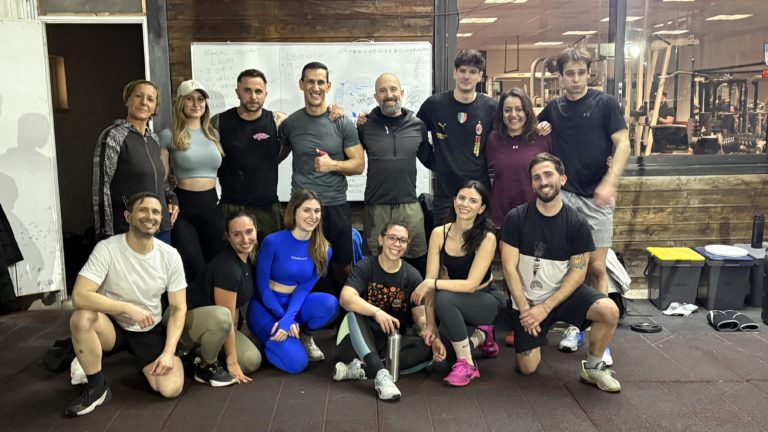
Coach Leonardo Renzi with one of his classes.
Helping Them Recognize the Impact of Life on Training
Many athletes don’t immediately connect what happens outside the gym with how they feel inside it. A “bad” workout is often experienced as a personal failure, rather than a reflection of stress, lack of sleep, or accumulated emotional load. Here, the coach’s role is educational, not judgmental.
Helping athletes recognize these connections means normalizing them, explaining that a difficult day can affect coordination, strength, and focus — that not every session is meant to break a record, that the body is not an isolated machine but part of a complex system.
Simple, shared language can work wonders: “Today feels like a technique day,” or “Maybe today the real goal is to move well and leave feeling better than when you came in.” In this way, the athlete learns to read themselves, not just the timer or the weight on the bar. It’s also a great time to remind athletes what relative intensity really means.
The Coach as Educator: Beyond Technique
To do all this, technical skills alone aren’t enough. A good coach is not only someone who knows how to program loads and progressions, but also an educator. It requires basic psychological sensitivity, the ability to read people, and to understand behaviors, reactions, and silences. Not to “do therapy,” but to create a context where the athlete can express themselves without fear of judgment.
In this sense, gym work closely resembles inclusive teaching in schools. A good teacher knows not all students learn in the same way, at the same pace, or under the same conditions. The goal isn’t to standardize, but to respond to individual needs, offering different tools to reach the same learning outcome.
The same happens in the gym: shared goals of health, strength, and growth, but paths that must adapt to people, not the other way around. Creating a positive and motivating environment means designing training sessions that account for individual differences, valuing little progress as much as big, and making every athlete feel like a legitimate part of the group, regardless of level or the kind of day they’re having.
Such an environment doesn’t happen by chance. It’s the result of daily choices — of language, attitude, and attention. And it’s often what makes the difference between a gym that trains bodies and a gym that supports people.
Leading With Compassion and Empathy
The most powerful thing to remember is that whatever is going on in their lives, they’re still there. They chose to show up for an hour to move their bodies and bring some order to their minds. That deserves respect.
Leading with compassion doesn’t mean lowering standards; it means adapting them intelligently. It means offering a different progression without making the athlete feel “less than.” It means celebrating consistency as much as performance. Sometimes success isn’t a PR, but putting on your shoes and walking out the door.
Empathy doesn’t take authority away from the coach; it strengthens it. It builds trust. And trust is what allows athletes to stay, grow, and move through difficult periods without giving up.
An Hour That Matters More Than It Seems
In the end, that single hour in the gym is just a parenthesis, but it can be a powerful one. A safe, consistent, predictable place in the middle of chaos. A place where the body works and the mind can breathe. A place where someone sees you, even when you’re not at your best.
Every athlete has a story. It’s not up to us to rewrite it, but we can walk alongside it for a while. And if we do so with attention, presence, and humanity, that hour becomes much more than a workout; it becomes an anchor in their day and maybe even their life.
Want to Make Your Relationships with Your Athletes Even Better?
Join us for the 2026 CrossFit Owners and Coaches Conference and come to our brand-new session, The Coach They Can’t Quit: Presence, Attitude, and the Art of Connection with Kelley Jackson Selig (CF-L3) and Lily Free (CF-L3).