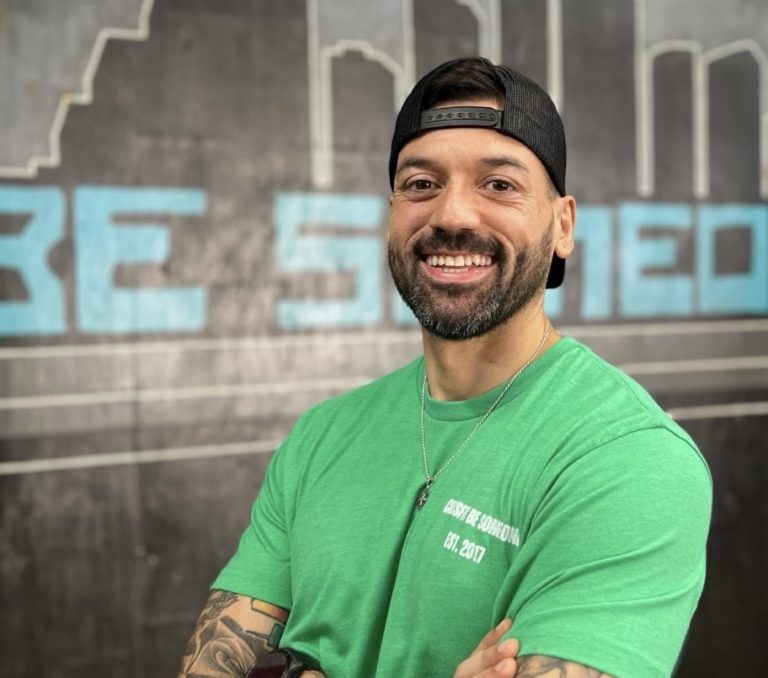
Five days after I took over CrossFit Be Someone, I became a father. I quickly learned the same truth in both roles: my daughter’s manners reflect my actions, and my athletes’ movement reflects my coaching.
Friday Night Lights during the Open makes that undeniable. The feedback stops, the cues stop, and what’s left is whatever your athletes have actually internalized. Watching my athletes manage threshold training on their own — balancing intensity with sound mechanics, without anyone reminding them — told me everything about what my coaches had been doing in class every single day.
Here’s how we make sure that reflection is one we’re proud of.
Coach every minute, not just the workout. The general warm-up is where we develop our eyes and establish the session’s standard. If a knee caves during a Samson stretch and squats are in the workout, we address it now. If an athlete’s arms drift during pass-throughs, we fix it while asking about their day. When coaches treat warm-up movements as throwaways, athletes do too.
Use the specific warm-up to build a common language. We call reps, hold positions, and provide constant feedback — just as coaches do at the L1 and L2. The cues we introduce here are the same ones we use mid-workout, so when an athlete hears one at high intensity, they already know exactly what to do. That shared language is what makes in-workout coaching efficient.
Watch with a plan. During the metcon, our coaches use a bottom-to-top scanning approach — feet first, then knees and elbows, hips and shoulders, trunk — one body part at a time, for every athlete, on a continuous loop. They’re not waiting for a fault to jump out. They’re looking for specific things and coaching them. Safety violations always come first; everything else follows the scan.
Don’t check out at the cool-down. Range of motion is a common movement theme across everything we do. Coach the stretches during the cool-down as well.
If the Open showed you gaps — athletes pressing early, losing depth under fatigue, breaking position when it got hard — those gaps didn’t appear randomly during Open workout time. They were there on Tuesday morning and Thursday afternoon. That’s where the work happens.
Mechanics, then consistency, then intensity. It’s simple. It’s not easy. But if you hold that standard every day, The Open will show you exactly what your coaching is worth.