Picture this: You’ve been doing CrossFit for two years. You can hit most movements, and your times are decent, but you feel stuck. You’re going through the motions, checking boxes, and getting sweaty, but are you actually getting better or fitter? The difference between what you’re doing and true training might be the missing piece that unlocks your next level of fitness.
The Nike Slogan That Changed Everything
About a decade ago, Nike used the slogan “Stop exercising, start training” to encourage a “shift from random physical activity to a planned, goal-oriented approach to fitness.” At the time, I recall wondering if this was a subtle jab at CrossFit’s varied programming in favor of the periodized, percentage-based programming that many gurus tout as the gold standard for achieving results. That might just be me being sensitive to the common criticism about CrossFit that if you are constantly doing different stuff, you’ll never get good at anything.
Still, CrossFit fits very well into the marketer’s definition of training as a “methodical approach that strings individual workouts together to achieve a specific, long-term goal. It involves a plan, targeting weak points, and consistent progress over time.” This is precisely what we do. We have clearly defined our goal: to improve fitness or increase work capacity across broad time and modal domains. To achieve this, we create an enormous variety of effective workouts to develop a broad, general, and inclusive capacity. Along the way, we constantly test to identify weaknesses that need to be addressed. We may not use percentages often, and we might not use microcycles, mesocycles, hypertrophy, strength, or power phases in our programming lingo, but we have a plan and intent. We know where we’re going and that’s what we train for.
Exercise vs. Training: The Crucial Difference
I have a different slant on this slogan. “Exercising,” to me, is focusing on the work that needs to be done today, checking off each round and rep, pushing through the workout to get to the end. This is an easy trap to fall into, and we all do this at times. “Training” is more focused on the process, staying in the moment, and embodying the charter of mechanics, consistency, and intensity. Instead of seeing a task that needs to be completed, like doing the dishes or mowing the lawn, we’re honing our craft like playing the violin or perfecting a dance routine. We focus on the quality of each rep from the warm-up through the cool-down, practicing and refining technical elements, all while adding intensity to challenge us as appropriate.
What does this look like in practice? During a workout with thrusters, instead of rushing through 21-15-9 reps to post a fast time, you focus on maintaining perfect front-rack position, driving through your heels on each squat, and pressing the bar in a straight line overhead, even as your heart rate climbs and your muscles burn. Every single rep becomes an opportunity to practice excellence under pressure.
The Three Pillars: Mechanics, Consistency, Intensity
CrossFit has always emphasized developing our mechanics (technique) first in functional movements and then ensuring we can reproduce these mechanics consistently across multiple reps linked together, before judicially and intelligently ramping up intensity over time. This ensures learning and gaining a certain level of mastery in the fundamentals before we start pushing limits. The thing is, once we’re no longer novices, this stops being a step-by-step or linear process.
Why Linear Progression Fails Advanced Athletes
If we work on our mechanics and consistency and get to a good level of proficiency in our movements, and then assume it’s just a matter of progressing intensity over time, we’ll quickly fall into the trap of exercising instead of training.
Mechanics ➡ Consistency ➡ Intensity
Exercising
With this mindset, once we feel comfortable with our movement, we start focusing on pushing more weight, completing the rounds and reps faster, or adding weight or speed, as that is what our linear periodization or progressive overload demands. Without realizing it, we lose the rep-by-rep focus on continuously refining our movement while blending in the proper intensity that is the true hallmark of CrossFit training. We might even let technique “slop” creep in to get done faster or use heavier loads. This approach might be acceptable if we’re relying on isolation movements and machines, but with the functional movements CrossFit uses, the practice, learning, mastery, and pushing never stop. It’s all blended together.
The Continuous Loop: How Real Training Works
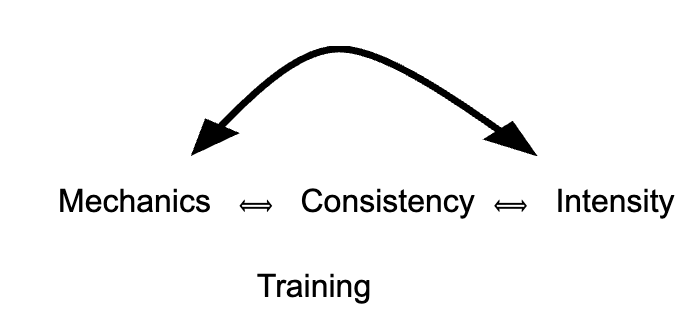
Let me dig into this and explain what this looks like in the gym over the long term. As we first start CrossFit, it’s all mechanics. We’re learning the gross points of performance for the main movements, such as proper range of motion, midline stabilization, core-to-extremity movement, and posterior-chain engagement. Gradually, as we incorporate these positions, we work on our consistency. We strive to string together quality reps, and we begin to do more good reps than bad. At this point, we are starting to feel the basic points of performance, so we can sense when something is off, and we can work to fix it on subsequent reps.
Once we’ve achieved the ability to consistently reproduce good reps (such as a set of 15-20 reps in an unweighted movement), we conservatively add intensity. We achieve this by simply adding a little load or speed and assessing how our technique responds. We gently push until we’re uncomfortable and struggling to maintain our technique as the reps accumulate. This is training or, more precisely, threshold training. This is what we do every workout in some form, from warm-up to cool-down, every day. It’s a constant battle. There are good days when we move effortlessly and bad days when we feel like a train wreck. In addition, every tiny increment of increased intensity requires practicing mechanics and developing consistency at that new level of speed or load.
From Novice to Virtuosity: The Long-Term Journey
It doesn’t stop there either. Once we can display the major points of performance consistently at an uncomfortable speed, it’s time to layer in more nuanced technique elements. In the air squat (or any squat), we strive to maintain foot pressure across the big toe, little toe, and the center of the heel every rep. We want to be balanced side to side as we move up and down and avoid having our pelvis tilt to one side or the other. We work for tension in our hips, glutes, and hamstrings in the bottom position and use these muscles (as opposed to a bounce off the calves) to drive us back to standing. And we can always work on our torso position throughout the rep.
In the clean, we can spend years refining our timing, our consistency at the mid-thigh position, keeping the bar close, the speed of our elbows, and the pull under. Even in something as seemingly simple as a push-up, we want to perfect how our shoulder blades move, our hollow position at the top, and the torque we build with our hands into the ground. All of this rep after rep under the duress of intensity.
I recall watching a workout video with Rich Froning where he was practicing air squats — sets of 25 or 50 — during his warm-up because he knew there were details he could improve. This was after winning multiple CrossFit Games. Mike Burgener tells the story of one of America’s top weightlifters who used video software to track his bar path in the snatch with a PVC pipe and 375 lb. The bar paths were identical. This comes from training. This demonstrates a persistent dedication to honing one’s craft, focusing on the present movement to move with intensity.
The Numbers Game: What Training Actually Looks Like
Ultimately, if I had to pin down numbers, I’d say the goal is to be able to move at a speed that is uncomfortable while hitting the gross points of performance 95 percent of the time or more, and the more detailed movement qualities 80 percent of the time or more, while constantly pushing the edge of the intensity envelope. This is hard, challenging, even frustrating work at times, but the reward is worth it. In contrast to “exercising,” which may leave us tired or subject to wear and tear, and decrease our skill, every “training” session captures and deposits results we now own. When we work diligently in this manner, we morph mechanics, consistency, and intensity into practice, mastery, and virtuosity.
Ready to Transform Your Approach?
This is how we become the best, fittest, healthiest version of ourselves. And that’s the difference between training and exercising. Ready to shift from exercising to training? Start with these three steps in your next workout:
- Slow down your warm-up: Use every air squat, push-up, and movement prep as technique practice, not just muscle activation.
- Choose one technical focus per workout: Pick one specific element — like bar path, breathing pattern, or foot position — and maintain awareness of it throughout the entire session.
- Scale intensity to maintain technique: If your form breaks down, reduce the load or slow the pace. Remember: we’re building skills under pressure, not just getting sweaty.
The path from exercise to training isn’t about doing different workouts; it’s about approaching every workout with the mindset of a craftsperson perfecting their art. Every rep matters. Every session is an opportunity to get better, not just get tired.
About the Author
 Stephane Rochet is a Senior Content Writer for CrossFit. He has worked as a Flowmaster on the CrossFit Seminar Staff and has over 15 years of experience as a collegiate/tactical strength and conditioning coach. He is a Certified CrossFit Trainer (CF-L3) and enjoys training athletes in his garage gym.