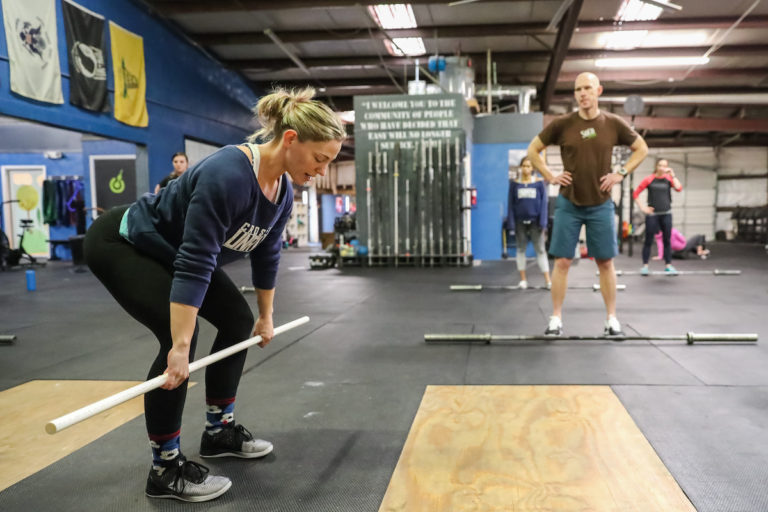
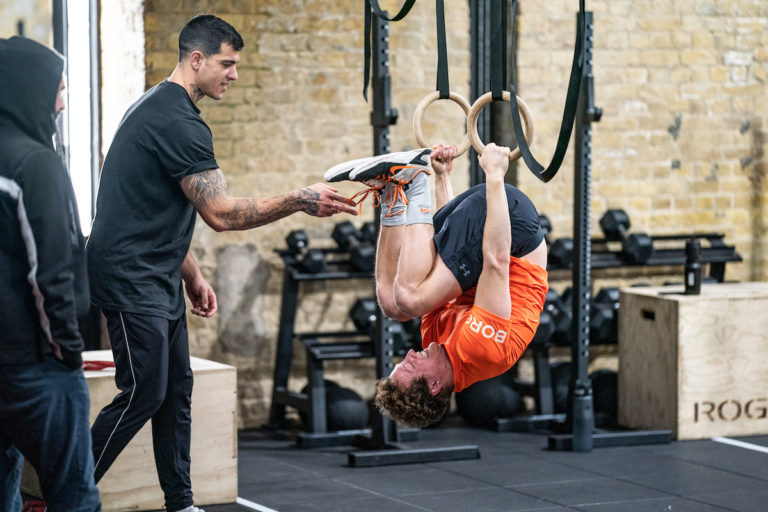
Have you ever watched athletes move and said to yourself, “Yep, those push jerks and pull-ups are happening” while not really seeing any movement faults because so much is going on? As coaches, it’s pretty easy for us to be looking for every possible flaw, and as a result, to miss out on most of what can be changed to improve our athletes’ performance. But there are specific ways to train your coach’s eye and improve your ability to see correct and incorrect movement. Leveraging multiple methods for identifying proper movement mechanics and faults can help us develop coaching virtuosity and ultimately do what we set out to do: help our athletes move better and increase their fitness.
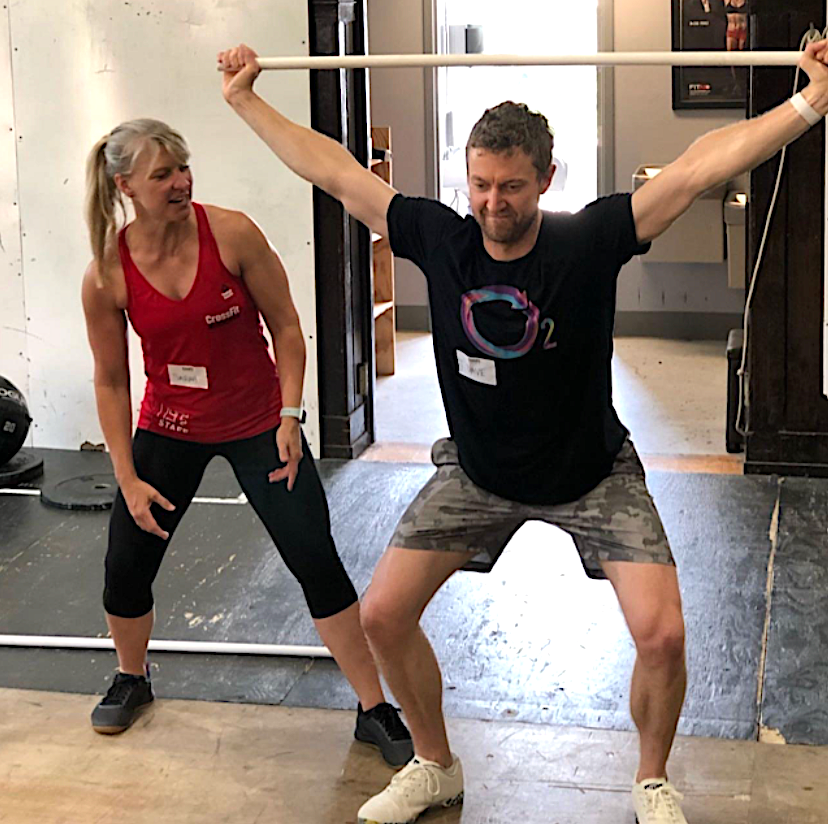
Mills (left) with a seminar participant
CrossFit courses like the Level 1, Level 2, and Spot the Flaw teach several fundamental approaches to spotting both good movement mechanics and movement faults. These fundamentals (below) show us that “seeing” is an important step along the path to improving movement, and it starts with knowing what to look for and where and when to look:
- Use the following sequence to improve movement:
- Watch — ID Fault — Cue — Check — Acknowledge — Repeat
- Note the three points in bold relate to seeing.
- Know and use the primary points of performance from your Level 1 Training Guide as a checklist.
- Know sound versus unsound movement mechanics (i.e., know the associated faults for each movement).
- Move around your athlete to see multiple angles.
- Apply micro and macro views.
- Watch one person at a time for dynamic movements (micro view).
- Scan a group for static positions (macro view).
- See how your athletes are moving during instruction (warm-ups) and workouts (intensity).
These concepts are the bedrock of how we see movement in CrossFit, and deploying them in our gym environments across a host of athletes and movements can boost us to 20/20 vision. Here are a few additional methods we can use to develop ourselves into masters at seeing movement mechanics.
Leverage Your Teaching: Teach a Point, See a Point.
As we instruct CrossFit classes, we can use progressions and layer in points of performance as we teach. An effective way to see movement mechanics (good and bad) is to teach one point of performance, then go see and correct only that point as your athletes perform a movement. This seems fundamental, but it can get lost when we’re rushed or focused on teaching the next point.
For example, when you’re coaching athletes to drive the knees out in line with the feet during the squat, watch the knees throughout the rep. Let your athletes know by telling them, “I’m watching your knees as you go down and come back up!” This keeps you focused, allows you to identify that particular fault, and connects your athletes to what you’re looking at.