There’s a moment that comes for most of us — we’ve got the rhythm down, classes run well, members improve, and we feel capable on the floor. But even in that confidence, a more profound question can creep in.
What kind of coach am I, really?
That question has little to do with job titles or the number of classes we coach. It cuts deeper into how we see ourselves in the role, what we stand for, and why we do what we do. That’s professional identity. And while it might sound abstract, it shapes every part of our coaching practice, from how we communicate to how we respond under pressure.
Professional identity grounds us in purpose, sharpens our presence, and sustains us in the long run. The stronger our connection to it, the more consistent, confident, and fulfilled we can be in the work.
What Is Professional Identity?
Professional identity refers to how we perceive ourselves as coaches. Not just what we do, but who we are when we do it. It includes:
- What we do: the daily responsibilities and skills we use, such as coaching movement, leading a group, giving feedback, and making decisions
- What we value: the principles that guide how we coach, like effort, empathy, accuracy, or integrity
- What we believe: Your daily CrossFit practice does two things. It makes you a credible example for your athletes, and it keeps you anchored to what works. When you’re committed to the methodology, you won’t get distracted by the latest fitness trends flooding social media.
- How we show up: the energy, presence, and personality we bring, whether that’s calm and focused, playful and warm, or steady and assertive
- Who we’re part of: our sense of connection to a professional coaching community, and the shared standards, language, and accountability that come with that
- Where we coach: the context that shapes our work, whether that’s a fast-paced affiliate, a small group setting, or one-to-one coaching
And importantly, professional identity is shaped by how authentically we coach. As the CrossFit Level 2 Training Guide reminds us, “a positive presence and attitude cannot be faked.” We don’t need to adopt someone else’s style. The goal is to show up fully as ourselves, with intention and care. A strong identity doesn’t come from pretending to be someone else. It comes from knowing who we are, being aware of how we affect others, and making choices that reflect both.
Why Awareness Matters
Professional identity is not something we build once and leave alone. We keep refining it, shaped by what’s happening around us and how we make sense of it.
Most of us develop our identity over time, often without realising it. We pick up habits from other coaches, adapt to our environment, and repeat what seems to work. But if we don’t reflect, we risk drifting into patterns that don’t align with who we want to be or slowly wear us down.
Being aware of our identity allows us to:
- Coach with more purpose. When we know what we stand for, we can coach consistently, confidently, and groundedly.
- Stay resilient. Clarity about who we are helps us respond rather than react when we face challenges or criticism.
- Adjust without losing ourselves. The coaching landscape will change, but when anchored in identity, we can adapt without compromising what matters most.
- Model leadership. Whether we’re guiding other coaches, shaping team culture, or simply showing up in front of members, clarity about who we are helps us lead by example with consistency, trust, and intention.
Awareness is what turns experience into growth. And it starts with taking a step back to ask better questions.
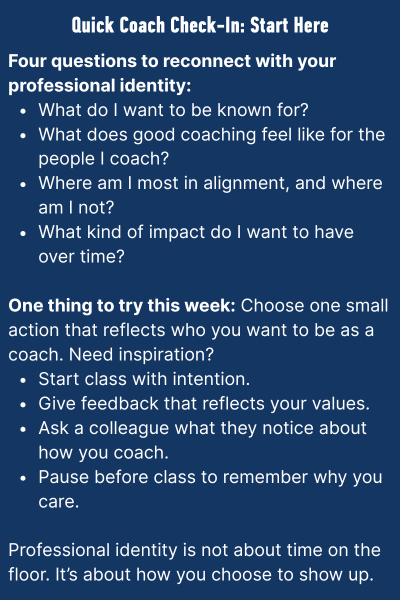
Start With Better Questions
We don’t need a new plan or a new persona. But we do need to reflect. Here are a few places to start:
- What do I want to be known for? Is it how we hold the standard, how we build trust, or how we bring focus, calm, or energy to a session?
- What does good coaching feel like for others? Supportive? Clear? Challenging? Safe? Empowering? Our intent shapes our presence.
- Where am I in sync, and where am I out of alignment? Are there moments in class when we feel off, like something didn’t sit right? That might be a sign that our actions don’t match our values.
- What kind of impact do I want to have over time? Do we want to be coaches who help people move better, feel braver, and take ownership of their lives, or something else?
From Reflection to Action
Start with one question. Write about it. Think it through. Then pick one small way to let it shape how you coach this week.
That might look like:
- Starting class with purpose, not just logistics. For example, opening by inviting the group to focus on movement quality today, or on approaching the workout with a growth mindset, where the goal is progress, not perfection
- Giving feedback that reflects what you value most. If precision matters to you, say, “Great job keeping your heels down through the drive” instead of a generic “nice work.” If connection is a priority, try, “You really stayed with that, I can tell how much this means to you.”
- Pausing before class to reconnect with what matters to you. Take 30 seconds to remind yourself that you’re here to serve, or to focus on helping one person feel seen today, or whatever it is, not just to run the plan.
- Asking a colleague a focused question like, “I’m aiming to create a space that feels focused and welcoming. Does that come across when you see me coach?” or “I want to come across as calm and clear under pressure. Is that what you’re seeing?”
This is what it means to grow as a professional — not by how many hours we spend on the floor, but by how intentionally we show up in the role for our members, our team, and ourselves.
The Identity You Bring to the Floor
Professional identity is not a title or a destination; it is a journey. It is a practice that deepens every time we reflect, act with intention, and stay true to what we value. It allows us to lead with clarity, adapt with purpose, and coach in a way that feels honest and aligned. In a world where it’s easy to go through the motions, choosing to show up as a professional by design, not by default, is one of the most powerful things we can do.
Have a question for a coach? Please submit that here.