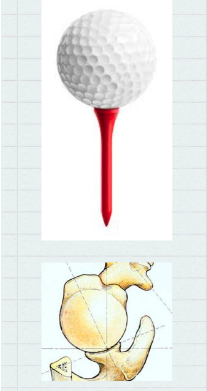
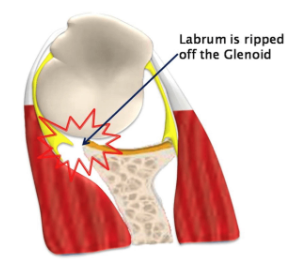
The CrossFit coach is tasked with a multitude of responsibilities. When it comes to athletes’ health, coaches are looked to for answers and best practices. The goal of this article is to help answer some of the questions athletes might have when it comes to shoulder health.
The easiest tool a coach has when it comes to assessing their athletes is to get a history of any issues, injuries, or surgeries they may have had in the past. Somebody who mentions that their shoulder dislocates every time they reach overhead is going to need a much different on-ramp than someone who has no prior history of injury.
I will go through a few of the most common conditions I see as a coach and orthopedic surgeon and ways coaches can help their athletes.
Overuse
The classic and most common example of shoulder pain comes from mere overuse, leading to tendinitis or tendinopathy. This can occur in any tendon in the shoulder, such as the biceps or rotator cuff. It is most commonly seen in the biceps tendon in the front of the shoulder.
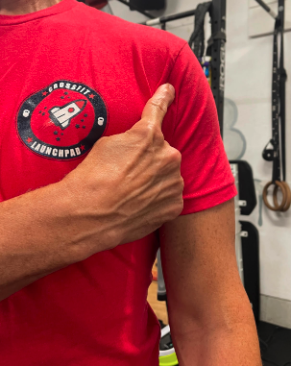 When seen in the rotator cuff, the four tendons surrounding the shoulder, tendinitis pain usually is described as occurring down the lateral, or outer, side of the arm.
Tendinitis starts as a result of a change in activity, often seen at the beginning of one’s CrossFit journey. Lifting medium to heavy weights and moving them overhead are movements that someone new to CrossFit may not have done before. So, these tendons become stressed and develop microscopic tears in the tendon structures. Symptoms include pain with reaching or lifting off to the side or in front of them. The simplest and most effective treatment for this is to modify activities until the tendons heal. Some people will push through this pain, which unfortunately exacerbates their symptoms and worsens the microtears. This ultimately leads to a longer healing process. Something that would easily take two or three weeks to quiet down on its own could take three to four months to heal if someone is not careful.
The goal is to limit activities that are painful and to make sure the pain does not recur the next day — if it does, you did too much the day before. It’s a process that requires some experimentation — but the great news for CrossFit athletes is that over time, tendons can adapt to the stress and become stronger, which decreases the risk of tendinitis.
This makes it abundantly clear that following CrossFit’s charter of mechanics, then consistency, and then intensity is of the utmost importance. In addition, ensure that workout programming is not excessively redundant with movement functions on a day-to-day basis.