That’s when Leydon said he went full steam ahead into the next phase of his coaching. He began mentoring and developing other coaches and started focusing on aspects of coaching beyond weightlifting and conditioning.
Leydon soon realized he’d never be a truly great coach if he couldn’t connect with other people. He credits his wife for teaching him how to communicate well, and the importance of truly connecting with and understanding other people.
“Communication has to be done in a way that you’re understanding who you’re talking to, you’re saying it in a way they are going to understand it, but you’re also hearing what they’re saying,” he said.
Leydon worked on removing emotion from situations with athletes, teams, and employees so he could hear both sides and bring about a resolution. He began to understand the importance of working with the different personalities within the gym and making sure everyone felt heard and understood.
“That was the next section of my coaching development,” Leydon said, “when it came to leadership and trying to become a ‘master coach’ and to me being an amazing leader, coach, father, friend. It comes down to your ability to communicate.”
Whether you’re a coach trying to direct a team in competition or you’re a gym owner trying to manage 10 different coaches, to be successful, you need people to buy into your leadership, he continued.
“Buy-in occurs through trust, and trust occurs when people feel they are heard and you have a good understanding of what their needs are and you meet their needs,” he said.
The Professional Coach: Keep It Simple
After being a coach for almost two decades and mentoring new coaches for years, Leydon said while knowledge is important, coaches should know how to apply that knowledge in many different settings — and combine all of that with true human connection.
“Someone once told me you could be the greatest coach in the world, but if no one likes you, no one is going to know you’re a great coach, because nobody wants to be around you,” Leydon said.
And the best piece of coaching advice he ever got is perhaps the most difficult to follow: “Keep it simple.” Once you’ve accumulated a significant amount of knowledge, it’s tempting to want to communicate everything you know to your athletes.
“For coaches, especially new coaches, you’re inundated with Facebook, Instagram, and all the flashy new gadgets, and the lights that light up,” Leydon said. “It’s difficult to just keep it simple and effective, but if you keep it simple and it’s effective and the person feels connected and they trust you, then people are going to come to you.”
The final piece of being a professional coach, Leydon said, is offering a five-star experience to everyone who walks into the gym, whether it’s their first or thousandth time.
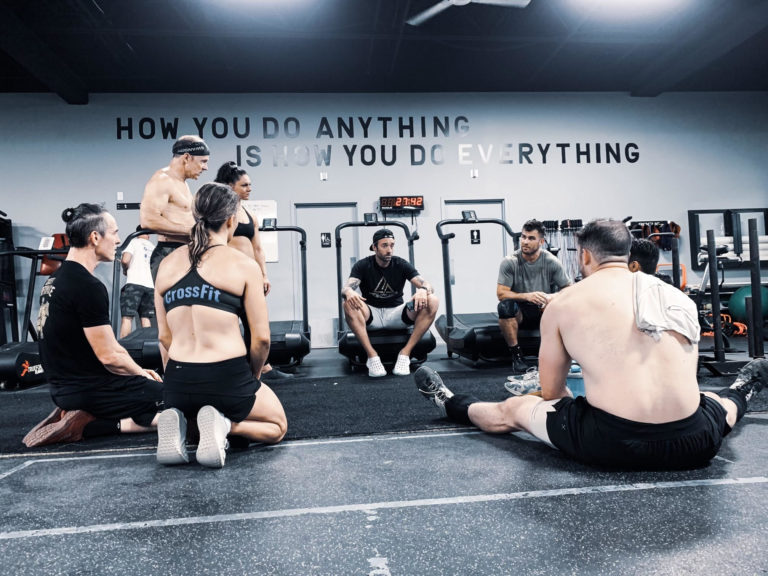
Leydon said he’s always thinking about being a good host inside the gym, making people feel connected and wanted. He accomplishes this through small details, like introducing people to one another, staying off his phone, and not eating while coaching. He often thinks of it like a doctor’s office — would we want our doctor texting and eating a sandwich in the middle of the appointment?
“Is this a hobby or are we professionals?” Leydon asked.
“If we’re professionals, we have to have our set of criteria that define professionalism, and we have to (hold) ourselves to that.”
Comments on Jason Leydon on Becoming a Professional Coach
6 Comments
Thank you for this! I'm a new coach, got my level 1 in April and on my 3rd week of coaching. My goal is to connect with each athlete that comes into the gym and help them to have a good workout and feel proud of themselves.
Thank you for this!
The breakdown of Beginner-Intermediate-Professional is brilliant and I hope others notice the inverse relationship between advancement in coaching and the technical aspects of the practice.
Beginner Coaches > become obsessed with the details and absorb knowledge
Intermediate Coaches > learn how to apply the knowledge
Professional Coaches > keep it simple
CrossFit does not get enough credit for the professionalization of fitness coaching. Just like CF for physical conditioning, the principles they bring to training their coaches are effective and replicable. Kudos to coach Glassman for thinking about this since day 1, and the organization for never wavering from the focus on this critical aspect of their success.
I am blessed to have cut my teach coaching swimming before CrossFit. The beauty there is that focusing on principles crosses all sports. For me in swimming it is form before speed aka in CrossFit mechanics-consistency-intensity.
Regardless of the sport, every athlete is an individual and likes to be treated personally. My key focus is to make sure I connect with every athlete in every session and ensure that they've had a positive experience.
My biggest need for my own improvement, after reading this article, is to identify mentors who can guide me further along my coaching journey. Thank you for the kick in the butt!
Thanks for sharing.
I agree with focusing on the principal rather than staying tied to a specific method.
Thanks for sharing your story Jason. Couldn't agree with you more about the "keeping it simple" philosophy/approach.