I want to do a muscle-up. Where do I start? This is a question coaches receive on a regular basis. Unfortunately, due to the wide range of starting points, there is no one-size-fits-all cookie-cutter 12-week program that can be handed out to allow athletes to develop at the same rate. Rather, a program can be developed that establishes specific goals for athletes to achieve before moving forward. The timeline is specific to the individual.
The plan outlined here is a variation of what was given to the CrossFit Level 1 Seminar Staff to aid with the development of their own muscle-up. This is a goal all Seminar Staff members challenge themselves to achieve. Spending the time to develop this movement serves as an example to your athletes to challenge themselves and to put in the work to overcome obstacles. Perhaps more valuable to your athletes is that this process will allow you to coach them better, even if you don’t achieve the ultimate goal of doing a muscle-up. You will learn a variety of cues, learn different drills and progressions, and you will also be able to resonate with the struggle.
The content outlined here can serve as guidelines for progressing yourself or allow you to assist others to achieve their goals. As a side note, the biggest limiting factor is patience. The process toward a muscle-up can take years. Do yourself and your athletes a favor and set small, achievable goals throughout each level to motivate you to keep moving forward and take comfort in knowing you are getting fitter each step of the way.
Step 1: Develop Strict Pull-ups and Dips
How many pull-ups and dips do you need to be able to complete before being able to do a muscle-up?
Answer: Nobody really knows! The number of reps will vary from person to person depending on a variety of factors such as flexibility and technique. In his November 2002 CrossFit Journal article, “The Muscle-up,” Greg Glassman suggested: “If you can do fifteen good pull-ups and fifteen good dips then you’re strong enough. If you can’t, work your pull-ups and dips over time until you can do the muscle-up.” These numbers are decent guidelines but not absolute prerequisites. Regardless, all coaches will agree that athletes will need to have the capacity to perform strict pull-ups and dips, and will need to progress to being able to perform a strict chest-to-ring pull-up while being able to maintain a false grip. For many athletes, this process will take time, commitment, and consistency. To streamline this process, follow CrossFit’s nutrition prescription of eating quality foods and quantifying intake as this prescription is notorious for shedding body fat and boosting performance.
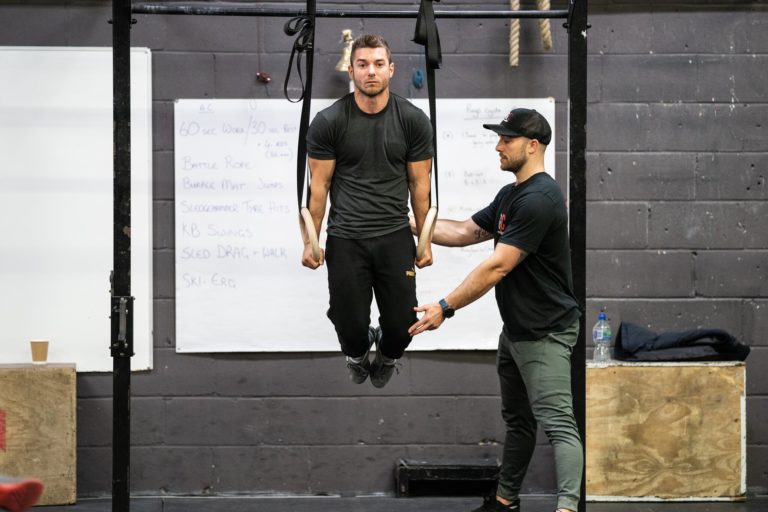
Below is a sample plan that can be followed to build the prerequisite strength. These sessions take into account that you are performing upper-body pulling and upper-body pushing movements throughout the week in your regular workouts. The sessions are intended to be short and consist of 1 pull-up-focused session and 1 ring dip-focused session per week and can be performed before or after your normal workout. Developing the strength necessary for a muscle-up may take months, even years. Be patient and consistent!
Why Negatives?
The term “negative” typically refers to the eccentric phase of a movement. Examples of the eccentric phase of a movement are the lowering phases of a squat, bench press, pull-up, dip, etc. Considering that most athletes are already doing a fair amount of fast-paced efforts during their normal workouts, doing some eccentric-focused efforts can provide a different means to develop strength for pull-ups and dips. The volume should be low — no more than 10 total reps in a session — with a focus on control throughout the entire range of motion.
Optional Accessory Work
Accessory movements are typically done after the main section of a workout to target specific muscle groups or a specific skill. To develop pull-ups and dips, a low dose of accessory work can be introduced with the goal of targeting upper-body pulling and pressing strength. Keep in mind, if this additional work takes away from your main sessions, or if time is an issue, this work can be removed altogether.
Weekly Overview
Session 1: Pull-up Focus (One time per week)
Phase 1- Negatives
5-7 sets of 1 negative pull-up (on bar or rings)
*Rest 2-4 minutes between sets.
Notes:
- Each rep is intended to be a maximum effort.
- Attempt to hold at the top for 8-10 seconds before lowering under control.
- The goal is to increase the time under tension for a single rep from week to week.
- Scale this movement by using a band or by performing a “toe-nail assisted” variation.
Phase 2 – Strict Pull-ups
When you have developed the capacity for strict pull-ups, remove the focused negatives and replace with 3-5 sets of 3-5 reps of strict pull-ups while resting 2-3 minutes between sets.
Notes:
- During this phase, you can start to practice muscle-up transition drills.
- When 3 sets of 5 strict pull-ups are achievable, add load or progress to reps on the rings while maintaining a false grip.
Optional Accessory Work
Variations of the pull-up and vertical pulling strength will be the main focus for development. Pick one of the options in this video and complete 2-3 sets for 10-12 challenging repetitions while resting approximately 1-2 minutes between sets. If you want some variance, you can pick a horizontal pulling movement like a ring row or single-arm dumbbell row and perform them in a similar fashion
Session 2 – Ring Dip Focus (One time per week)
Phase 1 – Negatives
5-7 sets of 1 negative ring dip
*Rest 2-4 minutes between sets.
Notes:
- Each rep is intended to be a maximum effort without exceeding 30 seconds.
- Do not hold at the top for more than 8-10 seconds before lowering.
- The goal is to increase the time under tension for a single rep from week to week.
- Scale this movement by completing a banded variation or performing a “toe-nail assisted” variation.
Phase 2 – Strict Ring Dips
Similar to the pull-up, when you have developed the capacity for strict ring dips, remove the focused negatives and replace with 3-5 sets of 3-5 reps of strict dips, resting 2-3 minutes between sets.
Notes:
- During this phase, you can start to practice muscle-up transition drills.
- When 3 sets of 5 strict dips are achievable, perform reps with a 1-2-second pause in the bottom position.
Optional Accessory Work
Variations of the ring dip that provide a challenge will be the priority when building strength and range of motion for this movement. Options include band-assisted ring dips, box dips, and toe-nail assisted dips on the rings, etc. Performing 2-3 sets of 8-12 reps while resting 1-2 minutes between sets will be sufficient. If looking for a change of pace, horizontal pressing movements like the dumbbell bench press, barbell bench press, and deficit push-up can be performed in a similar fashion.
Auto-Regulate
Come into the week with a plan of attack but feel free to alter the extra work as you see fit. If you notice a decrease in recovery, decreased performance, and/or decreased motivation in your normal workouts, eliminate the accessory exercises (if performing them) or reduce the extra sessions to one day per week. In contrast, if you are recovering well and your performance is good, feel free to add another low-volume session focusing on muscle-up skill development.