3, 2, 1 … go!
Fifteen athletes attack the workout. The room is a mix of experience levels, abilities, and strategies — some moving fast, others pacing deliberately.
A few minutes in, the coach notices the shifts: barbells getting lighter, movements scaling down mid-workout, and athletes slowing their pace. Meanwhile, others cruise through untouched, seemingly unbothered by the demands.
3, 2, 1 … time!
Athletes sprawl across the floor, chests heaving.
But here’s the question: Who actually got the better workout? Who hit the intended stimulus? Who executed their plan, and who crashed and burned halfway through?
Most athletes aren’t reckless. They’re not trying to blow themselves up or train carelessly. They simply don’t know how to make smart decisions under fatigue; when their heart rate spikes, their muscles burn, and clear thinking gets harder.
That gap — between effort and execution — is where Athlete IQ comes in.
What Is Athlete IQ?
Athlete IQ is an athlete’s ability to understand their own movement, pacing, strategic choices, and make better decisions while under fatigue.
And it’s the difference between executing the plan and simply surviving it.
Athlete IQ equips athletes with the tools to make better decisions and plan their workouts more effectively. It provides an added edge not only physically but also mentally. Training the mental side of fitness gives athletes a new perspective on how to approach workouts rather than going full-send every time. Athlete IQ can be learned through experience, but it can also be taught.
Athlete IQ can be broken down into specific, coachable components that show up daily on the gym floor.
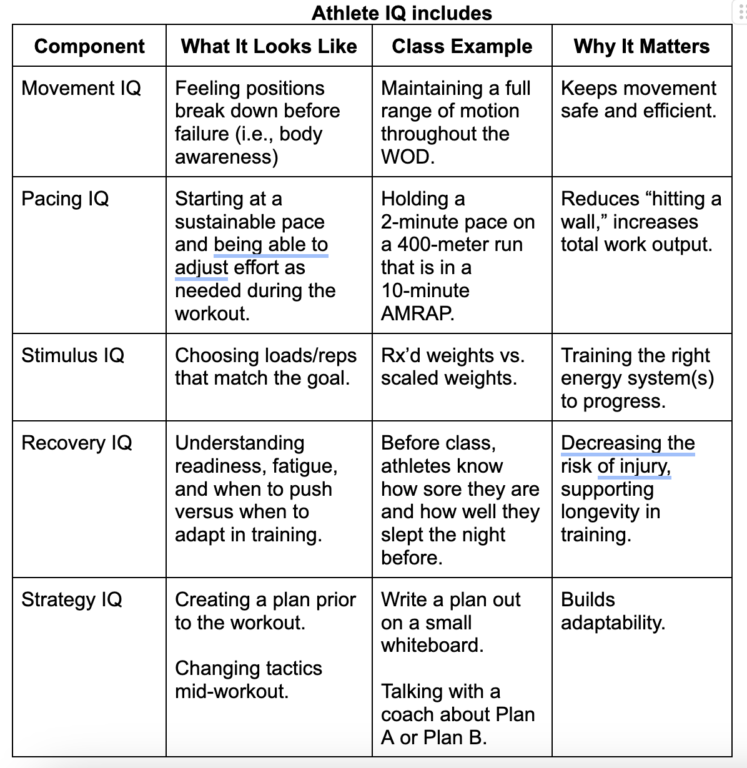
Athlete IQ Includes
Despite these components, many athletes are never taught how to apply them once the clock starts.
The Problem: We Coach Movement but Not Decisions
Coaches talk endlessly about mechanics, points of performance, and the why behind movement. But when the clock starts, athletes are often left to guess:
- “Should I go unbroken?”
- “How fast should I run?”
- “What happens when my lungs catch fire?”
- “Why does this feel impossible by Round 2?”
Many athletes stick to Rx’d simply because it’s written on the board. Then they scale inconsistently when exhaustion forces it, rather than creating a plan that supports success and avoids scaling mid-workout. Creating a plan helps athletes perform better workouts, respond to the stimulus, and return to class. That is what Athlete IQ is all about. Our job as coaches should be to equip our athletes with a tool/strategy/approach that elevates their athletic ability. We’re here to develop athletes. Not only physically, but also mentally.
A Lightbulb Moment: Wall-Ball Shots, Breathing, and Ownership
I coached an athlete who always crumbled on wall-ball shots. Great effort. Not so great in pacing.
Round 1: Perfect.
Round 2: Meltdown.
We focused on:
- Breathing rhythm
- Breaking earlier than the ego wanted
- Smooth is fast. Fast is smooth.
During Kelly
5 rounds for time of:
400-meter run
30 box jumps (20/24-inch box)
30 Wallballs (14/20 lb)
They held:
3 consistent sets of 10 reps every round.
No panic. No burnout. No guessing.
That wasn’t a wall-ball shot win.
That was a breakthrough in how the athlete approached training.
Athlete IQ permits athletes to train with intention instead of ego.
Why Athlete IQ Is a Coach’s Secret Weapon
When athletes gain decision-making skills, they learn faster, progress more safely, perform better, and become more coachable athletes. This gives athletes the tools to understand that training empowers them to push further. It keeps them coming back for more.
Coaching Athlete IQ: How YOU Can Implement Today
#1 – Coach the Stimulus Every Time
The stimulus guides workout intensity. This information can help you have clearer conversations with your athletes about expectations and execution.
#2 – Teach Pacing — Don’t Hope They Figure It Out
Ask athletes about their strategy before the workout and help them refine it when needed.
Questions to ask:
- “What are your breaks?”
- “Will you look at the clock to count your rest? If so, how long?”
- “If Rep Scheme A doesn’t work, what is the backup plan?”
#3 – Install Breathing Cues
Teach athletes how to breathe during specific movements and how breathing cadence affects output and fatigue.
Questions to ask:
- “How are you breathing on this movement? Are you holding your breath?”
- “What is a breathing cadence that helps you stay consistent?”
#4 – Require Athlete Reflection
During cool-downs, you can ask athletes questions to allow them to reflect on their decision and execution.
Questions to ask:
- “If you could change one thing about your strategy today, what would it be?”
- “What went well?”
#5 – Celebrate Smart Scaling
Celebrate good decisions, not just hard effort. Reinforcing smart scaling encourages confidence, consistency, and long-term progress.
The Coach’s Role in Athlete IQ
Coaches aren’t just movement mechanics.
We are teachers of self-awareness, translators of stimulus, and builders of athletic intelligence.
Don’t build athletes who can suffer. Build athletes who can think.