Whether it’s a torn ligament, a strained joint, or lingering overuse injuries — often from activities performed outside the gym — setbacks will happen to your athletes. But as coaches, we have the power to reframe these moments. Injury doesn’t have to mean inactivity or regression. When approached with clinical precision and coaching excellence, it becomes a transformative opportunity for growth.
The goal isn’t perfection, it’s progression. And progression doesn’t stop because your athlete is injured; it simply requires more sophisticated coaching.
Reframing the Coaching Narrative: Injury Is a Time to Coach Differently
A common coaching pitfall is treating injury as a reason to put training on pause or simply telling athletes to “take it easy.” But CrossFit’s core philosophy reminds us that fitness exists on a spectrum, and our methodology is specifically designed to meet athletes anywhere along that continuum.
“The needs of Olympic athletes and our grandparents differ by degree, not kind.”
This foundational concept from the Level 1 Course directly applies to coaching athletes through injury recovery. As coaches, our role shifts from programming for performance to programming for capacity, and this requires a deeper understanding of both movement mechanics and injury physiology.
Scaling isn’t about doing less; it’s about doing what’s appropriate without compromising training intent. This means maintaining intensity relative to your athlete’s current capacity across all domains: physical, mental, and emotional.
Case Study: Coaching Through a Torn ACL
When I tore my ACL and suffered a bucket-handle meniscus tear, a complex injury involving sudden directional changes and joint instability, I had a choice as both athlete and coach: sit out and wait, or adapt and thrive. I chose to stay in the gym, but more importantly, I chose to document the process that made this possible.
Here’s what I learned about coaching injured athletes:
The Assessment Phase (Days 1-7 Post-Injury)
Before any movement modifications, successful injury coaching requires a comprehensive assessment:
- Medical clearance parameters: What movements are contraindicated? What loads are permissible?
- Pain vs. discomfort differentiation: Teaching athletes to distinguish between protective pain and training discomfort
- Capacity testing: Establishing baseline abilities across all movement patterns
- Psychological readiness: Assessing fear, frustration, and motivation levels
The Coaching Framework: Progressive Scaling Through Recovery Phases
Let’s examine a practical coaching progression using a common CrossFit workout:
Original Workout
As many rounds as possible in 12 minutes of:
12 dumbbell snatches (35/50 lb)
24 wall-ball shots (14/20 lb)
36 double-unders
Phase 1: Acute Recovery Coaching (Weeks 1-4)
Coaching Focus: Maintain training stimulus while respecting tissue healing
Dumbbell Snatches:
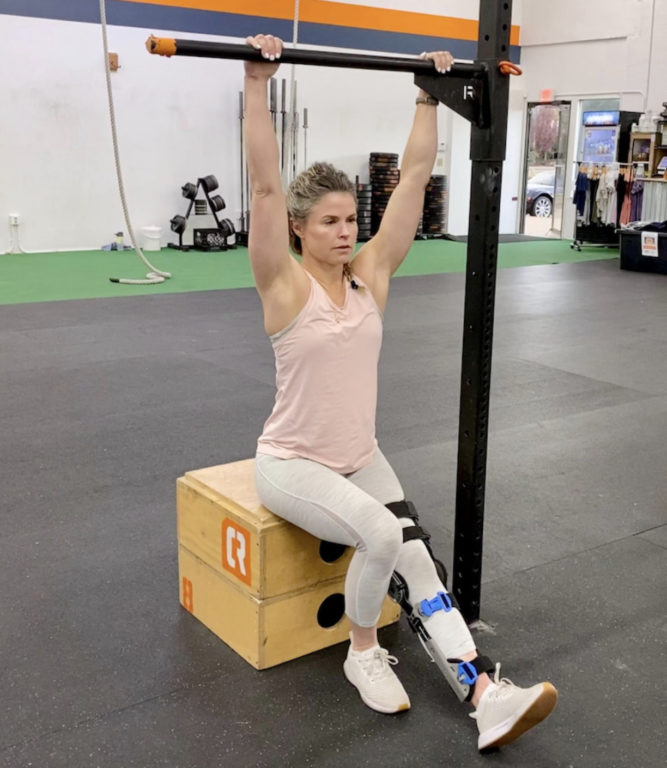
- Modification: Seated box position, 25-lb dumbbell
- Coaching Points: Emphasize unilateral loading, maintain vertical torso, and control descent
- Stimulus Preservation: 6 unbroken reps per arm, alternating sides
- Safety Markers: No knee flexion beyond 90 degrees, no rotational compensation
Wall-Ball Shots:
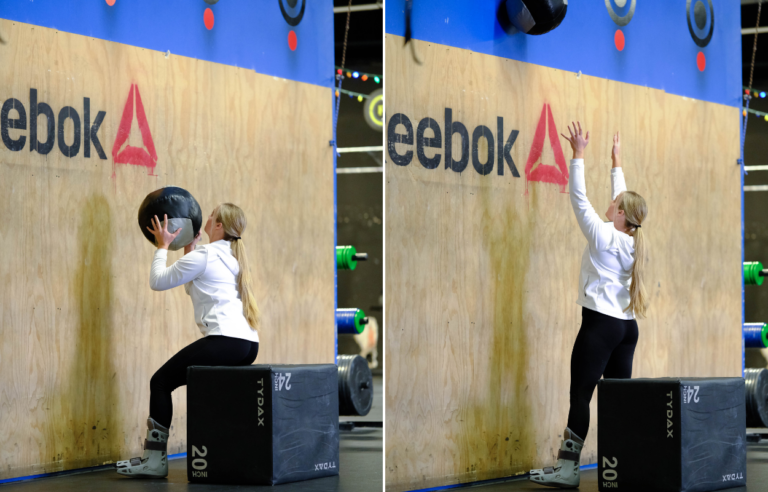
- Modification: Seated medicine-ball throw, 10-lb ball
- Coaching Points: Full arm extension, consistent target height, controlled catch
- Stimulus Preservation: Complete in a maximum of 2 sets
- Safety Markers: No standing knee load, maintain seated posture integrity
Double-Unders:
- Modification: 30-second single-leg Echo bike
- Coaching Points: Maintain consistent RPM, focus on smooth pedal stroke
- Stimulus Preservation: High heart rate, monostructural demand
- Safety Markers: No impact loading, no bilateral weight bearing
Phase 2: Progressive Loading (Weeks 5-12)
Coaching Focus: Gradual complexity increase while maintaining movement quality
Dumbbell Snatches:
- Modification: Hang muscle snatch, standing position
- Coaching Points: Eliminate deadlift portion, focus on vertical pulling mechanics
- Progressive Elements: Weeks 5-6: 25 lb, Weeks 7-8: 30 lb, Weeks 9-12: 35 lb
- Assessment Markers: No knee valgus, consistent bar path, pain-free range of motion
Wall-Ball Shots:
- Modification: Seated on a 24-inch box, partial range of motion (ROM)
- Coaching Points: Progressive depth increase, controlled eccentric loading
- Progressive Elements: Weeks 5-6: Quarter-squat depth, Weeks 7-8: Half squat, Weeks 9-12: Full ROM
- Assessment Markers: Symmetrical loading, no compensatory patterns
Double-Unders:
- Modification: Bilateral Echo bike
- Coaching Points: Smooth coordination, consistent power output
- Progressive Elements: Weeks 5-6: Seated position, Weeks 7-8: Standing, Weeks 9-12: Add arm movement
- Assessment Markers: No joint swelling post-workout, maintained technique under fatigue
Virtuosity Under Pressure: Teaching Movement Excellence
CrossFit’s emphasis on virtuosity — doing the common uncommonly well — becomes particularly relevant when coaching injured athletes. The forced reduction in intensity creates an unprecedented opportunity for movement refinement.
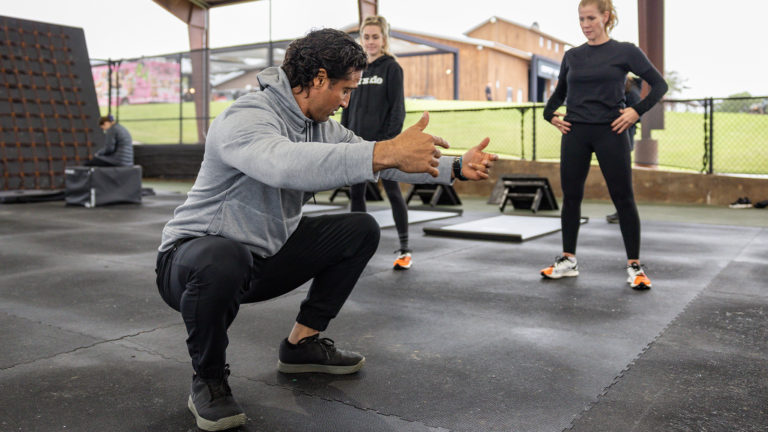
The Hierarchy in Action: Mechanics → Consistency → Intensity
For injured athletes, CrossFit’s foundational progression serves as both a framework and a safety protocol. Here’s how to coach each phase.
Advanced Scaling Strategies for Coaches
Effective scaling requires understanding the training stimulus and maintaining it through creative modification.
Range of Motion Scaling
- Partial ROM: Maintain muscle activation patterns while respecting pain-free ranges
- Tempo Manipulation: Use 3-1-X-1 tempos to increase time under tension
- Isometric Holds: Build strength in specific joint angles
Unilateral Training Applications
- Contralateral Strength Effects: Training the uninjured limb maintains strength in the injured limb
- Bilateral Coordination: Use unilateral movements to improve overall coordination
- Asymmetry Correction: Address imbalances revealed by injury
Load Management Protocols
- Percentage-Based Scaling: Use RPE scales rather than absolute loads
- Volume Adjustments: Maintain intensity through reduced volume
- Density Modifications: Adjust work-to-rest ratios to maintain stimulus
Position and Equipment Modifications
- Seated Variations: Maintain upper-body training with lower-body restrictions
- Supported Positions: Use boxes, walls, or bands for additional stability
- Equipment Substitutions: Replace high-impact with low-impact alternatives
The Community Factor: Coaching the Gym Culture

One of the most critical aspects of injury coaching extends beyond the individual athlete to the entire gym community. How you handle injured athletes sets the tone for your entire coaching philosophy.
Creating an Inclusive Training Environment
Celebrate Modified Achievements: When an athlete completes their first full ROM wall-ball shot after weeks of modifications, celebrate it with the same enthusiasm as a PR lift. This teaches your entire community that progress takes many forms.
Educate Your Community: Use injured athletes as teaching moments. Explain to the class why certain modifications maintain training stimulus — this builds understanding and respect for the scaling process.
Peer Support Systems: Pair injured athletes with experienced members who can provide encouragement and model positive attitudes toward scaling.
Coach Development
Regular Training on Injury Management: Ensure all coaches understand the basic principles of injury modification, not just your head coach.
Case Study Reviews: Monthly staff meetings should include discussion of successful injury management cases and lessons learned.
Medical Professional Relationships: Build relationships with local physical therapists, chiropractors, and sports medicine doctors who understand CrossFit methodology.
Key Coaching Principles for Injured Athletes
1. Scale With Clinical Intent
You’re not modifying to make things easier; you’re modifying to maintain training stimulus while respecting tissue healing. Every modification should have a clear purpose and desired outcome.
Implementation:
- Document the reason for each modification.
- Explain the intended stimulus to the athlete.
- Regularly reassess if modifications are still necessary.
2. Respect the Hierarchy, Always
Mechanics → Consistency → Intensity isn’t just a framework; it’s a safety protocol. This becomes even more critical when coaching injured athletes.
Implementation:
- Never advance to the next phase until the previous is mastered
- Use objective measures to determine readiness for progression.
- Be willing to regress if quality decreases.
3. Train Available Capacity
A shoulder injury doesn’t mean stopping training; it means intensifying focus on uninjured areas while maintaining what’s possible with the injured area.
Implementation:
- Develop unilateral training protocols.
- Use injury time to address weaknesses in uninjured areas.
- Maintain cardiovascular conditioning through alternative means.
4. Communicate with Precision
Ask specific questions, provide clear feedback, and scale with transparent reasoning.
Implementation:
- “How does this feel compared to yesterday?” not “How are you feeling?”
- “We’re reducing the load to focus on speed of movement,” not so you can “Take it easy.”
- “This modification maintains the same energy system demand,” not “Just do what you can.”
5. Maintain Community Connection
Isolation amplifies injury impact. Integrate injured athletes into the community while respecting their current capabilities.
Implementation:
- Modified athletes participate in team challenges.
- Injured athletes can coach or count reps for others.
- Create opportunities for injured athletes to share their progress.
Final Coaching Philosophy: This Is Still Athletic Development
Training through injury isn’t a compromise; it’s an opportunity for sophisticated coaching. It’s your chance to demonstrate that true coaching goes beyond programming workouts; it’s about developing resilient, intelligent athletes who understand their bodies and respect the training process.
CrossFit methodology doesn’t just prepare athletes for workouts; it prepares them for life’s physical demands. Part of that preparation involves learning to adapt, overcome, and thrive despite setbacks.
When you coach an injured athlete, remember:
- They’re still athletes with athletic goals.
- They deserve the same coaching excellence as uninjured athletes.
- They can often achieve things they never thought possible.
- Your coaching during their injury will define their long-term relationship with fitness.
The injured athlete in your gym today could become your most dedicated, knowledgeable, and resilient member tomorrow. That transformation depends entirely on the quality of coaching they receive during their most vulnerable training period.
Coach with intention. Scale with purpose. Build athletes who are stronger in every sense of the word.
Have a question for a coach? Please submit that here.
 Fran Pinheiro