The workout CHAD1000x is a popular Hero workout commonly performed on Nov. 11 (Veterans Day) or at some point throughout November. The prescribed version of this workout consists of performing 1,000 box step-ups to a 20-inch box while wearing a 35-lb ruck for females and a 45-lb ruck for males.
This workout will obviously tax the muscles and joints of the lower body; however, some other demands are often overlooked. The trunk is taxed significantly, partly due to the nature of the step-up, but more likely due to the demand of the ruck putting the core into slightly awkward positions, and the compression of the ruck restricting breathing.
This workout is notorious for causing athletes to feel sore for a couple of days due to the high volume and the impact on the eccentric phase of the movement. As coaches, you can alleviate some of the discomfort associated with this workout, as well as boost your athletes’ performance and recovery with some simple tweaks to your programming and by adding in some short accessory sessions.
1. Targeted Programming
Targeted programming refers to periods of time where you increase the frequency that an element is programmed while not taking away from other aspects of fitness. This could be as simple as ensuring a particular attribute is hit every week with a logical progression in mind. In this case, you can target stamina and endurance associated with the weighted step-up. For example, you can program one workout a week that is longer in duration and involves step-ups. An added element is to increase the volume of step-ups and/or perform higher-rep sets over the course of a multi-week training block. For example:
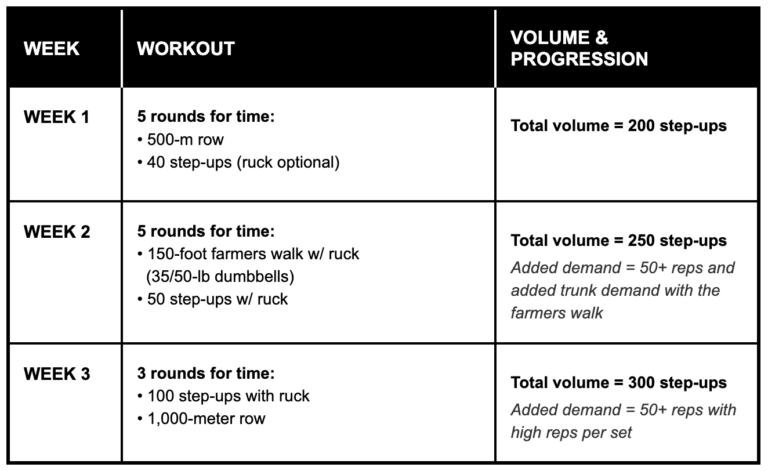
Note: Scale as needed
If you implemented a cycle like this for a period of six to eight weeks, your athletes could be accumulating around 600 reps of step-ups in a workout. This will aid with their performance and recovery from CHAD1000X while not hindering other aspects of their fitness. There are many different ways to create a logical template or progression, so get creative and have some fun. A strategy to consider is including 30-50 reps during the “rest” periods of a heavy upper-body lifting session. This can be an easy way to accumulate some volume without a ton of fatigue and with no effect on recovery. Just be consistent and have a progression in mind.
2. Accessory Work or Extra Sessions
Accessory work consists of elements in a training session that take place after the main session of the day. This time can be utilized to target movements that aid performance in this Hero workout while being time-efficient. Including variations of step-ups and lunge variations can be an obvious option here. But if you are already including a relatively demanding workout involving step-ups every week, consider movements that directly target the trunk.
For the posterior portion of the trunk, movements like hip extensions, back extensions, good mornings, dumbbell deadlifts/RDLs, Superman holds, and dumbbell death marches for relatively high reps are ways to target this region. For the anterior portion of the trunk, consider L-sits, hollow holds, hollow rocks, and plank variations to hit this region with stability in mind. Consider including these accessory sessions one to two times per week for no more than 10-15 minutes.
If your athletes have time for a training session outside of the gym, then you might recommend a long-duration ruck that is comfortable to perform. This effort can help them become accustomed to the sensation of the ruck and how it affects the trunk, as well as their breathing. You can suggest they progress these sessions over the course of the training block by simply starting at 20-30 minutes and then adding 5-10 minutes each week. These sessions will likely not hinder recovery between regular training sessions when included correctly. Consider recommending one of these sessions once a week if time allows.
3. Mindset
CHAD1000X can be as psychologically demanding as it is physically. Consider coaching your athletes on how to manage their repetitions and pace the workout correctly. For example, it can be daunting for athletes to have the mindset of, “I have finished 100 reps, I only have 900 more left to go.” Yikes! Encourage your athletes to focus on small, achievable chunks at a time. For example, you can coach them to focus on 25 reps at a time and move to the next section of the box after each set of 25. When they have completed a full rotation, that is 100 reps, and they might get a quick drink of water. Not only does this help them focus on things like “do 25 reps” instead of “I have 900 more left,” it also helps them count accurately. You can practice these mindset habits and proper pacing during those training workouts that involve large amounts of step-ups.
If you are looking for a training plan to incorporate, CrossFit Affiliate Programming (CAP) has a useful training plan here.
What tips do you have for coaching CHAD1000X? Post them in the comments section.