Question: In a squat, what’s the difference between a butt wink and a loss of the lumbar curve?
July 23, 2025
Question: In a squat, what’s the difference between a butt wink and a loss of the lumbar curve?
When squatting, a loss of the lumbar curve occurs when the lumbar spine (L1-L5) flexes during the movement, and often occurs in conjunction with the pelvis tucking under the athlete. This fault typically occurs near the bottom of the squat.
The lumbar curve can also be lost via hyperextension as the athlete initiates the descent; however, this is directly related to lumbar flexion. A loss of lumbar curve would be considered unsafe, particularly when the spine is loaded. The cause of the fault could be due to a variety of factors, such as a lack of posterior chain/core strength, limited flexibility (potentially in the ankle or hip region), and a lack of awareness.
If flexion of the spine is a problem, consider the following:
The athlete can practice the movements unloaded or at very light loads, but we do not want to see the athlete move into flexion of the spine at challenging loads.
Practice squat therapy daily in your warm-ups and cool-downs. This drill is notorious for building kinesthetic awareness and range of motion, as well as waking up the posterior chain. Move at a slow and controlled tempo and progress this movement over time. Even just five high-quality repetitions daily, with full control and quality in mind, will pay dividends.
Posterior chain strength is lacking in many athletes, so spending time in warm-ups and cool-downs targeting this region consistently, alongside performing movements like squats, deadlifts, and presses, can be highly valuable. The added benefit of the GHD is that you can target this region in the absence of an external load. Work on building up to a one-minute GHD superman hold (face down) and 2-3 sets of 15-25 reps of controlled GHD hip extensions.

Infrequently, you may have days when you choose to load the athlete. In this instance, reduce the range of motion to a point where lumbar flexion does not occur, and potentially utilize a target to establish a consistent range of motion you would like them to achieve. This strategy should be implemented in conjunction with practicing unloaded full range of motion movements and with the mindset of progressing to full range of motion loaded movements over time.
With a “butt wink,” the lumbar curve is maintained, but there is a tuck of the pelvis near the end range of the squat. A butt wink is safe, but not ideal, and measures should be made to develop a more mature squat over time.
The root causes and strategies for correcting lumbar curve issues will also be similar for the butt wink but consider the following as well:
A common cause of the butt wink actually occurs during the initiation of the squat if the athlete anteriorly rotates the pelvis excessively, which then leads to the pelvis being pulled under the athlete in the bottom position. In this instance, the athlete may need to be taught how to effectively brace their abdominals.
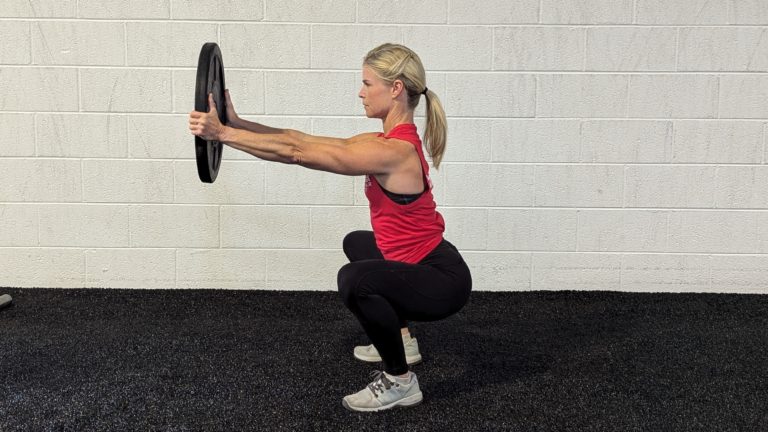
Performing a squat where the athlete holds a plate at arms length away from them, at shoulder height, can be a valuable tool to teach proper core and posterior chain engagement, as well as putting the athlete in a more mature squatting position. The key here is that the athlete is moving slowly and feels the correct positions, so they can try to recreate these more ideal positions when attempting the movement in an unloaded environment or when utilizing load in a more challenging manner (front squat, back squat, etc.).
Regardless of the method used to correct the issue, it is best to have a long-term approach in mind. Consistently practicing the movement, moving at controlled speeds, and focusing on the highest quality movement possible is the prescription for moving in a more ideal manner.
Have a question for a coach? Please submit that here.
 Eric O’Connor is a Content Developer and Seminar Staff Flowmaster for CrossFit’s Education Department and the co-creator of the former CrossFit Competitor’s Course. He has led over 400 seminars and has more than a decade of experience coaching at a CrossFit affiliate. He is a Certified CrossFit Coach (CF-L4), a former Division 1 collegiate wrestler, and a former CrossFit Games athlete.