Question: What’s the best way to teach, coach, and scale toes-to-bars?
July 9, 2025
Question: What’s the best way to teach, coach, and scale toes-to-bars?
The best approach to teaching, coaching, and scaling toes-to-bars is by breaking down the movement into progressive stages. When you break down the movement systematically, the athlete can feel the same muscles working in each position, thus creating the same neuromuscular response. This approach aligns with the philosophy of CrossFit, ensuring that when we tailor the movement properly to each athlete, the response remains similar while giving each individual a sense of ownership and control.
What we look for is a solid progression that each athlete goes through during the warm-up. Once they find a skill level that works for them, they can use the same progression for the workout. During practice, they might advance beyond their workout skill level to test their abilities and honor their individual development. This is where the magic happens — each training session becomes measurable, allowing them to track their progress over time.
Let’s break down the teaching progression:
#1 – Dragon Flags on Rig
At this foundational stage, explain the use of the abs (the flexion of the torso), the engagement of the hip flexors (fueling the legs up toward the bar), plus the push down on the rig to engage the lats. This teaches athletes the three primary muscle groups they need to coordinate for successful toes-to-bar movements.
#2 – Hollow Hold With PVC (add V-up when ready)
Explain the engagement of all the above-mentioned body parts, setting the stage for each progression. This stage introduces a greater range of motion, along with more progressive engagement of the abdominal and lat muscles. The PVC pipe helps athletes understand the target they’re reaching for while building the hollow body position on the ground.
#3 – Hanging Hollow to Arch (add knee lift when ready)
Explain that now the movement becomes more dynamic, allowing for the use of momentum. This may seem simpler to some athletes compared to the PVC V-up. We also add in grip strength and non-supported (meaning off the ground) lat engagement. Place a big emphasis on the push-down into the rig here, as this lat engagement is crucial for the kipping motion.
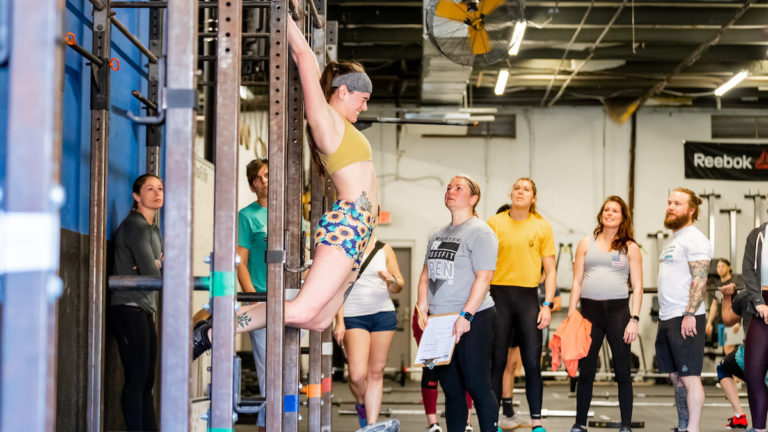
#4 – Banded Low J-Hooks Hollow to Arch (adding knee lift higher each time when ready)
Explain here the control of the kip and rebound, crucial elements for cycling toes-to-bars efficiently. With the band giving immediate feedback in the backswing, athletes learn to control their momentum. Both steps three and four can have multiple progressions, depending on the height of their knees in the kip, providing numerous scaling options for as long as the athlete needs them.
#5 – Copy and Paste – Execute
Explain that now the progression is simply getting the knees higher and higher by getting further and further behind the rig (meaning greater lat engagement or push down on the rig) until the smallest flick of their feet hits the bar. We call this “the flip phone” at our gym (if you’re old enough to remember those ancient devices) — try getting your body to open and close like a V, hence the flip phone analogy.
At this stage, you can add scaling options, such as a single leg or a bent leg vs. a straight leg, based on the athlete’s strength. Go ahead and get creative. When in doubt, have them add in a superhero pose as they come off the bar!
This is by no means the only way to progress the movement, but each progression builds from the one before. Most of the time, an athlete needs to master the movement pattern (in this case, controlling the arch and hollow positions) before moving on to the next stage. What we’re looking for is the classic concept of adaptation. The dictionary defines adaptation as “a change or the process of change by which a species becomes better suited to its environment.”
Toes-to-bars are a high-skill gymnastics movement that, when done correctly, can look and feel awesome. Don’t skimp on the progressions — find a tailoring option that works for your athletes to gain confidence and strength. Then, add volume and intensity!
Have a question for a coach? Please submit that here.

Sarah Coleman loves her fitness community, enjoys playing in the great outdoors (shredding, biking, surfing), is a Certified CrossFit Level 3 Trainer, and hasn’t met a burpee she doesn’t like. She inspires athletes to just show up, and the rest will fall into place. “Your purpose is not the thing you do. It is the thing that happens in others when you do what you do.”