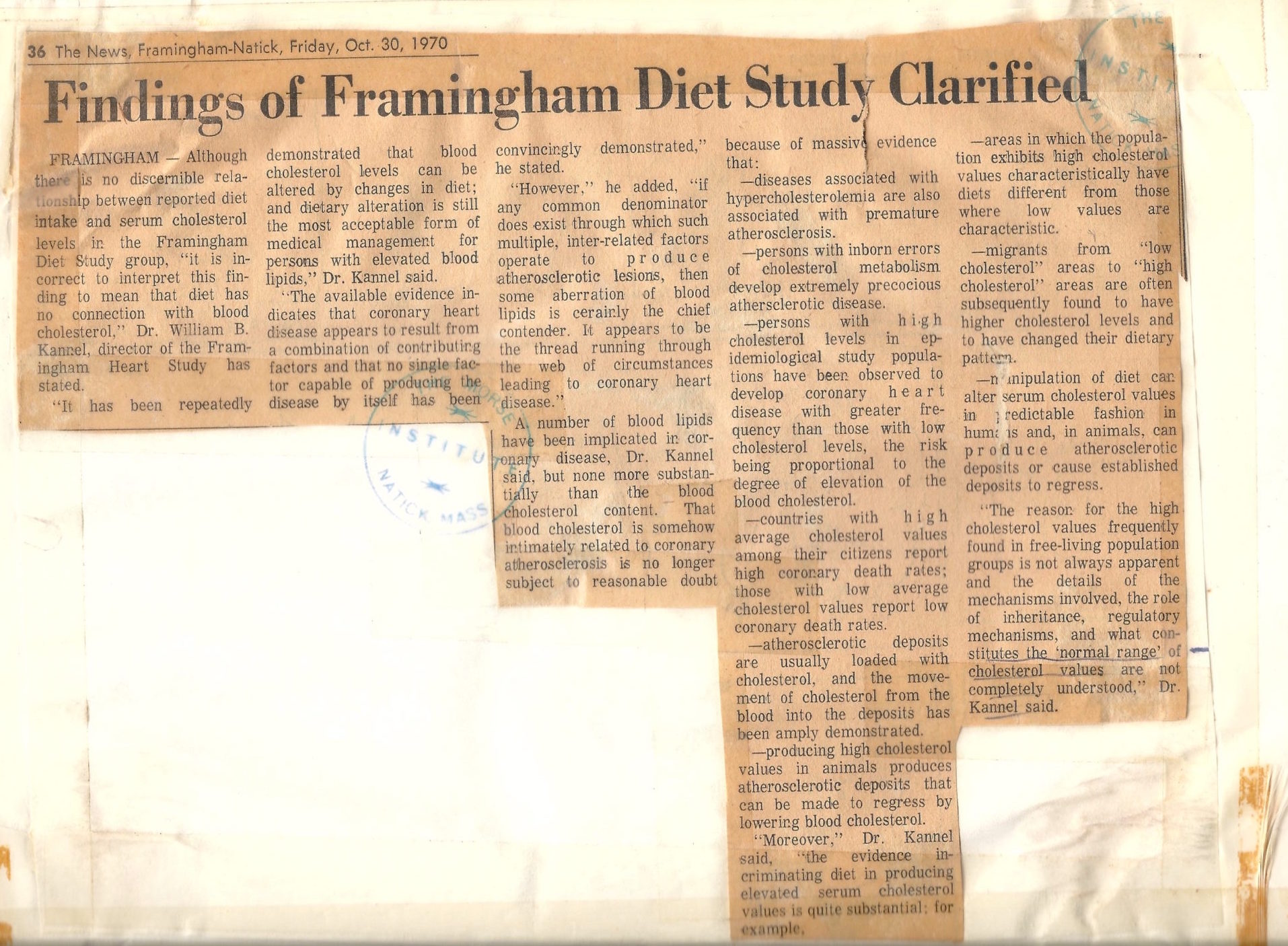
For all its landmark status, the Framingham Heart Study (FHS) was riddled with flaws and inconsistencies in methodology and analysis nearly from its inception. Yet perhaps the most damaging sleight of hand occurred in how the material was presented to the public.
Russell Smith, in his aforementioned treatise “Diet, Blood Cholesterol, and Coronary Heart Disease: A Clinical Review of the Literature,” writes: “Framingham investigators seemed to be objective in their early reports but subsequently exhibited stronger and stronger biases. The use of such terms as ‘powerful’ to describe an exceedingly weak relationship has been commonplace. One kind of bias exhibited was the process of reinterpreting data in order to be consistent with the current position of the alliance (the group providing the funding; i.e., the NHLBI).” (9)
It has become apparent that the bias of the National Heart, Lung and Blood Institute (NHLBI) is that the lipid hypothesis—the idea that cholesterol is the primary driving force behind the development of cardiovascular disease—is a proven fact. To that body, it is not just a hypothesis (and a weak one at best) but hard fact. This strong belief in the lipid hypothesis demands a lowering of cholesterol levels by any means necessary, which usually implies the use of drugs. Consequently, the NHLBI is now arguably the largest pusher of statins on the planet. But we get ahead of ourselves.
In an effort to make the lipid hypothesis more plausible, the NHLBI has resorted to what some consider outright fraud (5,10).
Interpretational Errors
If you study the actual data from the FHS, as I have, you will discover that the association of cholesterol with heart disease is a weak one and holds only for men under the age of 50. Above 50, lower cholesterol levels correlate with increased risk of death—each 1 mg/dL drop per year of cholesterol levels equates to an 11 percent increase in both the overall death rate and the cardiovascular-disease death rate. If cholesterol truly is the driving force behind cardiovascular disease, why would a falling blood-cholesterol level drive an increased rate of death from the very disease it is supposed to cause? That question remains unanswered (11).
Shortly after the publication of the paper showing these statistics, the American Heart Association and the NHLBI published a joint statement summarizing the evidence relating dietary fats, serum cholesterol, and coronary heart disease.
This summary contained the famous statement based on the data from the FHS: “A 1% reduction in an individual’s total serum cholesterol level translates into an approximate 2% reduction in CHD (coronary heart disease) risk.” (12)
The citation for this claim was the above-mentioned paper that showed a relationship between a falling serum-cholesterol level and an increase in the death rate for CHD (11). To be fair, that paper did show an increased risk for CHD, as cholesterol went up in those people under 50. But how could the authors be so definitive in their blanket statement that a 1 percent drop in cholesterol brings about a 2 percent reduction in CHD in all subjects when the reference paper clearly describes just the opposite in subjects over 50?
The short answer: They couldn’t. Yet they did.
Below are a few more examples of misdirection on the part of the NHLBI in regard to the FHS.