The August 2003 CrossFit Journal article, “Functionality and Wall Ball,” is a timeless piece that offers several valuable insights for any fitness enthusiast.
Functionality
Over the years, the term “functional” has been applied to a full range of exercises, from those resembling rehabilitation and physical therapy to exercises using Swiss balls, BOSU balls, and “core” work.
For CrossFit, functional fitness stems from the use of a limited number of fundamental movement patterns, including, but not limited to, squatting, deadlifting, cleaning, lunging, running, walking, jumping, throwing, climbing, and pressing. We’ve known for years that our functional exercises utilize universal motor recruitment patterns, training the fitness skills and movement patterns required to thrive in life beyond the gym. In addition, the potent neuroendocrine response delivered by these functional movements is a key aspect of the tremendous fitness qualities developed through their use.
Cardiovascular Benefits
CrossFit changed the fitness landscape by not separating cardio from weight training as two distinct types of training to be done on separate days. We also don’t rely solely on running, biking, rowing, or swimming for our cardio. In fact, by mixing functional movements performed at high intensity in the daily WOD, we can get a “better, more useful, broader cardiovascular stimulus than any monostructural activity like biking, swimming, or running — even in combinations.”
Our mixed-modality training makes CrossFit the ideal GPP (general physical preparedness) strength and conditioning program. By focusing on running, pressing, jumping, throwing, squatting, deadlifting, lunging, climbing, and Olympic lifting in all three metabolic pathways, in endless combinations, at high intensity, we develop a capacity that leaves us at most several weeks out from good to great performance (strength and conditioning-wise) for nearly any sport or activity. In addition, our fitness prepares us to perform well in competitions that require skills and activities for which we have little or no prior training.
THE WALL-BALL SHOT
The wall-ball shot is an excellent example of a functional movement that can impart tremendous cardiovascular benefits alone or in combination with other movements.
The Wall Ball “begins as a front squat and follows through to a push press/shove that sends the ball up and forward to the target from which it rebounds back to the thrower’s outstretched arms, where it is “absorbed” back into the squat. In its entirety, the wall-ball is quite simply a throw. When perfected, each shot looks identical to the one before, and the ball’s contact and departure are gentle and smooth.”
CrossFit invented the wall-ball shot, and when it is performed in our affiliates, we see good form. Outside of CrossFit, it is very common to see poor squat depth in this exercise. It’s essential to perform this movement correctly for optimal benefits. Follow these points of performance for a great wall-ball shot:
- Each rep begins with a rock bottom squat, with feet flat on the floor.
- Keep the elbows down and in.
- Keep the ball low to the chest.
- Don’t let the ball obstruct the view of the target.
- Launch with a little finger roll and push.
- Make ascending and descending movements the same.
- Minimize breathing and ball contact noise.
- Breathe deeply and attempt to synchronize breathing to shot rate.
The Drill
This article provides a great drill for achieving 150 wall-ball shots in 6 minutes (using a 14/20lb ball to a 9/10foot target). Anyone who hits this standard will not doubt as to just how potent a metabolic conditioning tool the wall-ball shot can be.
To perform this drill, start the clock and see how long you can continue hitting these milestones:
- 30 seconds: 12 shots
- 1 minute: 25 shots
- 1 ½ minutes: 37 shots
- 2 minutes: 50 shots
- 2 ½ minutes: 62 shots
- 3 minutes: 75 shots
- 3 ½ minutes: 87 shots
- 4 minutes: 100 shots
- 4 ½ minutes: 112 shots
- 5 minutes: 125 shots
- 5 ½ minutes: 137 shots
- 6 minutes: 150 shots
Upon failing to hit any milestone, meaning falling behind the pace, we simply stop, rest, and try again. There are tremendous fitness benefits to be gained simply by working toward this goal, so give it a try.
About the Author
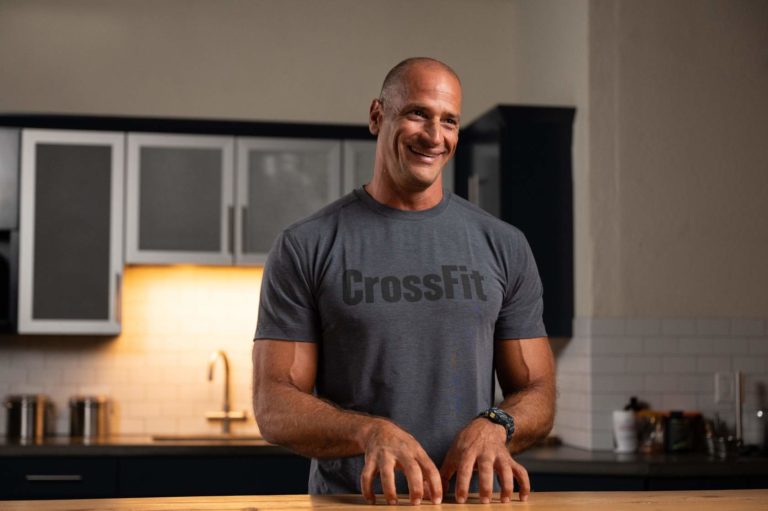 Stephane Rochet is a Senior Content Writer for CrossFit. He has worked as a Flowmaster on the CrossFit Seminar Staff and has over 15 years of experience as a collegiate/tactical strength and conditioning coach. He is a Certified CrossFit Trainer (CF-L3) and enjoys training athletes in his garage gym.