Introducing new habits is hard. Not because you’re undisciplined or unmotivated, but because, ironically, you are a creature of habit. And new habits are disruptive. They introduce uncomfortable changes that are easy to abandon when the opportunity or excuse arises to return to what you know.
Just Know Your Why
Many behavioral change experts say the first ingredient you need for change is a big enough “why.” Whatever it is in your life you want to change — your diet, your fitness regimen, your job, your relationships — needs a reason compelling enough to push you away from the comfort and safety of what you’re currently doing and propel you toward the new actions you need to take to install the new habit.
This process generally requires you to link the change you’re seeking to two powerful emotions: pain or pleasure. If you can understand, visualize, and internalize the deep pain caused by staying where you are instead of adopting the new habit you want, you can find the motivation to overcome the discomfort of change. Similarly, if you can clearly see the enormous pleasure you’ll get by overcoming the discomfort of change and embracing the new habit, you can use this emotion to push you to persist with the necessary actions for change.
This approach can work. I’ve experienced it myself and watched others succeed with it. The formula is clear: constantly revisit your reasons, visualize the pain of staying stuck or the pleasure of breaking free, and use those emotions to push through discomfort. It’s a reasonable investment for meaningful change.
But here’s the reality: it rarely lasts. The same habits that made change difficult in the first place don’t disappear; they wait. Motivation fades. Life gets busy. The daily work of reconnecting to your “why” starts to feel exhausting rather than energizing. And before long, you’re back where you started, frustrated and confused about why something that seemed so clear and compelling couldn’t stick.
Can You Make Change Easier?
I’m not sure you can ever make change easy, but you can use a process that makes it easier and more likely to occur. Just to be up front, this method is designed for creating change slowly and steadily. If you’re looking for a drastic change fast, figure out your “why” (it should be HUGE), and commit all your resources to achieving your goal.
There are times when you know you need to change something in your life, but the “why” doesn’t resonate with you, or it might even scare you. Maybe your doctor tells you that if you don’t change your diet, you’re at significant risk of a heart attack. You certainly don’t want to die, so isn’t survival a big enough “why?” This can get complicated, but denial — “this won’t happen to me” — a strong emotional/social attachment to eating patterns, and body chemistry, can obscure the power of a “why” even as important as survival.
The good news is that behavioral scientists who study change psychology offer us a way to come at change from a different angle. Instead of focusing on and nurturing the emotional “why,” you can focus on the process of change. Quite simply, assess where you are, figure out where you want to end up, and then take the smallest step that will take you toward your goal. I say “smallest” step because this is an absolutely critical piece of creating lasting change — the habits you select to move you toward your ultimate goal must be 9/10 or better in terms of our confidence you can accomplish them and sustain them.
For example:
- If you want to wake up at 5 a.m. instead of 7 a.m., you can shift your alarm by 5 to 10 minutes every few weeks until you reach your goal. Yes, it takes months instead of happening overnight. But compare that to the alternative: setting your alarm for 5 a.m. tomorrow, hitting snooze for two weeks straight, and quitting in frustration. One approach gets you to 5 a.m. eventually. The other never does.
- If you eat 70 grams of protein daily and want to increase this to 130 grams, the change to your meals and grocery shopping is substantial. Trying to do this all at once might be too much. Instead, you can increase your protein intake in 10-gram increments over time and adapt to the change slowly.
- If you want to get your first pull-up, setting up a program that adds 30 minutes of dedicated pull-up practice at the end of every workout might not be sustainable. However, one set of a max-time bar hangs at the end of every workout shouldn’t be too hard to stick to.
Again, the key is to start so small that your reaction to the suggested step is to respond, without hesitation, “Of course I can do that!”
The last piece of this process is to master the current step before moving to the next easy step. You should be able to consistently and easily get up at 6:50 a.m., eat 80 grams of protein, or hang from a bar for a specific target time before moving on to the next small increment. This is a solid, proven path to sustainable change over the long term. Most of us start with a plan that is too hard or too complicated, and we push for progress faster than we should.
Enjoy the journey of improvement. You should celebrate every time you accomplish your easy goal. You should feel pride in mastering this habit and making it part of your life before you nudge forward to the next step. It can be daunting to look forward and see how many steps it will take to get you where you want to be. But the benefit of this method is that it doesn’t take long before you can look back and see how far you’ve come. This is much better than waking up and realizing another year has gone by without you moving at all.
About the Author
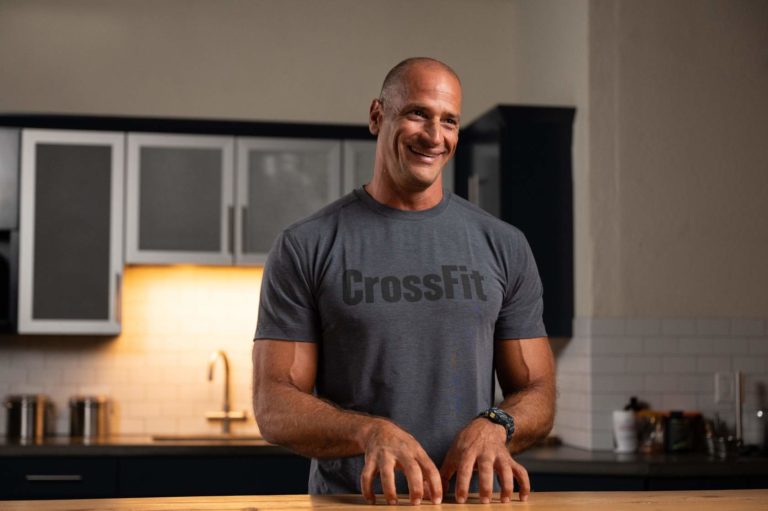 Stephane Rochet is a Senior Content Writer for CrossFit. He has worked as a Flowmaster on the CrossFit Seminar Staff and has over 15 years of experience as a collegiate/tactical strength and conditioning coach. He is a Certified CrossFit Trainer (CF-L3) and enjoys training athletes in his garage gym.