Let’s talk about progressive overload — that fundamental principle of training that says you need to gradually increase the stimulus to keep adapting and getting better.
If you’d rather watch/listen to this conversation, you can do that here.
If you’ve spent any time in traditional strength and conditioning circles, you’ve probably heard the criticism of CrossFit: “Where’s the progressive overload? How can you get stronger without a linear progression?”
It’s a fair question. And here’s the thing: CrossFit absolutely has progressive overload. In fact, it might do it better than any other training system. The catch? It wasn’t deliberately designed that way.
What Is Progressive Overload?
Let’s start with the basics. Progressive overload is increasing the stimulus a little bit over specific time periods, usually weeks or months, to force continued adaptation.
The logic is simple: once you get used to something, it stops causing adaptation. Therefore, you must increase the work or stimulus slightly to encourage your body to continue improving. The goal is to make small enough increments that you avoid plateaus while achieving the highest level of adaptation possible.
Traditional methods are straightforward:
- Increase the weight. Add 5 lb per week to your squat.
- Increase the reps. Hit 10 reps at a weight, then 11, then 12.
- Double progression. Add reps until you reach your target, then increase the weight and reduce the reps back to a lower level.
- Special techniques. Negatives, isometrics, partials, accommodating resistance with bands and chains; there are many ways to manipulate variables.
It sounds scientific. It looks good on a spreadsheet. And for a while, it works great.
Then Reality Hits
Here’s where it gets complicated, for two big reasons:
First, newbie gains disappear. When you start any training program, progress feels magical. You go from the empty bar to 220 lb in six months, and you think, “Hey, at this rate, I’ll be cleaning 440 in another six months, then 600 after that!”
Except that’s not how it works. You plateau. Everyone does.
Second, we’re talking about multidimensional fitness. Once those easy gains are gone, you’re not just adding 5 lb to one lift every week. You’re trying to improve strength across multiple movements, endurance across different time domains, power output, skill acquisition, metabolic conditioning, and the list goes on.
Traditional progressive overload works great when you’re focused on one thing. But fitness isn’t one thing. And that’s where CrossFit’s approach becomes brilliant.
The 10-Year Window
Greg Glassman never explicitly said, “I designed CrossFit to optimize progressive overload.” But he did say there’s a 10-year window of adaptation to CrossFit.
That statement is his answer to progressive overload, a stimulus designed in a way that takes you 10 years to reach your genetic potential of adaptation in the program.
Think about that. Ten years of continuous improvement through constantly varied functional movements performed at high intensity. Not 10 years of adding 5 lb to your squat every week until you plateau in three years.
Why CrossFit’s Approach Works
The criticism from traditional strength and conditioning experts is that CrossFit isn’t linear from week to week. And that’s exactly right. Because we’re not talking about linear progression, we’re talking about using variation to achieve long-term progressive overload.
Here’s what happens in CrossFit that you can’t easily track on a spreadsheet.
When your Fran time drops from 6 minutes to 4 minutes, what actually improved? Sure, your thrusters got stronger and your pull-ups got better. But there are a thousand other adaptations happening:
- Neural pathways from the brain to the muscle became more efficient
- Metabolic systems improved
- Hormonal responses optimized
- Movement patterns refined
- Mental toughness increased
- Recovery capacity expanded
Your 5K time probably got faster. Your deadlift probably got stronger. Your cleans and snatches probably got more solid because you’re using similar movement patterns. But we can’t pinpoint exactly which adaptation came from which stimulus.
And here’s the key question: Do we really care if we understand it, as long as the end result is there?
The Result That Matters
You have CrossFit athletes who can clean nearly 400 lb and do Fran in 2 minutes. That combination is mind-blowing. It shouldn’t be possible, but it happens all the time.
The varied stimuli create adaptations in ways you can’t track individually, but the cumulative effect is undeniable. Instead of obsessing over whether your deadlift increases by 5 lb this week or whether you increase reps on one specific movement, you have all these stimuli coming in from different angles, creating adaptations across multiple domains simultaneously.
The Motivation Factor
There’s another advantage to the varied approach that doesn’t get talked about enough — it’s actually sustainable for 10 years.
A linear approach where you do the same thing week after week with tiny adjustments? That sounds incredibly boring. Most people won’t stick with it long enough to see the full benefit.
But a varied approach where you get to test different capacities, face new challenges, and discover what you’re good at (and what you need to work on)? That’s engaging, keeps you coming back, and makes you actually want to train.
And consistency over time beats the perfect program you quit after six months.
The Secret Weapon: Working on Weaknesses
Here’s another piece of CrossFit’s progressive overload that happens organically: the culture of addressing weaknesses.
If you’re an Olympic lifter and you always miss the jerk, you know you need to work on the jerk. That’s obvious. It’s the same in any sport; you identify the weakness and target it.
But CrossFit makes this discovery process automatic. The varied programming constantly uncovers your weaknesses. You can’t hide from them. Double-unders show up and expose your coordination. Heavy deadlifts reveal strength gaps. Long chippers test your pacing and endurance.
And then, this is crucial, the culture says you should work on those weaknesses.
It’s really hard to program all the different things you need to push yourself forward. But here’s a simple heuristic that works: find your weaknesses through varied programming, then target them more frequently.
That’s progressive overload. Finding something you’re bad at and getting good at it is the most basic example of increasing stimulus to force adaptation.
You don’t need crazy diagrams, complex periodization schemes, or perfectly calculated percentages. Find what you suck at. Work on it. Rinse and repeat for a decade. You’re going to be fit.
The Answer to the Critics
When traditional strength and conditioning coaches ask, “Where’s the progressive overload in CrossFit?” the answer is it’s everywhere, you just don’t understand it.
Progressive overload doesn’t have to be linear; it can be cyclical. It doesn’t have to be trackable in a simple spreadsheet. It doesn’t have to follow a predictable pattern.
CrossFit achieves progressive overload through:
- Constant variation that creates novel stimuli
- Multiple energy systems that are challenged simultaneously
- Skills that are developed across a broad range of movements
- Weaknesses that are exposed and addressed
- Intensity that’s maintained across different time domains
- A 10-year adaptation window that keeps you improving
You can’t isolate which specific workout caused which specific adaptation, but you can look at the athlete who’s been doing CrossFit consistently for years and see comprehensive fitness that would be impossible to develop through traditional linear programming.
The Bottom Line
Progressive overload is about one thing: providing enough stimulus to keep adapting without hitting plateaus.
Traditional strength training does this through linear, measurable progressions in a narrow range of capacities. It works, but it’s limited in scope and often boring enough that people quit.
CrossFit does it through variation, breadth of stimulus, and cultural emphasis on addressing weaknesses. It’s harder to track, but the results speak for themselves.
The 10-year adaptation window isn’t a bug; it’s a feature. It means you have a decade of continuous improvement ahead of you if you stay consistent and honest about your weaknesses.
So the next time someone asks where the progressive overload is in CrossFit, you can tell them it’s in every varied workout that exposes a new weakness, every benchmark that tests improvement across different domains, and every decade-long journey of discovering just how fit a human can become.
About the Author
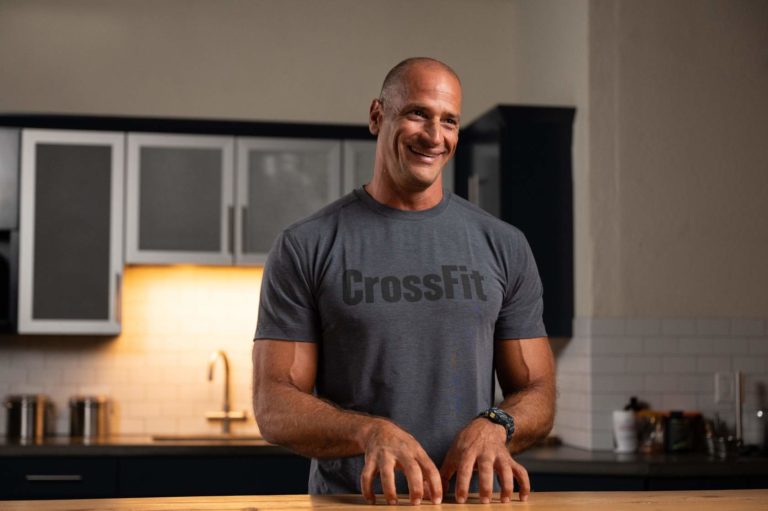 Stephane Rochet is a Senior Content Writer for CrossFit. He has worked as a Flowmaster on the CrossFit Seminar Staff and has over 15 years of experience as a collegiate/tactical strength and conditioning coach. He is a Certified CrossFit Trainer (CF-L3) and enjoys training athletes in his garage gym.