You walk into your gym and see the workout on the board: “Back squat 5-5-5-5-5 at 75%.” Simple enough, right? You punch some numbers into your phone calculator, load up the bar, and get to work.
But here’s something you might not know. Those percentages? They’re more like suggestions than commandments. And understanding why might change how you approach your training.
The Collegiate Strength and Conditioning Origins
Percentage-based programming originates from the world of collegiate strength and conditioning, where coaches must manage thirty athletes simultaneously. It’s a system born out of necessity and organization.
Here’s how it worked: spend four to six weeks teaching mechanics and consistency — starting with air squats and progressing to athletes who can clean, jerk, and snatch. Drill the movements repeatedly until everyone’s competent. Then do what you might call a “soft test.”
Not a real max. Not a grind-it-out-until-your-ears-bleed effort. Just build up to a heavy triple for the day. Maybe it’s actually about 80% of what an athlete could truly do on their best day. But that becomes “the max” for programming purposes.
Then you write your linear progression: 65%, 70%, 75%, 77.5%. Next cycle adds a bit more. Deload after a few weeks. Test again in 12 weeks. Run it back with new percentages.
Organized. Systematic. Scientific-looking.
And ultimately? Those percentages meant nothing.
The Organizational Tool
Let’s be clear: the percentages weren’t meaningless because the system didn’t work. They were meaningless because they were never meant to be absolute rules.
The percentages served one primary purpose: to provide athletes with a starting number to put on the bar. That’s it.
When a group trains together, everyone needs to know roughly what they’re lifting. You can group people by similar weights. You can get the session started efficiently. The athletes have something concrete on their training sheet.
But once warm-ups were done and work sets began — that’s when the real programming happened, through the coach’s eye.
Trust Your Eye (or Your Coach’s Eye)
Here’s what actually mattered: watching the movement.
The paper says 80%, but you’re bouncing up and down like the bar weighs nothing? That’s not really 80%. Add weight.
The paper says 80%, but that one rep looked like the only rep you could possibly get? Adjust accordingly.
This is what makes a great coach valuable. It’s not the ability to calculate percentages — any computer can do that. It’s the ability to see how someone’s moving, understand what the day’s intended stimulus should feel like, and adjust the loading to match.
If the workout is meant to be fast and fluid, keep the percentage lower. If it’s meant to be a grind on those last couple of reps, you may need to adjust the weight, regardless of the percentage indicated in your spreadsheet.
Real-Time Percentages: A Better Approach
Here’s a clever use of percentages that actually makes sense: build to a heavy triple in 15minutes, then use a percentage of that number for the conditioning workout that follows.
Why is this better? Because it’s based on what you did today. Not a test from six weeks ago. Not some theoretical max. What you actually lifted in the past fifteen minutes.
This approach has another benefit: newer athletes who rarely get to do workouts as prescribed might finally hit that Rx’d checkbox. The psychological boost of completing a workout at the prescribed loading is real and valuable.
The Body Weight Alternative
Another common approach is using body-weight multipliers: 1 ½ x body weight for this lift, 1 ¾ x body weight for that one. It’s fun, it gets you in the ballpark, and it’s easy to calculate.
But it has its own issues. Body-weight standards can get skewed as athletes get taller or heavier. A 6-foot-5-inch athlete faces different challenges than someone 5 feet, 5 inches at the same body weight.
Like percentages, body-weight multipliers are useful starting points. Then you fine-tune with your coach depending on the goal for that day.
What Actually Makes You Stronger
Here’s the truth that might deflate some of the spreadsheet enthusiasts: obsessing over whether today should be 75% or 77.5% isn’t what makes you stronger.
There are entire books written about programming percentages, periodization, and strength development. And yes, there’s value in having a plan. But the real value is understanding where you are in the bigger programming picture, and figuring out the weights, volume, sets, reps, and rounds you need to hit the intended stimulus.
The Bottom Line
If you’re following a program with percentages, here’s what you need to know:
Percentages are guidelines, not gospel. They’re an organizational tool to get you in the ballpark. Your actual working weight should be determined by how you’re moving that day.
Trust your coach’s adjustments. If your coach tells you to add or remove weight even though it “should” be a certain percentage, they’re doing their job. They’re watching you move and adjusting for the intended stimulus.
How it feels matters more than what it calculates to. Having a number on paper doesn’t mean anything if the actual training effect is wrong. The goal is to hit the right stimulus, not to hit a specific percentage.
Context changes everything. How much sleep you got, what you ate, stress from work, yesterday’s workout — all of this affects what your 80% actually feels like today. Good programming accounts for this through observation and adjustment, not rigid adherence to calculated percentages.
The Real Skill
At the end of the day, percentage-based training is a tool. Like any tool, its value depends on how it’s used.
Used well, it provides structure and organization. It gives you a starting point.
Used poorly, it becomes a rigid system that ignores the reality of how you’re actually moving and feeling.
The real skill, whether you’re a coach or an athlete, is understanding that the numbers are just the beginning of the conversation, not the end. The workout happens in the gym, not on the spreadsheet.
So, next time you see percentages on the board, load up that starting weight and get ready. But stay flexible. Trust the process. And remember, the best programs are written in real-time, based on what your coach sees happening in front of them.
Because in the end, it’s not about hitting 75% or 77.5%. It’s about getting the right training stimulus to make you better. The percentages are just trying to help you get there.
About the Author
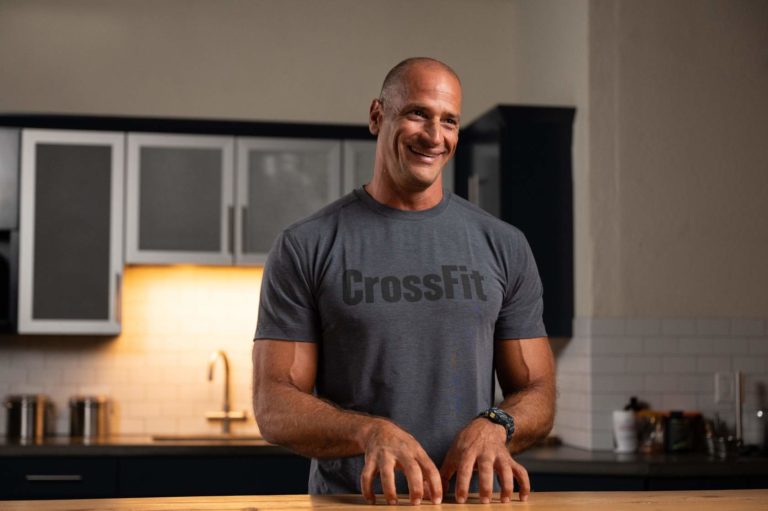 Stephane Rochet is a Senior Content Writer for CrossFit. He has worked as a Flowmaster on the CrossFit Seminar Staff and has over 15 years of experience as a collegiate/tactical strength and conditioning coach. He is a Certified CrossFit Trainer (CF-L3) and enjoys training athletes in his garage gym.