On a recent Rich Roll podcast, Roll’s guest was Dr. Andy Galpin, a well-respected performance coach and researcher. At the very beginning of the interview, Roll asked Galpin, “What is fitness?” and commented that he was asking because discussing fitness requires a functional definition. CrossFit had this very same thought over 20 years ago, and when we went in search of a workable definition, we found, to our dismay, that a suitable one did not exist. So we created our own — more on that in a second.

As I listened to the next few minutes of the interview of Roll and Galpin bouncing ideas back and forth, I felt like I was witnessing what the CrossFit team initially went through as they bandied about words and phrases to come up with a definition of fitness. Galpin made two remarks that directly aligned him with our definition. First, he suggested that “your fitness is your ability to express a power output … or to do something.” Galpin also stated that fitness is an expression of one’s capacity. He’s right there!
But here’s the thing. Had I been sitting in the podcast studio watching these two brainstorm, I would have been sure I was getting punked. I would have been searching for the hidden-camera crew and waiting for the host to walk in, capturing my stunned reaction that these two experts didn’t seem to realize that a concise, measurable, observable, and repeatable definition of fitness already exists, because CrossFit created it over 20 years ago.
Instead of assuming our definition of fitness is common knowledge even among industry experts, we need to keep shouting to the world that we have the definition they need. So here is CrossFit’s definition of fitness. We invite anyone to use it. If you don’t like it, then come up with your own, but ours is really good and really robust.
CrossFit defines fitness as work capacity across broad time and modal domains. This means we measure and compute fitness by the power output an individual can produce across a hypothetically unlimited set of tasks or workouts, across an unlimited number of time domains, from the shortest sprint to the longest challenge we can imagine. It’s a measure of the work an athlete can do in a given amount of time, averaged across all tasks. See how Galpin was right on track?
To support our definition, we have four standards or models that explain what we’ve seen in the real world with hundreds of thousands of athletes, and these models support the reasoning behind our definition.
The Four Models
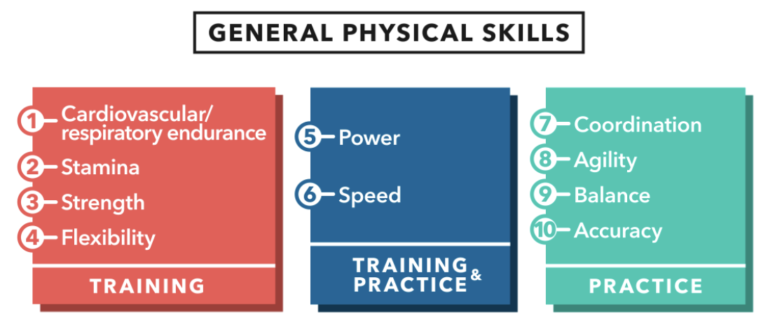
#1 – The 10 General Physical Skills
CrossFit proposes that there are 10 general physical skills any fitness program should develop: cardiovascular/respiratory endurance, stamina, strength, flexibility, power, coordination, agility, balance, and accuracy. An athlete is as fit as they are competent in each of these 10 skills. A program develops fitness to the extent that it improves each of these 10 skills. We want good capacity in all ten skills and balanced capacity across the list.
#2 – The Hopper
The essence of this model is the view that fitness is about performing well at any and every task imaginable. This model suggests your fitness can be measured by your capacity to perform well, in relation to other individuals, at any and all tasks pulled randomly from the hopper. The implication here is that fitness requires the ability to perform well at all tasks, even unfamiliar ones, in infinitely varied combinations. Nature frequently provides largely unforeseeable challenges; we train for that by striving to keep the training stimulus broad and constantly varied.
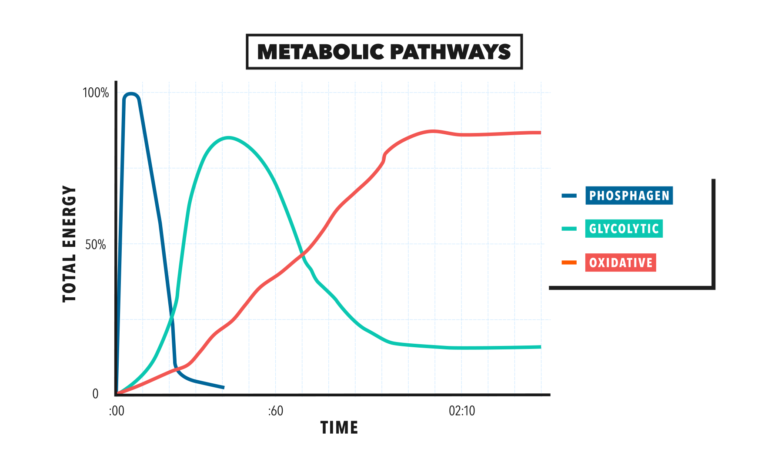
#3 – The Metabolic Pathways
Three metabolic pathways provide the energy for all human action. These “metabolic engines” are known as the phosphagen pathway, the glycolytic pathway, and the oxidative pathway. Total fitness, the fitness that CrossFit promotes and develops, requires competency and training in each of these three pathways. Balancing the effects of these three pathways largely determines how and why we do metabolic conditioning, or “cardio,” at CrossFit. We do not favor one or two pathways to the exclusion of the others, and we recognize the impact of excessive training in the oxidative pathway, which is common in so many other fitness programs.
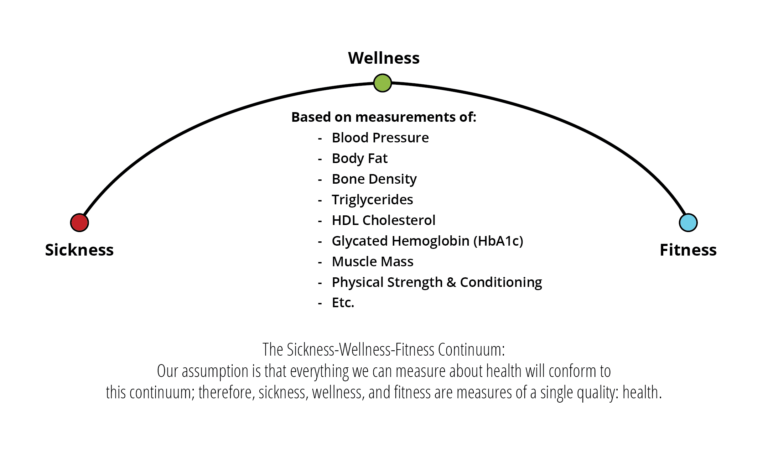
#4 – The Sickness, Wellness, Fitness Continuum
Every measurable value of health can be placed on a continuum that ranges from sickness to wellness to fitness — blood pressure, cholesterol, bone density, body fat, even mental health factors. The point to drive home here is that, done right, fitness provides a significant margin of protection against the ravages of time and disease. Fitness is and should be “super-wellness.” Sickness, wellness, and fitness are measures of the same entity. A fitness regimen that doesn’t support health is not CrossFit.
These standards ensure the broadest and most general fitness possible. CrossFit advocates and develops a fitness that is deliberately broad, general, and inclusive. Our fitness, or being “CrossFit,” comes from molding men and women who are equal parts gymnast, Olympic weightlifter, and multi-modal sprinter, or “sprintathlete.” Develop the capacity of a novice 800-meter track athlete, gymnast, and weightlifter, and you’ll be fitter than any world-class runner, gymnast, or weightlifter. Our specialty is not specializing.
This is a critical piece that is often missed or criticized by others who forget that CrossFit aims to build the healthiest and fittest people over the entirety of their lives. Critics often conflate CrossFit’s methodology with CrossFit Games athleticism — they’re not the same. Walk into any affiliate, and you’ll find the real story: people of all ages and abilities getting stronger, healthier, and more capable for the long haul. That’s the design. Games athletes represent an extraordinary pursuit that extends far beyond what CrossFit prescribes for optimal health and fitness. They train at volumes and intensities that would break most people, chasing a level of performance that, while inspiring, isn’t the goal for the vast majority. Affiliates don’t program for podium finishes; they program for parents, workers, retirees, and everyone in between who simply want to show up stronger tomorrow than they were yesterday, and still be moving well decades from now.
Over 20 years ago, CrossFit delivered to the world the definition of fitness. It works for all types of athletes and can be adapted for any population. It makes it possible to measure current fitness levels, identify weaknesses, and measure improvements or decreases in fitness. No one has offered a better or more useful one. Years ago, we had to define fitness so we could talk about it and compare fitness programs to demonstrate the value of CrossFit. Today, others may spend time creating their own definition because they don’t know ours exists, or because their program does not compare favorably to CrossFit when fitness is properly defined. Hopefully, this article will help solve the former problem. Their latter problem cannot be solved other than by adopting CrossFit.
About the Author
 Stephane Rochet is a Senior Content Writer for CrossFit. He has worked as a Flowmaster on the CrossFit Seminar Staff and has over 15 years of experience as a collegiate/tactical strength and conditioning coach. He is a Certified CrossFit Trainer (CF-L3) and enjoys training athletes in his garage gym.