If you’re stuck at the same back squat weight, seeing the same number on the bar week after week, month after month — you’re not alone. Squat plateaus are frustrating, common, and inevitable for everyone.
Even if you’re relatively new to CrossFit — six months, a year in — you’re probably going to bump up against some kind of plateau in your back squat. That’s just how it works.
The good news? There are relatively easy ways to break through, especially if you’re newer to training. And you don’t have to abandon your CrossFit programming to do it.
If you’d rather watch/listen to this conversation, you can do that here.
The CrossFit Strength Paradox
Let’s be honest about something: if you want to increase your back squat as quickly as possible in a short period, doing a 12-week concentrated Russian Smolov squat routine will get you there faster than just doing CrossFit.
That’s a fact.
But here’s the other side of that coin: if you just do CrossFit over time — years, not weeks — you’ll probably end up with a higher squat than if you stayed in endless squat specialization cycles. And, you won’t be bored.
Why? Because when you do a variety of things, you build many strength qualities and athletic attributes that help you squat better. Core stability. Hip mobility. Unilateral leg strength. Mental toughness. Postural control.
It just takes time for those qualities to manifest.
You Don’t Need a “Strength Cycle”
There was once a lot of discussion in the CrossFit community about the need for a “strength-biased program” or a “strength cycle” when a plateau is reached.
You don’t need to do that.
You can address your squat plateau right within your regular workouts. A good coach will assess your back squat technique, diagnose the reason for your struggles, and prescribe a remedy — all without disrupting your overall training.
And if you’re training in your garage without a coach? There are some common issues you can identify and fix yourself.
Common Issue #1: Upper Back Rounding
This is probably the most common squat plateau culprit.
You’re going down in the back squat, you drive through the ground, and what gives out? Your upper back rounds. You tip forward. You get stuck there. You either rack the bar on the pins or drop it.
If this is your issue, you need to build upper-back strength. Here’s what to do:
Substitute front squats for back squats for a period of time.
When a heavy squat day comes up, consider doing front squats instead. The rack position will develop tremendous strength in your upper back.
Spend a couple of months building up your front squat. When you return to back squats a few months later, you’ll have a much better upper-back position and be able to handle more load.
This is the first thing to try. It works.
Alternative: Use a safety squat bar if you or your gym has one. The padded yoke mimics the upper-back demands of the front squat. That’s literally why it was built.
Common Issue #2: Weak Point in the Range of Motion
Maybe your upper back is fine, but you have a specific point in the squat where you consistently get stuck. This is where paused squats and box squats come in.
Paused squats force you to develop strength at your weak point. Go down to where you struggle, pause for 3-5 seconds, then drive up. You’re building strength exactly where you need it while also improving your ability to stay tight under load.
Box squats work similarly but with a physical reference point. Set the box at the height where you struggle. Squat down to the box, pause briefly, then explode up. The box gives you a consistent depth to work from and teaches you to generate power from a dead stop.
Both of these can be programmed on regular squat days. Just use them instead of your standard back squat for a few weeks.
The Power of Tempo Squats
Tempo squats are underused for breaking plateaus.
Try this: 10 seconds down, 10 seconds up. Or 5 seconds down, 5-second hold at the bottom, 5 seconds up.
The weight will be ridiculously light — you might be at 65 lb for these when you normally squat 225. That’s fine. The point isn’t the weight.
When you slow down the rep, you feel every inch of the squat. You become intimately aware of where you lose tension, where your position breaks down, and where you compensate.
Super slow squats also teach you body control and position awareness that transfers immediately to normal-speed squats. Plus, they’re excellent for tendon and ligament health.
There was a period on CrossFit.com years ago where they programmed variations like:
- 3 sets of 21 back squats with varying schemes (power squats, bottom-to-bottom squats, and super slow squats)
- Progressive tempo squats: 5-5-5, then 10-10-10, then 20-20-20, then 30-30-30
These workouts were brutal. And they worked.
The Single-Leg Solution
Here’s something that helps bust through plateaus even though we can’t fully explain why: heavy single-leg work.
If you’re hitting a wall with back squats, take a three- or four-week block where you step away from bilateral squatting and work single-leg movements instead:
- Reverse lunges
- Pistols
- Rear-foot elevated split squats (Bulgarian split squats)
Load them up. Go decently heavy with good technique.
Keep all the lunges that show up in your regular programming. But on the days when heavy squatting appears, substitute one of these loaded single-leg movements.
Why does this work? It’s somewhat of a black box. Probably neurological to some degree. Probably mechanical. However, it appears to consistently help improve and bust through back squat plateaus.
And if your numbers are improving on heavy single-leg work, there’s almost certainly going to be a transfer to your back squat.
Varying Rep Schemes
Don’t just stick with sets of 3 and 5. Mix it up.
Try 20-rep back squats. Try Tabata squats (though your soul might leave your body). Try max reps at a moderate weight.
Different rep ranges challenge your body in different ways. High-rep squats build muscular endurance and mental toughness. They also force you to maintain position under fatigue, which has huge carryover to your heavy work.
Variety in rep schemes is its own form of progressive overload.
The Key: Work Within Your Programming
Here’s what makes all of this practical: you can insert these techniques into regular CrossFit programming without missing a beat.
You don’t have to say, “OK, well, I now have to go on a strength-bias program” or “I have to focus exclusively on squatting for 12 weeks.”
When the back squat comes up in your workout and you’re stuck, just change some things. Substitute front squats. Add pauses. Slow down the tempo. Do single-leg work instead.
Nothing else takes a backseat. You’re still doing your conditioning. You’re still hitting all your movement patterns. You’re still building broad, general fitness.
You’re just addressing your squat weakness within the context of your current programming, not by abandoning everything else to focus on one area.
When We Say “Work on Your Weaknesses”
This is important to understand: when CrossFit says “work on your weaknesses,” it doesn’t mean drop everything else and only focus on that weakness.
It means addressing your weakness within everything you’re doing.
If your back squat is stuck, don’t stop doing everything else to work on your squat every day. Make intelligent substitutions and modifications within your existing program. Do the variant work on squat days. Keep lunges when they show up. Stay consistent with everything else.
That’s how you get constant progress moving forward. That’s how you achieve what CrossFit calls elite fitness: by addressing weaknesses without creating new ones through excessive specialization.
The Long Game
Remember: CrossFit builds strength differently than specialized programs, but it builds it nonetheless.
The variety of movements, the different time domains, the constantly varied stimulus — all of this contributes to your squat in ways that aren’t immediately obvious. Your core gets stronger from L-sits. Your posterior chain develops from kettlebell swings. Your mental toughness improves from brutal metcons.
These qualities take time to manifest in your squat, but they do manifest.
So if you hit a plateau, don’t panic. Don’t think you need to abandon CrossFit for a powerlifting program. Just make some smart adjustments within your training:
- Upper back weak? Front squat for a while.
- Weak point in the range of motion? Paused squats or box squats.
- Need body awareness? Tempo squats.
- Stuck for no clear reason? Try heavy single-leg work.
- Getting stale? Vary your rep schemes.
Allow each adjustment four to eight weeks to take effect. Be patient. Stay consistent with everything else in your training. Then come back to your back squat and watch what happens.
About the Author
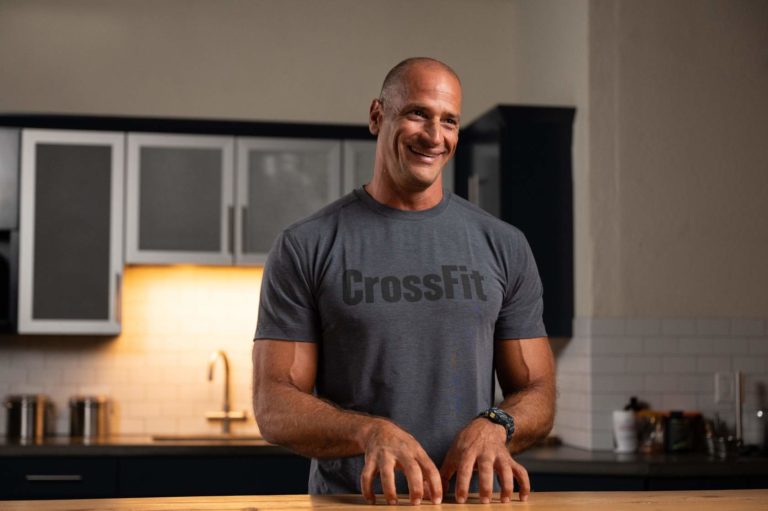 Stephane Rochet is a Senior Content Writer for CrossFit. He has worked as a Flowmaster on the CrossFit Seminar Staff and has over 15 years of experience as a collegiate/tactical strength and conditioning coach. He is a Certified CrossFit Trainer (CF-L3) and enjoys training athletes in his garage gym.