I have to applaud Andrew Hiller for his response to and balanced criticism of Peter Attia’s recent podcast on training for longevity with Mike Boyle, Gabrielle Lyon, and Jeff Cavaliere. Hiller did an especially good job addressing the discussion in which Mike Boyle recommended replacing back squats with single-leg lower-body movements, such as split squats and lunge variations, because back squats are a source of back pain for many trainees. I agree with Hiller that such statements are not innocuous and can lead people to make decisions that will negatively impact their health and fitness.
Everybody Should Squat
In CrossFit, the air squat is the foundational movement. The functionality of the air squat is obvious anywhere we need to raise our center of gravity from a seated to a standing position — getting off the toilet, out of the car, or off the couch. Anyone who cannot air squat with the full range of motion is functioning at a fraction of their athletic capacity. The air squat is also the foundational skill and gateway movement to back squats, front squats, and overhead squats. We insist our clients squat correctly, and we know from years of experience that their difficulty in squatting exactly describes their need.
In our daily efforts to build work capacity, we need to learn, refine, and master all types of squats, including air squats, plate squats, goblet squats, back squats, front squats, overhead squats, single-leg squats, split-squat variations, lunge variations, and step-up variations. We want all of these movements to consistently rotate through our programming so we can practice them and develop and maintain full ranges of motion.
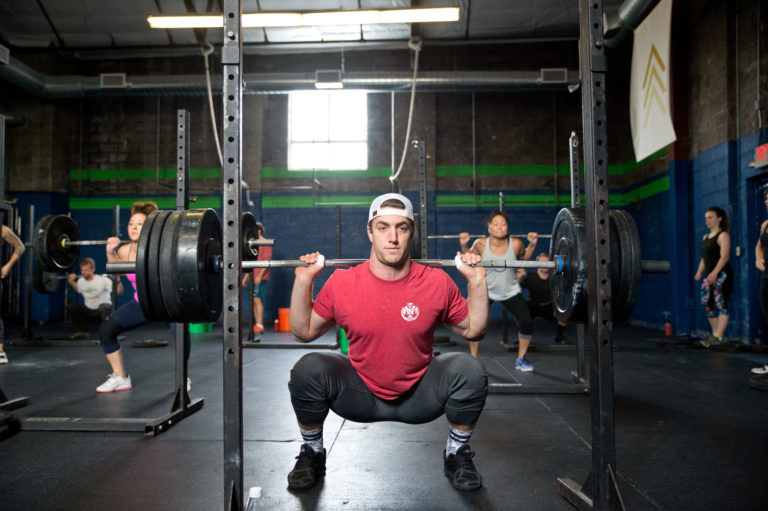
Over time, when the opportunity arises, we want to increase the weight to increase our capacity. This needs to be done judiciously, however, because it is often during our pursuit of benchmarks such as a 200-, 300-, 400-, or 500-lb squat that technique and range of motion degrade, leading to the knee or back pain blamed on squats instead of correctly attributed to the poor decisions and application of the coach and lifter.
The CrossFit mindset holds that, rather than abandoning back squats when we feel back or knee pain, we review exactly what we are doing and determine what needs to be fixed or scaled. Squats are an orthopedically sound way to move when done correctly; if we’re feeling pain, we’re most likely doing something wrong. This is a great time to lighten the load and practice, practice, practice. There is a significant benefit to attempting to squat perfectly with lighter loads — far more than omitting squats entirely and relying on single-leg movements. We don’t toss critical functional movements. We hold on to them. We have no problem scaling them down to PVC pipe and moving them to warm-ups, cool-downs, and practice sessions, but we don’t abandon them. Quitting two-legged squatting entirely would be a huge blow to our overall capacity.
As we reduce loading on squats to practice and refine technique, it is a good time to make sure we are following a suitably broad fitness program. Are we doing the presses, deadlifts, calisthenics, Olympic lifts, varied conditioning methods, and core work to provide the overall structural development and fitness to support the type of squatting we’re doing? As Hiller noted, maybe back pain from back squats comes when we don’t deadlift and lack the back strength to support the loads we want to squat.
To be fair to Boyle, most of his career has been spent coaching high-level collegiate and professional athletes. For these athletes, there might be a time, especially in-season, when any movement that causes pain and negatively impacts competition performance needs to be removed from the program. Although I might manipulate load and range of motion to see if I could find a non-provocative version as a new baseline to build from. If the movement is replaced altogether, this should not be a permanent decision. Once the athlete’s competition season is over, a priority should be to reintroduce the movement at loads and ranges of motion that cause no pain and progress from there. This long-term view for (re)building capacity is critical for a long career and peak performance.
As athletes, we need to understand our own strengths and weaknesses in the weight room. All athletes should do all types of squats regularly, but this does not mean their movement patterns or loading parameters will be the same.
For example, a tall, lanky athlete and a stouter, shorter athlete will both benefit greatly from including back squats in their program. Both need to strive to master the points of performance and nuanced technical elements of the squat, including moving through a full range of motion. However, the shorter lifter, most likely displaying a more classical squat pattern, will probably move more load than the taller athlete. For the taller lifter to sacrifice technique and range of motion to match the loads of his shorter counterpart is a recipe for back or knee pain. Again, the error is in the application, not the movement itself.
During over 20 years of coaching, I have seen world-champion sprinters back squat over double bodyweight for explosive pause reps, world-record throwers cut their back squat loads in half and set new records, and thousands of athletes use infinite set, rep, and loading schemes in the back squat to increase power and speed, gain muscle, and overcome injuries. None of these athletes had time for, or would have tolerated, back pain that affected performance — they squatted to improve performance. When properly applied, back squats are a tremendous tool in our fitness arsenal.
Think For Yourself
I hope Hiller’s arguments and the points made here will help anyone pondering how to proceed with their health and fitness program use critical thinking rather than being swayed by experts making blanket statements and overreacting. Listen to what others say, but realize they know nothing about your situation. Only you and your coach can decide what the best approach is for achieving your goals. When it comes to squats specifically for health and fitness, our recommendation is to squat more, more often.
About the Author
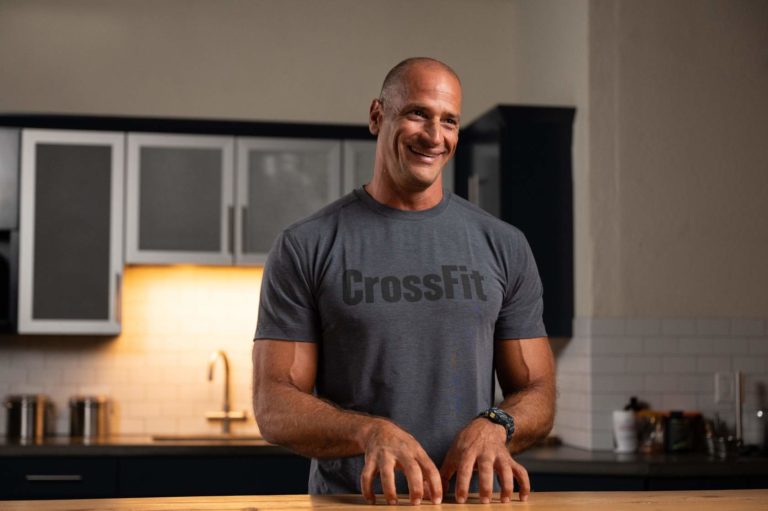 Stephane Rochet is a Senior Content Writer for CrossFit. He has worked as a Flowmaster on the CrossFit Seminar Staff and has over 15 years of experience as a collegiate/tactical strength and conditioning coach. He is a Certified CrossFit Trainer (CF-L3) and enjoys training athletes in his garage gym.