Caffeine is the world’s most widely consumed (and beloved?) psychoactive substance. It is a naturally occurring alkaloid found in coffee beans, tea leaves, and cacao pods. It is the star of morning routines, the cause of withdrawal headaches, the persistent enemy of bank accounts, and the fuel that drove the entire industrial revolution. And of course, caffeine is the crown jewel of athletes everywhere, seeking a performance edge. But does the research support its anointed status when it comes to CrossFit workouts? Let’s dive in.
What Is Caffeine, and What Does It Do?
Legend has it that coffee was first discovered over a thousand years ago by an Ethiopian goat herder named Kaldi. He noticed his goats became unusually energetic, dancing, bleating, and refusing to sleep, after nibbling on bright red berries from a certain shrub. Curious, Kaldi tried the berries himself and felt the same invigorating buzz. Local monks later brewed the berries into a drink that helped them stay awake during long nights of prayer, and word of the stimulating “bean” spread across Arabia, Europe, and eventually the world. [Note: For a fascinating history of the influence of coffee throughout human history, check out Michael Pollan’s Audiobook “Caffeine.”]
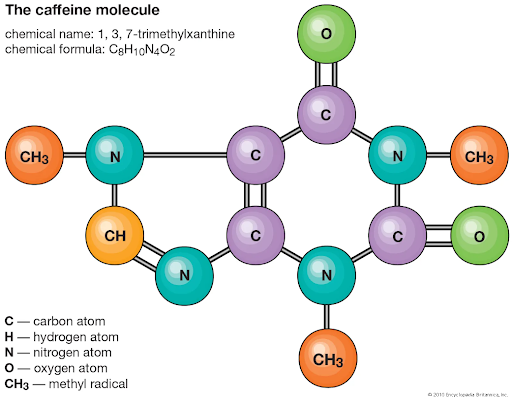
Source: Encyclopædia Britannica
The discovery of the actual molecule of caffeine itself dates back to the early 19th century, when the German chemist Friedlieb Ferdinand Runge isolated it from coffee beans. His friend, the poet Johann Wolfgang von Goethe, handed Runge a bag of exotic beans and asked him to “analyze their secrets.” That curiosity-driven experiment would eventually fuel more than a century of research into caffeine’s performance-enhancing potential, from Olympic sprinters to CrossFit athletes.
The stimulating effects of caffeine come primarily from its ability to block adenosine receptors in the brain. As a byproduct of staying alive and making energy, adenosine builds up over the day, which slows nerve activity and induces drowsiness. Eventually, you go to sleep, and the nighttime cleaning process of the brain clears it away. When caffeine occupies the receptors, however, it prevents adenosine from binding, thereby blocking the drowsiness signal. It also triggers a mild rise in adrenaline and dopamine, enhancing both mental focus and physical readiness.
Dosage Amounts in Common Use
Before we dive into the research, it’s important that we have a reference point for the amounts of caffeine we will see being tested.
Amount of caffeine in common consumption:
- 8-oz cup of green tea: 30-50 mg
- Scoop of Strong Coffee: 110 mg caffeine
- Grande Starbucks: Pike Place 310 mg / Blonde roast 360 mg
- Shot of espresso: 75 mg for reg roast / 85 mg for blonde roast
- Caffeine pill: 200 mg
- Cellucor C4 pre-workout (most standard pre-workouts): 200 mg
In the studies, we will see low, moderate, and high doses of caffeine, always dosed at mg per kilogram of body weight. As a reference, here’s what those dosages look like for a 60-kg individual and an 85-kg individual.
| 60kg (132 lb) | 85 kg (187 lb) | |
| 3 mg/kg | 180 mg | 255 mg |
| 6 mg/kg | 360 mg | 510 mg |
| 9 mg/kg | 540 mg | 765 mg |
What the Research Says About the Benefits
Study No. 1 – Low, Medium, and High Doses of Caffeine Before Fight Gone Bad
Citation:
Główka N, Malik J, Podgórski T, et al. The dose-dependent effect of caffeine supplementation on performance, reaction time and postural stability in CrossFit – a randomized placebo-controlled crossover trial. J Int Soc Sports Nutr. 2024;21(1):2301384. doi:10.1080/15502783.2023.2301384
Who was tested:
Twenty-six “moderately trained” CrossFit athletes, all in generally good health. Ten females, 16 males, with an average age of 35 years old, and all had a minimum of two years of CrossFit experience, attending at least four times per week.
The athletes were prescreened for genes known to affect caffeine metabolism to see if there was any genetic influence in the results.
What was tested:
The workout test was Fight Gone Bad.
5 rounds for max reps, 1 minute at each station:
Wall-ball shots (6 kg/9 kg to 2.75 m/3 m)
Sumo deadlift high pulls (25 kg/35 kg)
Box jumps (50 cm/60 cm)
Push presses (25 kg/35 kg)
Row calories (damper 7)
1-minute rest
Additionally, the participants were assessed for reaction time in a test where they had to push a button as soon as they saw a light flash on a screen, and postural stability, where they had to stand on one leg on a force plate, which captured weight shifts across the foot. These tests were conducted before and after the Fight Gone Bad workout.
Additionally, the heart rate of the athletes was monitored throughout the workout, and they were asked to provide a “rate of perceived exertion” subjective rating after the workout was complete.
Blood samples were also collected to measure pyruvate and lactate concentrations, both indicators of energy metabolism and exercise-induced metabolic stress.
How was it tested:
The test conditions were
- Placebo
- 3 mg of caffeine per kg of body weight
- 6 mg of caffeine per kg of body weight
- 9 mg of caffeine per kg of body weight
All the participants completed all the above-listed tests in what’s known as a “crossover design,” with a one-week washout period between. Neither the athletes nor the researchers knew which conditions were being tested or in which order (known as “double blind”).
What were the results:
Tl;dr – The caffeine did not improve performance in any meaningful way
| Placebo | Low dose (3 mg/kg) | Medium dose (6 mg/kg) | High dose (9 mg/kg) | |
| FGB Score: | 289 ± 66 | 290 ± 55 | 294 ± 57 | 293 ± 67 |
None of the caffeine doses (3, 6, or 9 mg/kg) produced statistically significant differences versus placebo in: the total score on Fight Gone Bad, the athletes’ max or average heart rate, their Rate of Perceived Exertion, the pre/post reaction time, postural stability, or pyruvate concentration.
The caffeine-associated genotype (CYP1A2 or ADORA2A) had no observable effect on performance outcomes in this group.
Lactate concentrations before and after exercise were significantly higher in all caffeine conditions compared to placebo, indicating muscles were working harder and relying more on the glycolytic pathway to produce ATP.
Study No. 2 – High-Dose of Caffeine Before a Strength-Stamina Workout
Citation:
Konidari Z, Smilios I, Mougios V, Bogdanis GC. Effects of an Acute High Dose of Caffeine on Physiological Responses and Performance During a Strength-Focused CrossFit® Workout: A Randomized, Double-Blind, Crossover Study. Nutrients. 2025;17(9):1419. Published 2025 Apr 23. doi:10.3390/nu17091419
Who was tested:
Twelve healthy men with an average age of 29 years and roughly five years of consistent (several times per week) CrossFit training experience participated in the study.
What was tested:
The workout test was:
4 rounds of 50 seconds of max reps with correct technique, 10 seconds of rest:
Push-ups
Power cleans (40% of body weight)
Front squats (50% of body weight)
Sit-ups
Deadlifts (60% of body weight)
Blood lactate was measured before and immediately after the workout, heart rate was measured throughout the workout, and athletes were again asked to provide a subjective rate of perceived exertion (RPE) after the workout.
How it was tested:
This was a randomized, double-blind, crossover design, meaning that all participants completed the workout twice, once after taking caffeine and once after taking a placebo, with at least a one-week washout period between sessions. In the caffeine condition, athletes consumed an anhydrous caffeine pill at a dose of about 7 mg per kilogram of body weight (roughly equivalent to four to five strong cups of coffee) taken 60 minutes before the workout. The placebo condition used an identical-looking tablet that contained no caffeine.
What were the results:
Tl;dr – Caffeine did not improve performance in this CrossFit workout.
The total number of reps completed was nearly identical between caffeine (381 ± 56) and placebo (386 ± 48) conditions. When broken down by exercise, caffeine had no effect on push-ups, power cleans, front squats, or deadlifts. Interestingly, performance in sit-ups slightly declined under the caffeine condition, with participants averaging fewer repetitions in the final round compared to placebo.
Blood lactate levels rose sharply from rest to post-exercise in both conditions, showing that the workout was indeed high-intensity, but caffeine did not make any difference in lactate response. Heart rate and RPE were also unaffected. Notably, 67% of participants reported at least one side effect after caffeine ingestion, most commonly gastrointestinal discomfort, compared with only 25% reporting side effects after placebo.
Study No. 3: Moderate Dose of Caffeine Before 1-Rep Max and Max Reps at 60% Back Squat Tests
Citation:
M.L. Caetano, M.L.R. Souza, L.L. Loureiro, V.L.M. Capistrano Junior. The effects of acute caffeine supplementation on performance in trained CrossFit® athletes: A randomized, double-blind, placebo-controlled, and crossover trial. Science & Sports, Volume 38, Issue 7, 2023, Pages 701-707, ISSN 0765-1597, https://doi.org/10.1016/j.scispo.2022.04.007.
Who was tested:
Eight generally healthy, well-trained male CrossFit athletes participated in the study. On average, they were 30 years old, weighed about 81 kg, and all had multiple years of consistent CrossFit training experience.
What was tested:
Participants first performed a 1-rep max (1RM) back squat test to establish load. Then they completed a muscular endurance test using ~60% of their 1RM load for as many repetitions as possible.
How it was tested:
This was a randomized, double-blind, placebo-controlled crossover design. Each athlete completed two testing sessions separated by a one-week wash-out. In one session, they took a placebo, and in the other, they ingested caffeine at 6 mg per kg of body weight about 60 minutes before the workout. This amount is equivalent to about five to six shots of espresso.
What were the results:
Tl;dr – Caffeine improved muscle stamina, but did not increase the 1RM back-squat load.
Athletes completed more reps in the 60% of 1RM max-rep test after taking caffeine vs. the placebo — average of 37.8 reps vs. 31.4 reps, respectively. This result did achieve statistical significance. However, there was no meaningful difference in 1RM back-squat performance with caffeine vs. placebo.
Wrap Up
Across all three published studies examining caffeine and CrossFit performance, the evidence is surprisingly underwhelming. Despite caffeine’s well-established benefits in endurance and power sports, the data in CrossFit-style workouts show little to no consistent improvement in total work performed, strength, or perceived exertion. When benefits do appear, they tend to be modest and task-specific, such as slightly higher reps in a local muscular endurance test, but fall short of the sweeping ergogenic effects often claimed in popular fitness media.
It’s worth noting that these studies were small, typically including between eight and 26 participants, and almost entirely male. Most subjects were also young, well-trained athletes, which limits how much we can generalize these findings to recreational CrossFit athletes, female athletes, or older populations. The workouts tested — Fight Gone Bad or isolated strength protocols — represent only a small slice of what CrossFit training entails, and dosing protocols (3-9 mg/kg) may not reflect how athletes commonly use caffeine in real life.
Finally, while caffeine is legal, accessible, and generally safe in moderate doses, it’s not without drawbacks. Timing matters. Caffeine’s half-life is long (often five to eight hours), so preworkout doses taken later in the day can disrupt sleep quality and recovery. For athletes training in the afternoon or evening, this can subtly undermine the very performance gains they’re trying to achieve. Taken together, the current evidence suggests that caffeine may offer a small edge for certain workouts but is far from a guaranteed performance enhancer in CrossFit, and its costs, especially to sleep and recovery, should be weighed carefully against its potential benefits.
LEARN MORE
Caffeine is the most widely used psychoactive substance in the world, and it is deeply embedded in fitness culture. Coffee, pre-workout, and energy drinks are often treated as essential tools for training and performance.
But what does the science actually say?
In this episode of the CrossFit Podcast, host Jocelyn Rylee sits down with sleep scientist and active duty Army neuroscientist Dr. Allison Brager to examine the relationship between caffeine, sleep, recovery, and performance.