An infamous sales tool of shady retail outlets called “bait and switch” lures customers in with the offer of a deal so good they can’t resist, and once they’ve taken the bait, switches the item in question to a higher-priced alternative. It’s an age-old trick of double-dealing, but it isn’t limited to cheap furniture outlets. It’s also a sleight of hand employed in scientific research.
Moving the Goal Posts
Take, for example, the issue of the lipid hypothesis, dating back to the original Framingham Study. At the outset, no one had a clue about what was actually causing heart disease, and scientists rightly attempted to determine what the cause or causes might be—answering such questions is what science is supposed to do, after all. Cholesterol was investigated as a culprit in part because it seemed like it might play a role; there was cholesterol in the plaque found in diseased coronary arteries, and it was something quantifiable. But despite their best efforts, researchers could find no significant connection between cholesterol and cardiac disease other than an association between the two, which, of course, does not prove causality.
Even then, the data cast doubt on the hypothesis that cholesterol is the culprit behind heart disease. Nevertheless, the myth took hold and the decades-long quest to prevent and cure cardiovascular diseases through aggressive cholesterol lowering began. It’s important to note here that the endpoint being sought from the outset was a reduction in disability and deaths from heart disease.
Cue the discovery of statins, which act to inhibit the body’s rate-limiting step in the cholesterol production pathway: HMG-coenzyme-A reductase. Early studies proved the drugs did their enzyme-inhibiting job and indeed lowered cholesterol, but the studies failed to show that such lowering actually significantly reduced risk of death from heart disease. When there was a very slight reduction in heart disease mortality, the studies also failed to reveal a reduction in all-cause mortality—meaning that maybe people weren’t dying of heart attacks but more often of something else. All the same, they reached an unfavorable endpoint. And this was widely known. Notice the magnified text inside the white box in this ad from 2005:
-
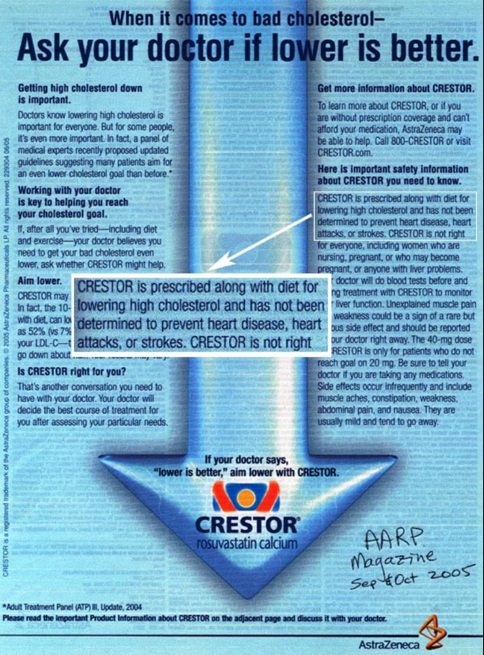
Figure 1