This case series reviews the experiences of three diabetic patients treated at the Intensive Dietary Management clinic in Toronto. All patients were male, ages 40 to 67, with long-term diabetes (10 to 25 years), and all were receiving multiple diabetic medications, including insulin, at baseline. Each patient agreed to follow an intermittent fasting protocol (two patients completed alternating-day 24-hour fasts, while the third followed a triweekly 24-hour fast schedule) in which, in addition to fasting, all meals consumed were directed to be low-carbohydrate to minimize glucose and insulin response. On fasting days, patients only ate dinner; on non-fasting days, they ate lunch and dinner. This protocol was explained during a six-hour nutritional training seminar at study initiation, and patient follow-up visits occurred every two weeks thereafter. Patient 1 followed this diet for seven months, while patients 2 and 3 followed it for 11 months.
The HbA1C responses of patients 1 (40 y/o, T2D for 20 yrs, baseline HbA1C 11), 2 (52 y/o, T2D for 25 yrs, baseline HbA1C 7.2), and 3 (67 y/o, T2D for 10 yrs, baseline HbA1C 6.8) are provided in the figures below.
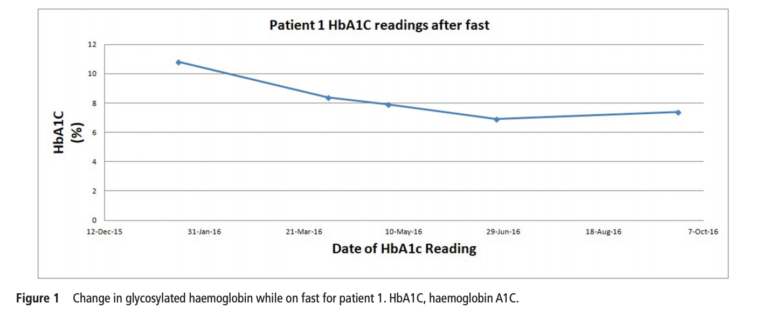
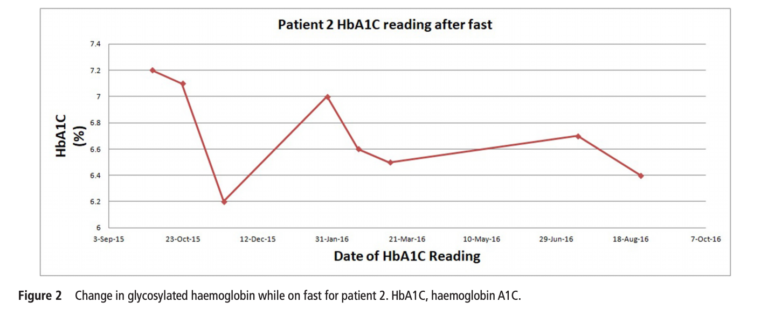
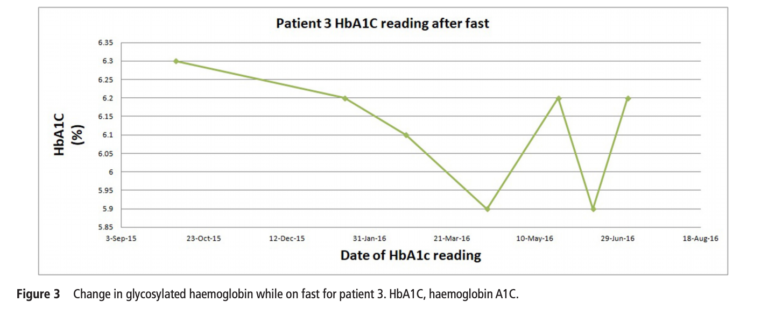 All three patients were able to discontinue insulin less than a month after beginning the regimen, with patient 1 discontinuing insulin five days after therapy began. All patients also saw a decrease in other diabetic medications, with patients 2 and 3 discontinuing all medication and patient 1 discontinuing three out of four medications. HbA1C decreased from 11% to 7%, 7.2% to 6%, and 6.8% to 6.2% in patients 1, 2, and 3, respectively. All patients lost at least 10 kg.
All patients found the diet tolerable and gave positive assessments of how they felt: Patient 1 felt “excellent” on fasting days, patient 2 felt “terrific,” and patient 3 found fasting “easy” and reported higher energy levels.
Overall, the case series illustrated that an intermittent fasting regimen, paired with a low-carbohydrate diet on non-fasting days, can lead to significant improvements in blood glucose levels (as measured by HbA1C) and diabetic condition (as evidenced by the observed reduction in medication), even in long-term diabetics. Future research could build on this by testing different fasting and patient engagement protocols to identify the most efficacious methods for using fasting to control and reverse diabetes.